Search for a travel pill organizer and the results mix five products that solve different problems: a weekly box with a cell per dose, a small sealed case sorted by pill type, a binder of labeled pouches for trips longer than a week, a metal tube stack for places where plastic breaks, and a bag that holds your prescription bottles exactly as the pharmacy handed them over. The question that sorts them is not which is best. It is how long the trip is, how many times a day you dose, and whether what you are carrying is vitamins or prescriptions — because that last one changes the answer completely.
The five shapes, and what each one is for
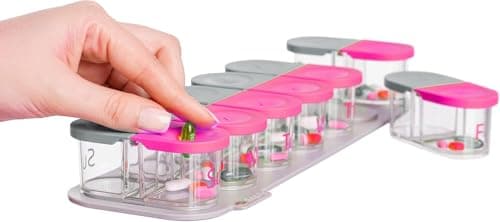
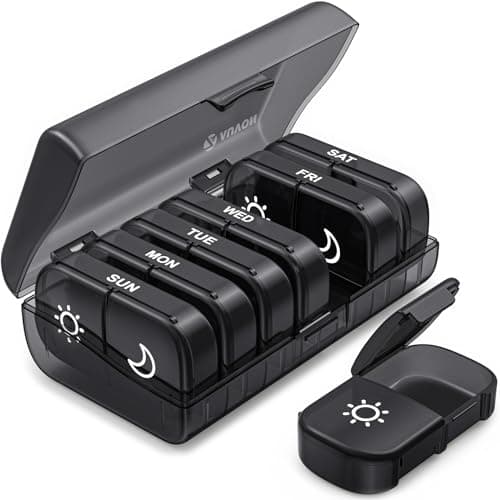
- The weekly AM/PM box.Seven day-boxes, each split into morning and evening, usually detachable from a zip case. It is the only shape that answers “did I take it?” by looking rather than remembering, which is the whole reason a dosing organizer exists. The AUVON is this shape.
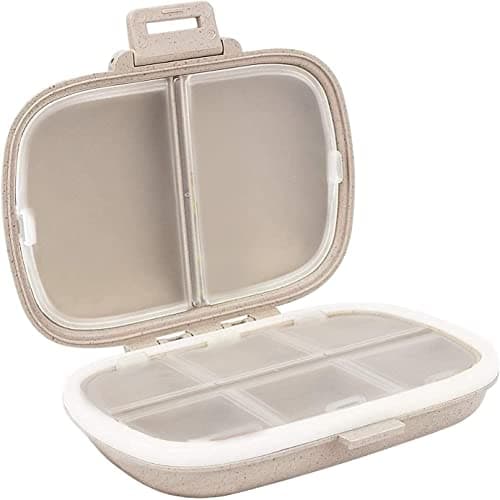
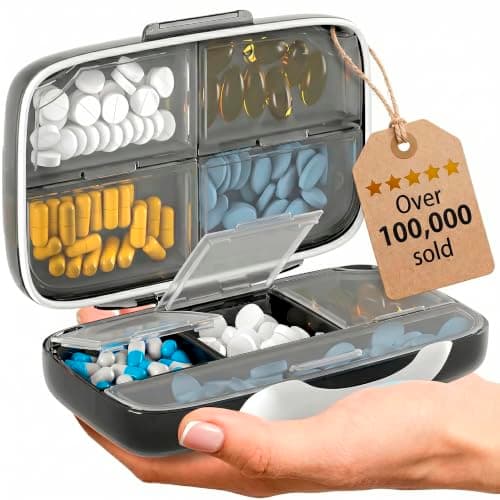
- The sealed pocket case. One case, six to eight compartments, sorted by pill type rather than by day. It is a vitamin and over-the-counter case: brilliant for carrying four supplements and some ibuprofen, useless for telling you whether you dosed this morning. The Holii and the BEXEEN are this shape.
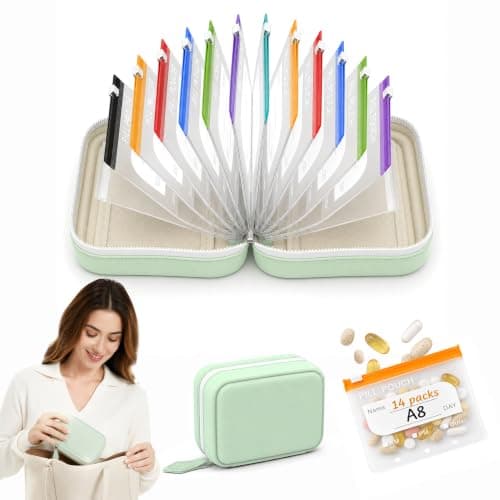
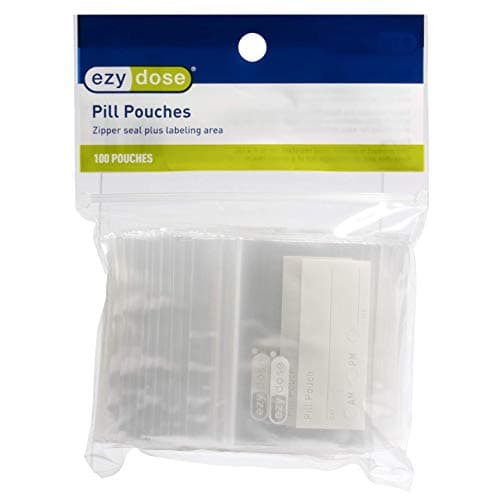
- The pouch system. Writable zip pouches on removable rings in a case. The one shape that scales past seven days, because you relabel pouches instead of running out of cells. The A8 is this shape, and the Ezy Dose pouches are the same idea without the case.
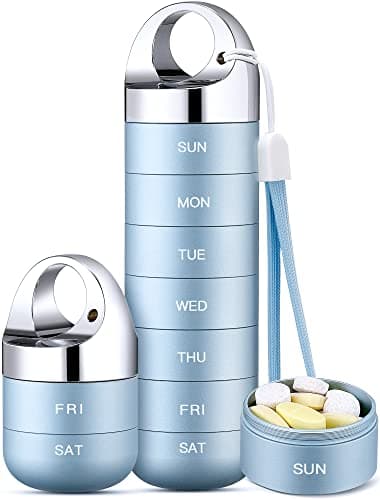
- The metal tube stack. Screw-together aluminum tubes with rubber O-rings. Waterproof, crushproof, opaque, one dose per tube. This is outdoor gear that happens to hold pills. The Zannaki is this shape.
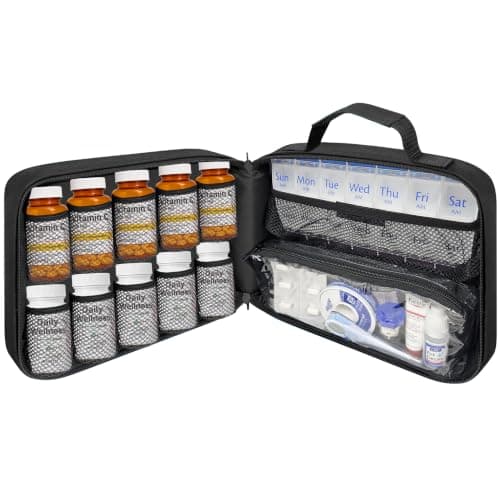
- The bottle bag. A padded clamshell with a mesh pocket per prescription bottle. It organizes without decanting, which makes it the only shape that does not quietly conflict with the labeling advice below. The StarPlus2 is this shape.
The thing almost no roundup in this category tells you
There is a direct tension at the heart of this product category, and it is worth stating plainly before you buy anything. A weekly pill box works by taking medication out of the container it came in. The CDC's guidance for travelers goes the other way: keep medicines in their original, labeled containers, clearly labeled with your full name, your health care provider's name, the generic and brand name, and the exact dosage. It also advises packing medication in a carry-on rather than a checked bag in case luggage is lost or delayed, bringing copies of written prescriptions including generic names, asking your prescriber for a note if you use controlled substances or injectables, and checking with the embassy of your destination — and of anywhere you have a layover — to confirm your medicines are permitted at all.
That does not make pill organizers a bad idea. It makes them the right tool for a specific job: the daily dose you carry out of the hotel, the vitamins and over-the-counter items nobody will ever ask you about, and the regimen that is simply too complicated to run out of five bottles on a nightstand. The way most careful travelers square the circle is to carry both — bottles in the bag, today's dose in the box. That is exactly why the StarPlus2 bottle bag sits in this ranking next to the boxes rather than on a separate page, and why the Ezy Dose pouches, which let you write the drug name and date on each dose, score better on this problem than any unlabeled plastic case does.
On the airport itself, the TSA's position is more relaxed than people expect. Medication in pill or other solid form must undergo security screening, and the TSA's own advice is that “you can facilitate this screening by clearly labeling medication” — labeling, not a prescription bottle. Liquid medication is treated separately and generously: medically necessary liquids, gels and aerosols are allowed in reasonable quantities above the usual limit, but you must declare them to an officer at the checkpoint before screening begins. Nothing on this page needs to be “TSA approved,” because the TSA does not approve containers — the same point our are packing cubes TSA approved guide makes about cubes.
One more thing, said once and said clearly: this is a page about containers. It is not medical advice, we are not clinicians, and nothing here should change how or when you take anything. Ask your pharmacist or prescriber about splitting doses, repackaging, refrigeration or time zones.
How we ranked them
Five criteria, weighted in this order. Dose accuracy— whether the organizer tells you at a glance that today's dose is still in there, which is the actual job and the thing most cheap cases fail. Capacity — the compartment count and the published pill or bottle capacity, read against the trip length it is sold for. Containment — the seal, the lock and whether the thing survives being dropped, soaked or sat on. Carry — footprint and weight, because an organizer you have to allocate luggage space to is competing with your clothes. Value — what you get for the money, not the brand on the label.
Every score is a judgment from documented specs and listing detail rather than a measurement we took — we do not run a testing lab, and our methodology page says so in those words. Every dimension, weight, compartment count and capacity figure on this page traces to the product's own Amazon listing, and each listing is named in Sources at the bottom. Where a listing contradicts itself we say so: Zannaki publishes a compartment size that is really the whole stack's dimensions, the A8 publishes two different footprints, and the Ezy Dose capacity line describes compartments a flat pouch does not have. Prices are pulled live from Amazon and date-stamped, so nothing here anchors you to a number that expired two seasons ago.
Who should skip a travel pill organizer entirely
- Anyone carrying one prescription on a short trip. One bottle in the personal item is already organized, already labeled, and already compliant with the advice above. Buy a box when the count goes past two or the trip past a week.
- Anyone crossing a border with controlled substances. This is the case where the bottle and the paperwork matter more than the container. Carry the original labeled bottles, a copy of the prescription and a note from your prescriber, and use the bag rather than the box.
- Anyone planning to put medication in a checked bag. No organizer makes that a good idea. Medication rides in the bag that stays with you, for the same reason documents do — see the carry-on packing list for where the small, irreplaceable things go.
- Anyone tempted to use a spare packing cube. A cube is one unlined fabric compartment, so a loose blister pack in it ends up at the bottom of a bag under your jeans, and anything uncoated gets crushed. It is the wrong container for the same reason it is wrong for cables, jewelry and documents — the division of labor our what to pack in each cube guide sets out.
The buyer's guide: what to check before you click
Start with doses, not days
Multiply trip length by doses per day and you have the number that picks the shape. Seven or fourteen cells covers a week at one or two doses a day, which is the AUVON. Anything past that and fixed cells run out: a 21-day trip at two doses a day needs 42 slots, and no weekly box on the market has them. That is the moment the A8's relabelable pouches stop looking like a gimmick, and it is why “best travel pill organizer for 2 weeks” and “for long trips” are such common searches in this category with so few honest answers. If you dose three times a day, do the math before you buy a two-compartment box — most of them quietly assume twice.
Measure your biggest pill, not your smallest
A compartment that holds 20 small tablets may hold two fish oil softgels, and fish oil is what breaks these cases. AUVON is unusually straightforward about it and publishes both the cell size (1.5 by 1.7 by 0.8 inches) and a capacity in fish oils; Zannaki quotes a per-tube capacity in fish oils too. If large softgels are a daily item, the Sagely XL is built around them and the BEXEEN advertises large cells, while the pocket-size Holii puts its two large cells next to six small ones precisely so the big items are not sharing with tablets. Pull out your biggest capsule and look at it before you order.
Containment is three separate questions
“Will it stay shut” is not the same question as “will it keep moisture out,” which is not the same as “will it survive being sat on.” Press-fit lids pop open in a bag; a latch like the BEXEEN's or a screw thread like the Zannaki's does not. A silicone gasket, which the BEXEEN and the Holii both have and the Zannaki does with rubber O-rings, is what matters in a humid climate, where tablets that normally live in a bottle with a desiccant are suddenly sitting in open air. And only metal resists crushing, which is why the Zannaki is the pick for a backpack side pocket and the Ezy Dose pouches are the pick that most needs protecting by something else around it.
Labels are a feature, and most boxes do not have them
A compartment with nothing written on it tells you nothing at 6 a.m. in a time zone you arrived in last night. Printed or etched day labels — AUVON's UV printing, Zannaki's laser etching — survive the trip; stuck-on labels peel. A blank sheet of stickers, which the BEXEEN includes, is better than nothing. And writable surfaces, which the A8 pouches and the Ezy Dose pouches both have, are the best of the lot, because they carry the drug name and the date rather than just a weekday. That is also the format that lines up with the TSA's own suggestion to clearly label medication to make screening easier.
Decide where it lives before you decide what it is
This category spans a flat pouch at one end and an 11-inch padded clamshell at the other, and the organizer that only fits in checked luggage is an organizer you cannot use. The Holii at 4.33 inches and the Ezy Dose pouches go in a pocket. The AUVON at 6.1 inches and the Zannaki at 6.5 inches go in a personal item. The BEXEEN and the A8 are bag items. The StarPlus2 at 11 by 9 by 4.5 inches and the Sagely at 12.5 inches long are allocated luggage space, in the same way a hanging toiletry kit is. Medication belongs in the bag that stays with you, so the real constraint is what fits in your personal item alongside everything else.
Two containers beats one compromise
The setup that actually works for multi-prescription travel is not a single clever box. It is bottles in the bag and today's dose in a pocket: the StarPlus2 or an equivalent in the suitcase keeping every prescription in its labeled container, plus an AUVON or a handful of labeled Ezy Dose pouches carrying the next day or two out of the room. It costs less than the Sagely on its own, it satisfies the original-container guidance, and it means a lost day bag is an inconvenience rather than a medical problem. If you only buy one thing, buy the one that matches the harder half of your trip.
Pack it with the documents, not the clothes
Wherever you land on the shape question, the placement rule is free and it is the same every time. Medication goes in the bag that stays under the seat, in a fixed pocket you can reach without unpacking, and never in checked baggage or a cube. Liquid medication comes out and gets declared at the checkpoint. It is the same principle behind how to pack a carry-on with packing cubes, applied to the second category of item in the bag — after documents — that cannot be replaced at the destination.
The short version
For most trips of a week or less the AUVON is the buy: detachable AM/PM days, a published cell size so you can check your dose fits, and a price that makes it a low-stakes first organizer. Two or three weeks, or a schedule too complicated for fourteen cells? The A8's relabelable pouch system. Four supplements and some ibuprofen in a jacket pocket? The Holii. A humid destination where a vented case is a real risk? The BEXEEN's gasket. Camping, kayaking or a pack that gets thrown in a truck bed? The Zannaki, in metal. Several prescriptions and a long stay, kept in their original labeled bottles? The StarPlus2 bag. Large softgels, or hands that struggle with small stiff lids? The Sagely XL, accepting that the base stays home. And buy a box of Ezy Dose pouches whatever else you choose, because a labeled dose that weighs nothing is the cheapest insurance on this page. And whichever you buy, it is not a first aid kit — injuries are a separate box with a separate contents list, ranked in the best travel first aid kits. The rest of the travel organization hub covers the containers for everything else in the bag.