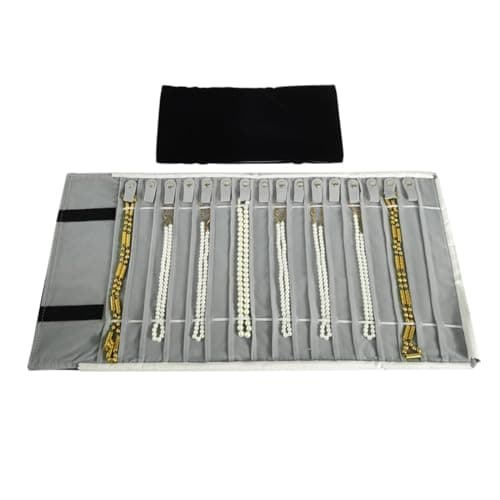
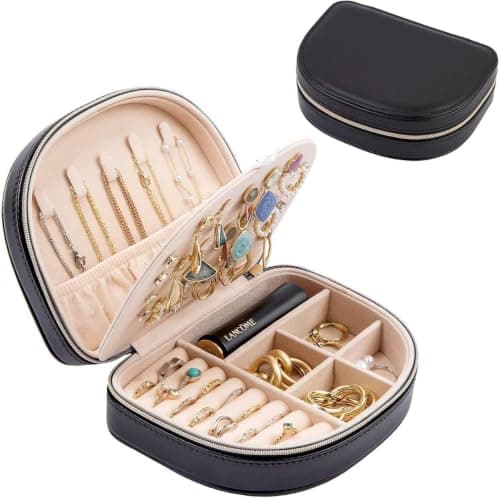
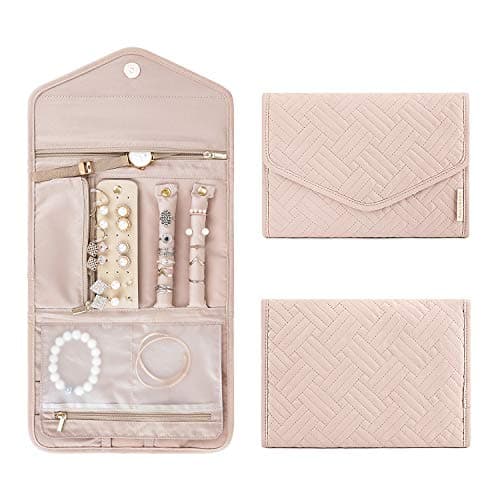
Pack jewelry in your carry-on, in one container per format, with every chain threaded so it has no slack. TSA's own guidance on valuables is to keep items such as jewelry with you at all times and not to put them in checked baggage, and that you can ask an officer to screen you and your valuables in private. For the container itself, the BAGSMART roll is the pick for most people; if chains are your problem the SCIKHEFT 16-hook organizer does that one job better than anything.
The three failures, and why one container does not fix all of them
Jewelry fails in travel in three distinct ways, and they have nothing in common except the bag they happen in.
Chains tangle. A chain knots because it is flexible and both ends are free - put three in a pouch, add six hours of vibration, and you have a single object. The fix is a fixing point, not a compartment: thread one end through something and fasten the clasp, and the chain cannot knot because it has no slack to knot with.
Small things vanish. Stud earrings, backs and thin rings are small enough to fall through a gap, hide in a seam or come out with a handful of something else. The fix is to pair them through a physical medium - a button, a felt pad, a mesh panel - so each pair is one object.
Hard things damage soft things. Stones scratch metal; harder stones scratch softer ones; plated finishes abrade against anything. The fix is separation, which means one pouch or one padded slot per piece that can do damage.
A single zip-lock bag fails all three, which is why it remains the most common method and the worst.
What TSA says about carrying valuables
TSA's own page for jewelry lists it as allowed in both carry-on and checked bags, and then adds the advice that matters: if you are travelling with valuable items such as jewelry, keep those items with you at all times and do not put them in checked baggage, and you can ask a TSA officer to screen you and your valuables in private to maintain your security. It also notes, as every item page does, that the final decision on whether an item is allowed through the checkpoint rests with the officer.
In practice: jewelry does not need to come out of your bag at screening the way liquids do, but it is the one category where the private-screening option is genuinely worth asking for - a tray of rings on an open belt, in a queue, is the situation people describe when they say they lost something at an airport.
What to look for in a jewelry case
- Fixing points for chains, not just compartments. Hooks, slots or elastic bands. A pocket does not stop a chain knotting with itself; a hook does.
- Stud positions, counted. This is where loss happens. Twenty paired positions sounds excessive until you count the earrings you actually own.
- A soft lining for metal. Velvet or quilted cotton. Plated and gold-filled finishes abrade against hard shells and against each other.
- Structure only if you need crush protection. A rigid case protects a setting; it also packs badly. If nothing you carry has a fragile stone, a flat roll is the better object.
- A shape that fits a packed bag. A flat roll goes in anywhere; a box needs a corner and tends to end up in the one place you did not want to put it.
- Don't buy for security. No case on the market is theft protection - they are not locked, not slash-proof, and a case is if anything an advertisement of where the valuables are. The protection is carrying it with you.
Which container for which piece
| Piece | Container | Method |
|---|
| Fine chains and necklaces | Hook organizer or a straw | Thread one end, fasten the clasp, lay it flat with no slack |
| Statement necklaces | Its own padded pouch | Alone - these scratch everything they touch |
| Stud earrings | Stud card, felt pad or a button | Both studs through the same medium, backs fitted |
| Hoops and drops | Zipped compartment | Clasps closed so they cannot hook each other |
| Rings, plain bands | Small zipped pouch or a ring roll | Together is fine if the metals match |
| Rings with stones | Structured case, padded slot | One per slot - the stone is the hardest thing in the bag |
| Bracelets and bangles | Zipped compartment | Clasped; bangles nested with cloth between them |
| Watch | Worn, or its own padded slot | Never loose - the crystal scratches and gets scratched |
| Anything irreplaceable | Home | The only method with a zero failure rate |
Three tricks that cost nothing
- The straw. A cut drinking straw, chain threaded through, clasp fastened. It is the hook-organizer mechanism for free, and it travels inside any pouch you already own.
- The button. A spare shirt button takes two studs and holds the pair together. A piece of felt or a cork does the same job.
- Cling film for a layered necklace. Lay it flat, wrap it once, and it arrives in the shape it left in. Ugly and completely effective.
Where it goes in the bag
In your personal item, not the overhead bag, and not inside a packing cube of clothes where you will forget it when you unpack. The sensible home is beside your documents - both are small, both are valuable, both should never be in checked baggage, and keeping them together means one thing to account for rather than two. Our travel document system applies the same rule, and what to pack in each cube explains why jewelry is one of the few things that does not belong in a cube at all.
How we scored the three picks
Stops tangling - whether the design provides actual fixing points for chains. Stops loss - paired stud positions and closed compartments. Stops scratching - lining material and per-piece separation. Packs small - published dimensions and weight, and how the shape behaves in a full bag. Value - live price against the capacity you get. Our methodology states plainly that these are judgments from documented specs and listings, not measurements we took. No case on this page is claimed to be security, because none of them is.