Skip to content
Fold & Ferry

Beyond the cube · Travel Organization

The best travel first aid kits, ranked by contents rather than piece count

Piece count is the number on the box and the worst way to choose one of these: a 300-piece kit is mostly adhesive bandages in six sizes. Here is what separates a kit worth packing from a bag of plasters, ranked on the contents that are genuinely hard to improvise, how fast you can find them, and whether the case survives the trip.

By Stephen V.Updated How we research
#ad

We earn a commission when you buy through our Amazon links, at no extra cost to you. It never affects our rankings, and we say so when the cheaper product is the better buy. How this works.

Nearly every first aid kit on Amazon is sold on a single number, and it is the wrong one. A 300-piece kit sounds four times better than a 75-piece kit and usually is not, because the pieces are adhesive bandages in six sizes and the count goes up by adding more of the cheapest item in the box. What separates a kit worth packing from a bag of plasters is a short list of things that are genuinely hard to improvise in a hotel room or on a trail. So this page ranks contents, not counts.

The items that actually decide a kit

You can buy adhesive bandages anywhere on earth, which is exactly why the bandage count is the least informative thing on the box. These are the contents worth paying for, roughly in order of how annoying they are to source once a trip has started:

  • Die-cut moleskin. Blisters end more walking holidays than anything else on this list, and moleskin cut to shape is the one fix that works once a blister has started. The Adventure Medical kits include it; most budget kits do not.
  • A splinter picker or metal tweezers. Plastic tweezers are decoration. This is the item you will use most often and the one most likely to be missing or useless.
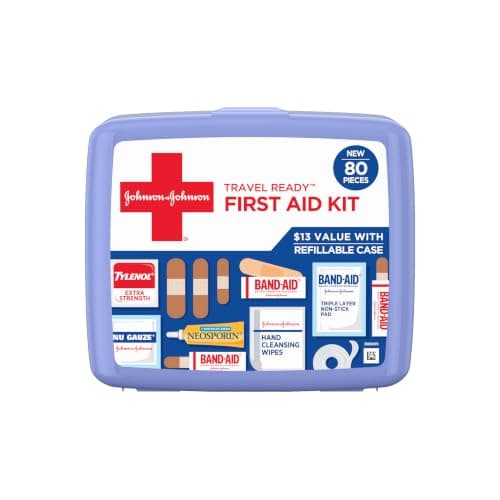
  • A named antibiotic ointment and a named analgesic. Unbranded sachets tell you nothing about dose or active ingredient. The BAND-AID kit naming NEOSPORIN and TYLENOL is worth more than fifty extra bandages.
  • A trauma pad and an elastic bandage. The step from treating a scrape to managing an injury. Only the Adventure Medical Backpacker kit here carries both, and only it includes a book telling you how to use them.
  • Burn cream and wound closures. Both are common injuries and both are almost always missing from travel-size kits. The First Aid Only 298-piece has them.
  • An emergency foil blanket. Weighs nothing, costs cents, and is the one item whose absence you would genuinely regret. The General Medi kit includes one at under ten dollars.

A first aid kit is not a medicine kit

This is the most common mistake in the category and it is worth separating cleanly. A first aid kit handles injuries: cuts, blisters, burns, stings, sprains. It does not handle your prescriptions, and almost none of these kits contain more than a couple of doses of anything. Your actual medication is a different packing problem with different rules — it belongs in a labeled case in the bag that stays with you, and for prescriptions crossing a border the guidance runs the other way from a pill box entirely. That is the subject of our travel pill organizer roundup, and the two containers do different jobs. Buy both or buy neither; do not buy one and assume it covers the other.

There is no such thing as a TSA approved first aid kit

Several listings in this category put TSA Approved in the title. It is not a status that exists: the TSA does not approve, certify or endorse first aid kits, any more than it approves toiletry bags — the same point our are packing cubes TSA approved guide makes about cubes. What is actually true is narrower and more useful. Scissors are allowed in a carry-on if the blades are less than 4 inches from the pivot point. Tweezers are allowed in carry-on bags. Any ointments, gels or liquids in the kit count as liquids and follow the 3.4 ounce container rule, which is why most kits ship them in sachets. And the final call at any checkpoint rests with the officer in front of you, whatever a product title says. If you would rather avoid the conversation entirely, pick a kit with no scissors in it and buy a pair at the destination.

How we ranked them

Five criteria, weighted in this order. Contents that matter — the presence of the hard-to-improvise items above, which is deliberately not the same as the piece count. Findability — whether the kit is divided and labeled, because a 298-piece kit in one pocket is slower to use than an 80-piece kit in six. Case and durability — hard versus soft, water resistance, and whether the thing survives a season in a backpack. Carry — footprint and weight against the bag it has to fit in. Value — what you get for the money, judged on contents rather than count.

You will notice there is no cost-per-piece figure anywhere on this page, and that is deliberate: the site publishes a per-unit value number wherever it means something, and here it would simply reward whichever seller padded the bandage count hardest. Every score is a judgment from documented specs and listing detail rather than a measurement we took — we do not run a testing lab, and our methodology page says so in those words. Every dimension, weight and contents claim traces to the product's own Amazon listing, named in Sources at the bottom. Prices are pulled live from Amazon and date-stamped.

One thing said plainly, once: this page is about which box to buy. It is not medical advice, we are not clinicians, and a kit is not training. If you are heading somewhere genuinely remote, the course matters more than the kit.

Who should skip a pre-made kit

  • Anyone on a city break who already carries bandages. Two plasters and some ibuprofen in a toiletry bag is a first aid kit for a weekend in a city with pharmacies on every corner.
  • Anyone who will actually build a better one. A do-it-yourself kit built around the six items above beats any boxed kit, and `travel first aid kit diy` is a real search for a reason. The honest case for buying boxed is that most people never get around to it.
  • Anyone expecting it to replace a pharmacy. None of these carry antihistamines, rehydration salts or anything for stomach trouble in useful quantity — the three things most likely to actually affect a trip. Add those yourself.

The short answer

Quick picks

#ProductBest forScorePrice
01
Band-Aid BAND-AID Travel Ready Portable First Aid Kit (80-Piece)
BAND-AID Travel Ready Portable First Aid Kit (80-Piece)

The kit most travelers should buy, and the one whose contents you can identify without a magnifying glass. A 6.25 by 5.5 by 1.6 inch zip case at 0.43 pounds holding 80 pieces, and the reason it ranks first is not the count but the names on them: the listing specifies BAND-AID bandages, NEOSPORIN antibiotic cream and TYLENOL pain relief caplets rather than unbranded sachets. For the ordinary travel injuries — a blister, a cut from a razor, a headache at altitude, a scrape off a cobblestone — that is the whole job, and knowing exactly what the ointment is matters more than having nine kinds of gauze. The case is a flat rectangle, so it sits against the side of a personal item instead of lumping in the middle.

Best overall
7.8
$10.98Amazon
02
Adventure Medical Kits Adventure Medical Kits Ultralight/Watertight .5 (2-Person)
Adventure Medical Kits Ultralight/Watertight .5 (2-Person)

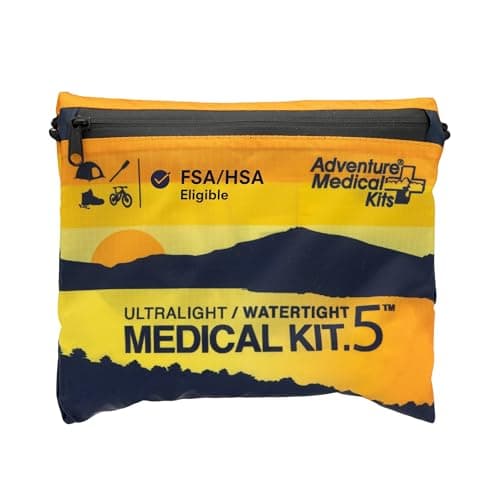
The pick if weight and water are the constraints, and the only kit here built by a company whose whole business is wilderness medicine. Listed at 7 by 5 by 1 inches and 0.22 pounds — less than half the weight of anything else on this page — with a reusable waterproof DryFlex inner bag inside a water-resistant outer with a durable water repellent finish. The contents are chosen rather than counted: bandages, gauze, antiseptic wipes, antibiotic ointment, alcohol swabs, insect sting relief, a splinter picker, a safety pin and die-cut moleskin for blisters. That moleskin is the tell. Blisters are the single most likely thing to actually ruin a walking trip, and die-cut moleskin is the item cheap kits leave out most often.

Best for one-bag and wet trips
8.4
$31.95Amazon
03
General Medi General Medi Mini First Aid Kit (110-Piece)
General Medi Mini First Aid Kit (110-Piece)

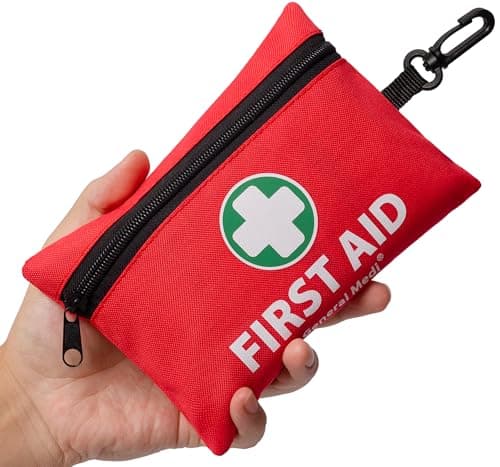
The cheapest kit here that still includes the two items the budget tier normally cuts. Listed at 7.1 by 5.1 by 1.9 inches and just 0.35 pounds for 110 pieces, and it ships with scissors and an emergency foil blanket — the foil blanket in particular being the thing you will never need until the one time you really do, and the thing almost no sub-ten-dollar kit carries. General Medi states its products carry a certificate of conformity to global standards, which is more than most listings in this price tier say about anything. The pouch is soft and unstructured, and at this price that is the honest trade.

Best value
7.4
$7.99Amazon
04
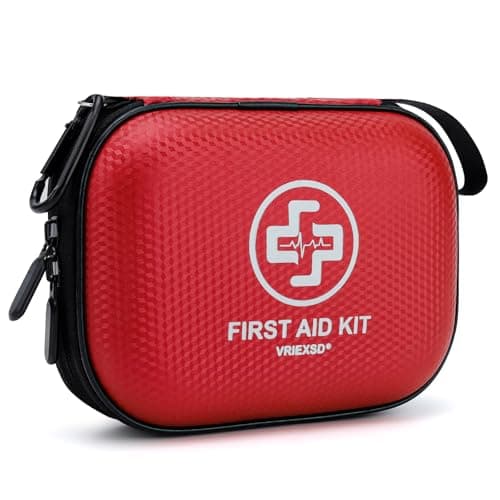
Vriexsd Mini First Aid Kit, 150-Piece Waterproof EVA Hard Shell
Mini First Aid Kit, 150-Piece Waterproof EVA Hard Shell

The pick if the kit is going to live in a backpack lid or a car door pocket and get abused. A waterproof EVA hard-shell case listed at 6.4 by 4.9 by 2.7 inches and 0.73 pounds with 150-plus pieces, and the contents list is better than the price suggests: alongside the usual bandages and gloves it names povidone-iodine prep pads, metal tweezers and a tourniquet. A tourniquet in a ten-dollar kit is unusual and worth knowing about, with the obvious caveat that a tourniquet is only as useful as your training. The interior is divided into labeled compartments rather than being one pocket, and it comes with carabiners so it can hang off a pack.

Best hard case
8.2
$9.99Amazon
05
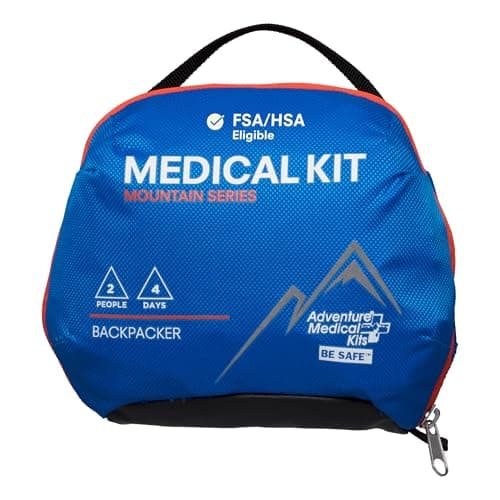
Adventure Medical Kits Adventure Medical Kits Mountain Series Backpacker (96-Piece)
Adventure Medical Kits Mountain Series Backpacker (96-Piece)

The kit to buy when the nearest pharmacy is a day away, and the only one here that includes a book. Listed at 7 by 3.75 by 3.75 inches and 0.84 pounds, 96 pieces, and Adventure Medical states it is designed to support up to 2 people for up to 4 days. The contents move up a tier from everything above: a trauma pad for controlling severe bleeding and an elastic bandage for stabilizing an injury, organized in clearly labeled pockets under the maker's Easy Care system, inside a water-resistant bag. The included wilderness first aid book is the part people underrate — a trauma pad you do not know how to use is dead weight, and this is the only pick that addresses that.

Best for hiking and remote trips
7.8
$57.49Amazon
06
First Aid Only First Aid Only 298-Piece Family First Aid Kit
First Aid Only 298-Piece Family First Aid Kit

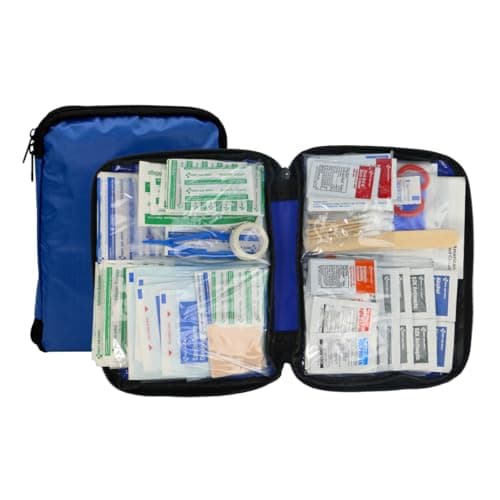
The one to leave in the rental car or the hotel room while a smaller kit rides in the day bag. Listed at 9.25 by 7 by 3 inches and 1 pound, 298 pieces, in a soft zip case with two separate layers of individual compartments and clear plastic pockets — which is the detail that stops a 298-piece kit becoming a bag of loose sachets. The contents list is broad in the right way: adhesive fabric and plastic bandages, antibiotic ointments, BZK antiseptic towelettes, burn cream packets, a gauze roll and pads, wound closures and a cold pack. Burn cream and wound closures are both items that almost never appear in a travel-size kit. First Aid Only also lists it as HSA and FSA eligible, which is a real saving if you have either.

Best for families and base camp
7.2
$18.08Amazon
07
Prelady Prelady 152-Piece Small First Aid Kit
Prelady 152-Piece Small First Aid Kit

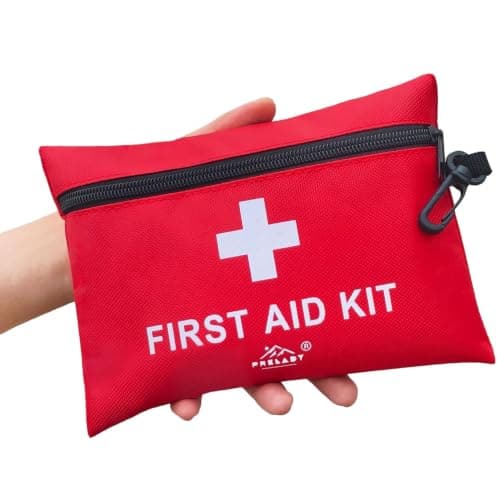
Included because it is the shape of listing this category is full of, and because being honest about it is more useful than pretending it does not sell. A 152-piece flat zip pouch listed at 7.8 by 5.95 inches, and the cheapest thing on this page. Two things to know before you buy it. First, the title says TSA Approved, which is not a status that exists — the TSA approves no first aid kit, and that phrase in a title tells you something about the seller rather than the product. Second, its five feature bullets are keyword padding that repeat the same sentence with the word first aid misspelled, and they never itemize the 152 pieces. What you are buying is an unverified bandage assortment at a very low price, which is a legitimate purchase as long as that is what you think you are buying.

Cheapest, with caveats
5.4
$5.99Amazon

#ad · Live prices from the Amazon Product API, as of Oct 4, 2026. Where we have no verified live price we show none — a gap beats a rotted number.

In detail

The picks, in full

01
Band-Aid BAND-AID Travel Ready Portable First Aid Kit (80-Piece)

Best overall

BAND-AID Travel Ready Portable First Aid Kit (80-Piece)

6.25 x 5.5 x 1.6 in0.43 lb80 piecesBAND-AID / NEOSPORIN / TYLENOL contents
7.8/10
Value: —

The kit most travelers should buy, and the one whose contents you can identify without a magnifying glass. A 6.25 by 5.5 by 1.6 inch zip case at 0.43 pounds holding 80 pieces, and the reason it ranks first is not the count but the names on them: the listing specifies BAND-AID bandages, NEOSPORIN antibiotic cream and TYLENOL pain relief caplets rather than unbranded sachets. For the ordinary travel injuries — a blister, a cut from a razor, a headache at altitude, a scrape off a cobblestone — that is the whole job, and knowing exactly what the ointment is matters more than having nine kinds of gauze. The case is a flat rectangle, so it sits against the side of a personal item instead of lumping in the middle.

Contents that matter
7
Findability
8
Case and durability
6
Carry
9
Value
9

Pros

  • Named contents: BAND-AID, NEOSPORIN and TYLENOL rather than unlabeled generics, per the listing
  • 0.43 lb and 1.6 in thick — a flat rectangle that packs against a bag wall
  • Includes actual pain relief caplets, which a surprising number of 200-piece kits do not

Cons

  • No tourniquet, no trauma pad and no emergency blanket: this is a minor-injury kit, not a trauma kit
  • Soft zip case with no structure, so the contents shuffle and need re-sorting after a few trips

Don't buy this if…

…you are going anywhere more than an hour from a pharmacy. For a city trip this is exactly right; for a trail or a remote coastline the Adventure Medical kits below carry things you genuinely cannot improvise.

$10.98View on Amazon

$14.6925% off

Price as of Oct 4, 2026. Prices change — Amazon's at checkout is the one that counts.

#ad · we may earn a commission from this link to BAND-AID Travel Ready Portable First Aid Kit (80-Piece)

02
Adventure Medical Kits Adventure Medical Kits Ultralight/Watertight .5 (2-Person)

Best for one-bag and wet trips

Adventure Medical Kits Ultralight/Watertight .5 (2-Person)

7 x 5 x 1 in0.22 lbWaterproof DryFlex inner bagBlister and wound care
8.4/10
Value: —

The pick if weight and water are the constraints, and the only kit here built by a company whose whole business is wilderness medicine. Listed at 7 by 5 by 1 inches and 0.22 pounds — less than half the weight of anything else on this page — with a reusable waterproof DryFlex inner bag inside a water-resistant outer with a durable water repellent finish. The contents are chosen rather than counted: bandages, gauze, antiseptic wipes, antibiotic ointment, alcohol swabs, insect sting relief, a splinter picker, a safety pin and die-cut moleskin for blisters. That moleskin is the tell. Blisters are the single most likely thing to actually ruin a walking trip, and die-cut moleskin is the item cheap kits leave out most often.

Contents that matter
8
Findability
8
Case and durability
9
Carry
10
Value
7

Pros

  • 0.22 lb and one inch thick, per the listing — the lightest and flattest kit here by a wide margin
  • Waterproof DryFlex inner bag inside a water-resistant outer: the contents stay dry in a wet pack
  • Die-cut moleskin and a splinter picker — two genuinely hard-to-improvise items cheap kits skip

Cons

  • Rated for 2 people and sized to match; it is a top-up kit, not a household one
  • No scissors, no tweezers and no emergency blanket, so it is not a complete stand-alone kit

Don't buy this if…

…you want one kit to cover a family. This is deliberately minimal for a pack's side pocket; the First Aid Only 298-piece below is the opposite trade and costs less.

$31.95View on Amazon

Price as of Oct 4, 2026. Prices change — Amazon's at checkout is the one that counts.

#ad · we may earn a commission from this link to Adventure Medical Kits Ultralight/Watertight .5 (2-Person)

03
General Medi General Medi Mini First Aid Kit (110-Piece)

Best value

General Medi Mini First Aid Kit (110-Piece)

7.1 x 5.1 x 1.9 in0.35 lb110 piecesFoil blanket + scissors included
7.4/10
Value: —

The cheapest kit here that still includes the two items the budget tier normally cuts. Listed at 7.1 by 5.1 by 1.9 inches and just 0.35 pounds for 110 pieces, and it ships with scissors and an emergency foil blanket — the foil blanket in particular being the thing you will never need until the one time you really do, and the thing almost no sub-ten-dollar kit carries. General Medi states its products carry a certificate of conformity to global standards, which is more than most listings in this price tier say about anything. The pouch is soft and unstructured, and at this price that is the honest trade.

Contents that matter
7
Findability
6
Case and durability
5
Carry
9
Value
10

Pros

  • Scissors and an emergency foil blanket included, which the rest of the budget tier omits
  • 0.35 lb — the second-lightest kit on this page
  • Listing states a certificate of conformity to global standards for the contents

Cons

  • The listing never itemizes the 110 pieces in text, pointing you at the product images instead
  • Soft unstructured pouch: nothing holds its place, so you re-sort it every few trips

Don't buy this if…

…you are flying carry-on and have not checked the scissor rules. The included scissors are fine under 4 inches from the pivot, but if you would rather not have the conversation at the checkpoint, the BAND-AID kit above has none.

$7.99View on Amazon

$8.435% off

Price as of Oct 4, 2026. Prices change — Amazon's at checkout is the one that counts.

#ad · we may earn a commission from this link to General Medi Mini First Aid Kit (110-Piece)

04
Vriexsd Mini First Aid Kit, 150-Piece Waterproof EVA Hard Shell

Best hard case

Mini First Aid Kit, 150-Piece Waterproof EVA Hard Shell

6.4 x 4.9 x 2.7 in0.73 lb150+ piecesWaterproof EVA shell, tourniquet
8.2/10
Value: —

The pick if the kit is going to live in a backpack lid or a car door pocket and get abused. A waterproof EVA hard-shell case listed at 6.4 by 4.9 by 2.7 inches and 0.73 pounds with 150-plus pieces, and the contents list is better than the price suggests: alongside the usual bandages and gloves it names povidone-iodine prep pads, metal tweezers and a tourniquet. A tourniquet in a ten-dollar kit is unusual and worth knowing about, with the obvious caveat that a tourniquet is only as useful as your training. The interior is divided into labeled compartments rather than being one pocket, and it comes with carabiners so it can hang off a pack.

Contents that matter
8
Findability
9
Case and durability
10
Carry
5
Value
9

Pros

  • Waterproof EVA hard shell — the only crush-resistant case here under thirty dollars
  • Includes metal tweezers, povidone-iodine prep pads and a tourniquet, per the listing
  • Divided labeled compartments rather than one pocket, so things stay where you left them

Cons

  • 2.7 inches thick: a hard box that will not flex into a gap the way a flat pouch does
  • The listing says do not soak it, so waterproof here means splash and rain, not submersion

Don't buy this if…

…you are packing a carry-on to the inch. The hard shell is its whole advantage and also its whole cost — it takes a fixed 85 cubic inches whether it is full or not.

$9.99View on Amazon

Price as of Oct 4, 2026. Prices change — Amazon's at checkout is the one that counts.

#ad · we may earn a commission from this link to Mini First Aid Kit, 150-Piece Waterproof EVA Hard Shell

05
Adventure Medical Kits Adventure Medical Kits Mountain Series Backpacker (96-Piece)

Best for hiking and remote trips

Adventure Medical Kits Mountain Series Backpacker (96-Piece)

7 x 3.75 x 3.75 in0.84 lb2 people / 4 daysTrauma pad + wilderness first aid book
7.8/10
Value: —

The kit to buy when the nearest pharmacy is a day away, and the only one here that includes a book. Listed at 7 by 3.75 by 3.75 inches and 0.84 pounds, 96 pieces, and Adventure Medical states it is designed to support up to 2 people for up to 4 days. The contents move up a tier from everything above: a trauma pad for controlling severe bleeding and an elastic bandage for stabilizing an injury, organized in clearly labeled pockets under the maker's Easy Care system, inside a water-resistant bag. The included wilderness first aid book is the part people underrate — a trauma pad you do not know how to use is dead weight, and this is the only pick that addresses that.

Contents that matter
10
Findability
10
Case and durability
8
Carry
5
Value
6

Pros

  • Trauma pad and elastic bandage: the step up from minor-injury care to injury management
  • Includes a wilderness first aid book, so the contents come with instructions
  • Easy Care labeled pockets — the best organization on this page for finding one item fast

Cons

  • The most expensive kit here, and overkill for any trip that stays in a city
  • 0.84 lb and a boxy 3.75 inch square section — it is a pack item, not a day-bag item

Don't buy this if…

…your travel is flights and hotels. Nothing in the upgrade over the BAND-AID kit applies to a trip where the answer to a real injury is a taxi.

$57.49View on Amazon

Price as of Oct 4, 2026. Prices change — Amazon's at checkout is the one that counts.

#ad · we may earn a commission from this link to Adventure Medical Kits Mountain Series Backpacker (96-Piece)

06
First Aid Only First Aid Only 298-Piece Family First Aid Kit

Best for families and base camp

First Aid Only 298-Piece Family First Aid Kit

9.25 x 7 x 3 in1 lb298 piecesTwo-layer soft case, HSA/FSA eligible
7.2/10
Value: —

The one to leave in the rental car or the hotel room while a smaller kit rides in the day bag. Listed at 9.25 by 7 by 3 inches and 1 pound, 298 pieces, in a soft zip case with two separate layers of individual compartments and clear plastic pockets — which is the detail that stops a 298-piece kit becoming a bag of loose sachets. The contents list is broad in the right way: adhesive fabric and plastic bandages, antibiotic ointments, BZK antiseptic towelettes, burn cream packets, a gauze roll and pads, wound closures and a cold pack. Burn cream and wound closures are both items that almost never appear in a travel-size kit. First Aid Only also lists it as HSA and FSA eligible, which is a real saving if you have either.

Contents that matter
9
Findability
9
Case and durability
6
Carry
3
Value
9

Pros

  • Two-layer case with clear pockets, so a 298-piece kit stays findable instead of becoming a jumble
  • Burn cream, wound closures and a cold pack — three things the small kits all skip
  • HSA and FSA eligible per the listing, which effectively discounts it if you have an account

Cons

  • 9.25 by 7 by 3 inches and a full pound: this is luggage you allocate space to, not a pocket kit
  • Soft-sided, so it has no crush protection for the cold pack or the plastic items

Don't buy this if…

…you are traveling with one bag. The right use of this kit is as a base that stays put, and if you only buy one thing for a one-bag trip it should be the Adventure Medical Ultralight instead.

$18.08View on Amazon

Price as of Oct 4, 2026. Prices change — Amazon's at checkout is the one that counts.

#ad · we may earn a commission from this link to First Aid Only 298-Piece Family First Aid Kit

07
Prelady Prelady 152-Piece Small First Aid Kit

Cheapest, with caveats

Prelady 152-Piece Small First Aid Kit

7.8 x 5.95 in152 piecesFlat zip pouchNo weight published
5.4/10
Value: —

Included because it is the shape of listing this category is full of, and because being honest about it is more useful than pretending it does not sell. A 152-piece flat zip pouch listed at 7.8 by 5.95 inches, and the cheapest thing on this page. Two things to know before you buy it. First, the title says TSA Approved, which is not a status that exists — the TSA approves no first aid kit, and that phrase in a title tells you something about the seller rather than the product. Second, its five feature bullets are keyword padding that repeat the same sentence with the word first aid misspelled, and they never itemize the 152 pieces. What you are buying is an unverified bandage assortment at a very low price, which is a legitimate purchase as long as that is what you think you are buying.

Contents that matter
3
Findability
5
Case and durability
4
Carry
9
Value
6

Pros

  • By far the cheapest kit here, and cheap enough to leave one in every bag
  • Flat pouch at 7.8 by 5.95 inches per the listing — slides into a laptop sleeve or a seat pocket
  • 152 pieces is a genuinely useful bandage supply for scrapes and blisters

Cons

  • The TSA Approved claim in the title is meaningless; TSA does not approve or certify first aid kits
  • No itemized contents and no published weight; the 0.6 inch thickness in its dimension block is not credible for 152 pieces

Don't buy this if…

…you want to know what is in it before it arrives. Every other pick on this page names its contents; this one names its keywords. Pay the extra few dollars for the BAND-AID kit.

$5.99View on Amazon

Price as of Oct 4, 2026. Prices change — Amazon's at checkout is the one that counts.

#ad · we may earn a commission from this link to Prelady 152-Piece Small First Aid Kit

The buyer's guide: what to check before you click

Read the contents list, and treat its absence as the answer

The single best filter in this category is whether the listing itemizes what is inside in text. Adventure Medical names the moleskin and the splinter picker. BAND-AID names NEOSPORIN and TYLENOL. First Aid Only names the burn cream and the wound closures. The Prelady kit names none of its 152 pieces and spends five bullets repeating keywords instead. A seller who will not tell you what is in the box in words has told you something.

Match the kit to your distance from a pharmacy, not your trip length

Trip length is the wrong variable. A two-week city trip needs less kit than a two-day hike, because the city has pharmacies and the trail does not. Ask how long it would take to buy a replacement for whatever you need: under an hour means the BAND-AID or General Medi kit is plenty, a few hours means the Vriexsd hard case or the Ultralight, and a day or more is where the Backpacker kit's trauma pad and elastic bandage start to earn their weight.

Two kits usually beats one

The setup that works for families and longer trips is a base kit that stays put and a small kit that moves. The First Aid Only 298-piece in the rental car or the hotel room, plus the Adventure Medical Ultralight at 0.22 pounds in the day bag, costs about fifty dollars together and covers both failure modes — the thing you need at 2 a.m. in the room and the thing you need six miles out. One mid-size kit compromises on both.

Hard case or soft pouch is a question about your bag

A hard EVA shell like the Vriexsd protects the contents and holds its shape forever, and it occupies the same fixed box whether it is full or empty. A flat soft pouch like the BAND-AID or Prelady kit slides into the gap beside a laptop and squashes to fit, and its contents shuffle into a jumble over a season. If the kit lives in a car, a pack lid or a checked bag, go hard. If it lives in a personal item that is already full, go flat. This is the same hard-versus-soft trade the jewelry case roundup works through for a different set of contents.

Check what counts as a liquid before you fly

Antibiotic ointment, burn gel, antiseptic and insect sting relief are all liquids or gels as far as a checkpoint is concerned, and they follow the same 3.4 ounce container rule as your shampoo. Sachets are the reason most kits sail through: a single-use packet is well under any limit. If you have decanted anything into a tube, it belongs in the quart bag with your travel bottles, not loose in the kit.

Restock it once, immediately

Every boxed kit is short of something, and the cheapest upgrade in this entire category is ten dollars of additions on day one: antihistamines, rehydration salts, something for stomach trouble, a few extra blister plasters, and whatever you personally always end up needing. Do it when the kit arrives, not when you are packing. A kit you topped up once is better than a kit twice the price that you did not.

The short version

For most trips, the BAND-AID Travel Ready kit: named contents, a flat case, and cheap enough to be a non-decision. One bag, or anywhere wet? The Adventure Medical Ultralight/Watertight .5 at 0.22 pounds, for the DryFlex bag and the moleskin. Spending as little as possible without losing the useful extras? General Medi, for the scissors and foil blanket. Living in a pack lid or a car door? The Vriexsd EVA hard case. Genuinely remote, with a trauma pad you know how to use? The Backpacker kit and its book. A family, with a room or a car to leave it in? First Aid Only's 298-piece, as the base half of a two-kit setup. And if you buy the cheapest thing on the page, buy it knowing its title claims a certification that does not exist. The rest of the travel organization hub covers the containers for everything else in the bag.
How we picked

We haven't tested these on a plane — and we say so

Every site in this category says it tested twenty cubes. We haven't tested any. We compiled the published manufacturer specs, computed the numbers that decide the buy — capacity, compression, cost per cube — and scored each set against a published rubric. The scores are judgments from documented research, not measurements we took. Where a figure came from a manufacturer's spec sheet we name it in Sources. Prices are pulled live from Amazon.

Questions

Frequently asked

What should a travel first aid kit contain?

Beyond adhesive bandages, which you can buy anywhere: die-cut moleskin for blisters, metal tweezers or a splinter picker, a named antibiotic ointment and a named pain reliever, antiseptic wipes, gauze and tape, and an emergency foil blanket. For remote trips add a trauma pad and an elastic bandage. Add yourself what no boxed kit includes in useful quantity — antihistamines, rehydration salts and something for stomach trouble.

Is there such a thing as a TSA approved first aid kit?

No. The TSA does not approve, certify or endorse first aid kits, and a title claiming it tells you about the seller rather than the product. What is real: scissors are permitted in carry-on if the blades are less than 4 inches from the pivot point, tweezers are permitted, ointments and gels count as liquids under the 3.4 ounce container rule, and the final decision at any checkpoint rests with the officer.

Can I bring a first aid kit in my carry-on?

Yes, and it is the better place for it — a kit in a checked bag is a kit you cannot reach. The only items worth thinking about are scissors (fine under 4 inches from the pivot) and any ointments or gels, which follow the usual liquid container limit. Most kits ship those as single-use sachets, which is well inside the rule.

Is a 300-piece first aid kit better than an 80-piece one?

Usually not, for travel. Piece count rises by adding more of the cheapest item in the box, so a 300-piece kit is typically a larger bandage assortment rather than a broader one. Judge it on the presence of moleskin, metal tweezers, named medications, burn cream and wound closures. The 298-piece kit here earns its count because it adds categories, not just quantity — and it is a base-camp kit, not a day-bag one.

Should I buy a first aid kit or build my own?

A kit built around the six items that matter beats any boxed kit, and it is cheaper. The honest argument for buying boxed is that it happens: most people who plan to assemble a kit never finish. A good compromise is to buy an inexpensive base and spend ten dollars topping it up the day it arrives.

Do I need a first aid kit if I already have a pill organizer?

Yes, because they solve different problems. A pill organizer carries your medication on a schedule; a first aid kit handles injuries, and almost none of these kits contain more than a token dose of anything. See the pill organizer roundup for the medication half, including the official guidance on keeping prescriptions in their original labeled bottles.

Where should a first aid kit go in my luggage?

In the bag that stays with you, in a pocket you can reach without unpacking. A kit buried under clothes in a checked bag is useless at the moment you want it. If you carry two — a base kit and a small one — the base can ride in checked luggage and the small one goes in the personal item.

Keep reading

Receipts

Sources & how we got these numbers

We do not run a testing lab, and we do not pretend to. Every dimension, capacity and compression figure traces to the manufacturer's own spec or listing; prices come live from Amazon. Where we couldn't verify something, we say so on the page rather than quietly leaving it out. Read our full method.