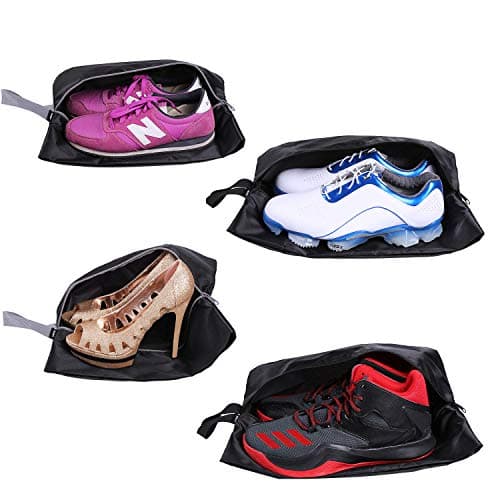
Shoes are the dirtiest thing in your suitcase and the only item with a hard sole. A shoe bag is quarantine, not organization — here are the ones that actually contain the mess.
We earn a commission when you buy through our Amazon links, at no extra cost to you. It never affects our rankings, and we say so when the cheaper product is the better buy. How this works.
A shoe bag is the only container in your luggage whose job is to keep something away from everything else. Cubes group clean things together; a shoe bag isolates a dirty thing so the rest of the suitcase stays clean. That inversion changes what you should look for: containment beats capacity, a zip beats a drawstring, and a fabric you can wipe beats a fabric that looks nice. Get those three right and the rest is price.
Zip or drawstring — this is the whole decision
A drawstring bag closes to a gathered opening with a hole in the middle. That is fine for a clean pair of trainers you are simply keeping separate, and it is not fine for anything that has walked through a city. Dirt migrates through the gap, and so does smell. A zip closes completely. Given the price difference is roughly two dollars across a four-pack, the zip is nearly always the right call — the drawstring picks here earn their place on weight and on transparency, not on containment. If you only remember one thing from this page, make it this.
Measure before you buy — the sizing trap
Shoe bags are one of the few travel products with a genuine fit problem, because almost all of them are sold in one universal size built around an average adult shoe. Listings quote dimensions inconsistently or not at all, and a bag that swallows a women's size 7 flat will not close around a men's size 13 hiking boot. The reliable move is to measure your largest pair sole-to-toe and check that against whatever dimension the listing gives. Where a listing publishes no dimension at all, treat it as sized for ordinary shoes and buy accordingly. We have not measured any of these bags ourselves and will not pretend otherwise.
One bag per pair, or one bag for all of them?
One per pair, if you can. Shoes packed together transfer dirt to each other and give you no way to grab one pair without handling all of them. It is also why multi-packs dominate this category — the sets exist because the sensible answer to "how many shoe bags do I need" is "one more than pairs of shoes," with the spare doing duty for wet swimwear or a muddy jacket. That spare-bag habit is the same thinking behind giving every category its own cube.
How we ranked them
Containment — zip versus drawstring, and whether dirt and odor stay inside. Capacity — how large a shoe realistically fits. Build — fabric weight, zip quality and warranty. Cleanability — whether you can wipe it out or have to wash it. Value — live Amazon price divided by the number of bags, which is the honest comparison in a category where set sizes range from one to six. The rubric is on our methodology page.
The short version
Buy the YAMIU four-pack. Zipped, waterproof, one per pair with a spare, and cheap. If you already run an Eagle Creek Pack-It system and want the shoe sack that matches it, the Eagle Creek is the better object and you know what you are paying for. Family of four? BeeGreen's six-pack. Want the lightest possible and your shoes are clean? The clear drawstring set. And the budget zip four-pack is the right answer if you want a zip and nothing else.
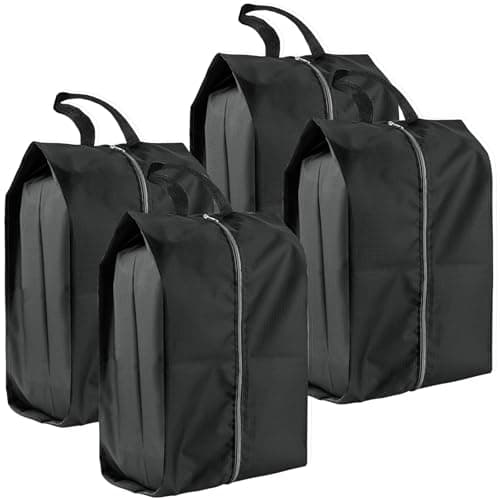
The right default: four zipped, waterproof nylon bags at a price where you can afford one per pair and still have a spare. Zip closure is the reason these beat drawstring bags — nothing escapes a closed zip.
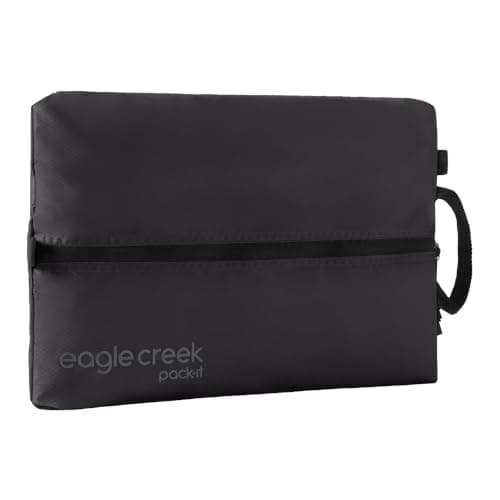
The one that matches a Pack-It cube set. It is a single bag at the price of a four-pack of generics, and what you get for that is Eagle Creek fabric, Eagle Creek construction and the warranty behind both.
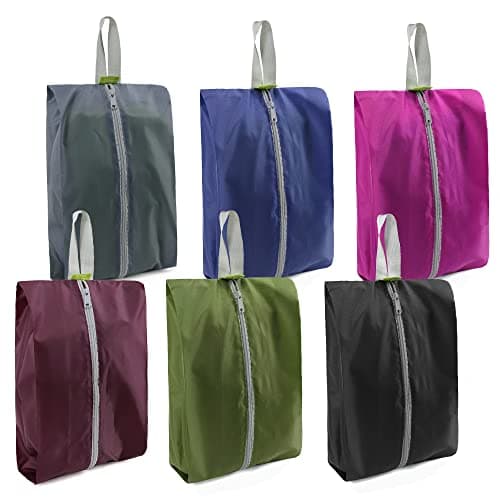
Six zipped bags with carry handles — the pick when the problem is not one pair of shoes but a family of four leaving for two weeks. The handle sounds trivial and is not: it makes a shoe bag usable as a day bag for wet swim gear.
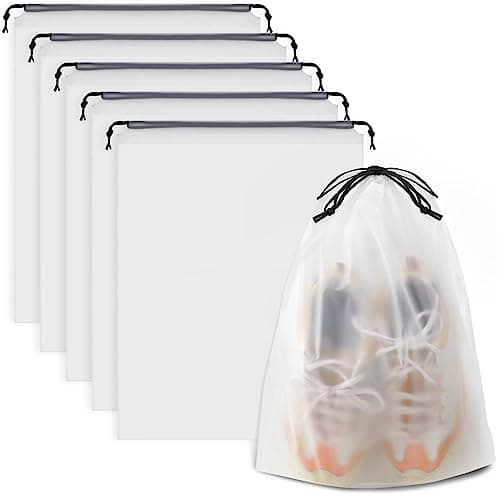
Clear drawstring bags, five for the price of a coffee. Being able to see which pair is in which bag without opening any of them is a genuine convenience, and the drawstring keeps them featherlight.
Four zipped, water-resistant bags for under seven dollars — the cheapest way to get a zip rather than a drawstring, which is the feature that actually matters in this category.
#ad · Live prices from the Amazon Product API, as of October 15, 2026. Where we have no verified live price we show none — a gap beats a rotted number.
In detail
The picks, in full
01
Best overall shoe bags
YAMIU Travel Shoe Bags (Set of 4)
4-packZip closureWaterproof nylonFits most adult shoes
8.2/10
Value: $2.50 /bag
The right default: four zipped, waterproof nylon bags at a price where you can afford one per pair and still have a spare. Zip closure is the reason these beat drawstring bags — nothing escapes a closed zip.
Containment
9
Capacity
7
Build
8
Cleanability
8
Value
9
Pros
+Zip closure genuinely contains dirt and odor, unlike a drawstring gap
+Waterproof nylon wipes clean instead of absorbing what it touches
+Four bags means one per pair for a couple, or shoes plus a wet-swimwear bag
Cons
−Tight on large boots and adult sizes above about a US 12
−One universal size, so a sandal wastes most of the bag
Don't buy this if…
…you are packing hiking boots or ski boots — measure first; these are sized around shoes, not footwear with a shaft.
Sold singlyPack-It Isolate lineTreated fabricEagle Creek warranty
8.0/10
Value: —
The one that matches a Pack-It cube set. It is a single bag at the price of a four-pack of generics, and what you get for that is Eagle Creek fabric, Eagle Creek construction and the warranty behind both.
Containment
9
Capacity
7
Build
10
Cleanability
9
Value
5
Pros
+Built and warranted to the same standard as the Pack-It cubes
+Treated fabric aimed squarely at the odor problem
+Matches an existing Pack-It Isolate or Reveal set if you already own one
Cons
−Sold singly at roughly four times the per-bag cost of the YAMIU set
−Premium build does not make it any bigger inside
Don't buy this if…
…you need three or four bags. This is a considered single purchase, and buying four is an expensive way to solve a cheap problem.
Six zipped bags with carry handles — the pick when the problem is not one pair of shoes but a family of four leaving for two weeks. The handle sounds trivial and is not: it makes a shoe bag usable as a day bag for wet swim gear.
Containment
8
Capacity
8
Build
7
Cleanability
7
Value
8
Pros
+Six bags covers a family or a long trip in one purchase
+Carry handle makes each bag useful outside the suitcase too
+Zip closure, so the same containment as the YAMIU set
Cons
−More bags than a solo traveler will ever need
−Colorful nylon is thinner than the Eagle Creek fabric
Don't buy this if…
…you travel alone with one spare pair — you are paying for four bags that will live in a drawer.
Clear drawstring bags, five for the price of a coffee. Being able to see which pair is in which bag without opening any of them is a genuine convenience, and the drawstring keeps them featherlight.
Containment
5
Capacity
7
Build
5
Cleanability
7
Value
10
Pros
+See-through, so you never open the wrong bag
+Lightest and cheapest option here by a distance
+Five bags covers a couple with shoes to spare
Cons
−Drawstring leaves a gap — dirt and smell are contained, not sealed
−Thin film, and clear material shows every scuff
Don't buy this if…
…your shoes are properly dirty. A drawstring is a courtesy barrier; muddy soles need a zip and a wipeable fabric.
Four zipped, water-resistant bags for under seven dollars — the cheapest way to get a zip rather than a drawstring, which is the feature that actually matters in this category.
Containment
8
Capacity
7
Build
6
Cleanability
7
Value
9
Pros
+Zip closure at a drawstring price
+Water-resistant shell handles a damp sole
+Cheap enough to keep a permanently dirty one for hiking boots
Cons
−Zips are the obvious cost saving and will be the first thing to fail
−Generic sizing — check against your largest pair before you rely on them
Don't buy this if…
…you want these to last years. At this price they are consumables; the YAMIU set costs a little more and lasts noticeably longer.
Put the pair in the bag with the soles facing each other rather than both facing the same way. It halves the effective height, keeps both dirty surfaces on the inside of the sandwich, and stops the heel of one shoe pressing into the upper of the other. It costs nothing and it is the single biggest improvement most people can make to how they pack shoes.
Fill the shoes before you bag them
A shoe is a rigid container full of air, which makes it the most wasteful object in your suitcase by volume. Socks, underwear, chargers and a rolled belt all live happily inside shoes, and stuffing them also helps the shoe hold its shape. Do this before the shoe goes in the bag, not after, or you will be unpacking to do it.
Position: low, at the wheel end
Bagged shoes are dense and hard, and they belong at the wheel end of a suitcase, low in the bag. That keeps the weight where it helps the case roll and stops hard soles pressing into folded clothes from above. It is the same weight-distribution logic as the cube system — detailed in how to pack shoes with packing cubes, which covers the full method.
Deal with odor at the source
No bag deodorizes a shoe; it just delays the smell reaching your clothes. Treated fabrics like Eagle Creek's help at the margins, but the effective moves are cheap and unglamorous: let shoes air out before you pack them, never bag a damp pair, and drop a dryer sheet or a small silica pack in with them. A sealed bag around a wet shoe is a greenhouse.
Keep one bag permanently dirty
The most useful habit in this category is to designate one bag as the one that never gets clean — hiking boots, beach sandals, anything that has been in mud go in that one, and it lives in the outer pocket. Everything else stays genuinely clean. It costs you one bag out of a four-pack and removes the entire category of decisions about whether something is too dirty to pack.
The shoe bag that comes free in a kit
Plenty of readers arrive here because an all-in-one organizer kit included a drawstring shoe pouch and it was not good enough. That is the usual outcome: the bundled pouch is the piece most often padded in rather than chosen. Before you let a kit's bundled bag influence the purchase, check what it actually publishes — our travel organizer set roundup goes through what is genuinely in each box and what is not.
How we picked
We haven't tested these on a plane — and we say so
Every site in this category says it tested twenty cubes. We haven't tested any. We compiled the published manufacturer specs, computed the numbers that decide the buy — capacity, compression, cost per cube — and scored each set against a published rubric. The scores are judgments from documented research, not measurements we took. Where a figure came from a manufacturer's spec sheet we name it in Sources. Prices are pulled live from Amazon.
Questions
Frequently asked
Do I really need shoe bags for travel?+
If you pack more than the shoes on your feet, yes. Soles carry whatever you walked through, and a shoe loose in a suitcase transfers that directly onto folded clothes. A shoe bag is the cheapest insurance in your luggage — a four-pack costs less than one shirt.
Zip or drawstring shoe bags — which is better?+
Zip, in almost every case. A drawstring closes to a gathered opening with a gap, so dirt and smell still escape. Zips close completely and cost roughly two dollars more across a four-pack. Drawstring bags earn their place only on weight and on see-through convenience.
Will travel shoe bags fit hiking boots?+
Often not. Almost all shoe bags are sold in one universal size built around an average adult shoe, and boots with a shaft need noticeably more room. Measure your largest pair and check it against whatever dimension the listing publishes before you buy.
Can I use a packing cube for shoes instead?+
Only if it is a cube dedicated permanently to shoes and never used for clothes. Cubes are usually unlined mesh-and-polyester, so dirt passes through and odor stays. Some sets include a long, shallow shoe cube for exactly this — see how to pack shoes with packing cubes.
How many shoe bags do I need?+
One per pair, plus one spare. The spare does duty for wet swimwear, a muddy jacket or the pair you wore in the rain on the last day. That is why this category sells in multipacks — a four-pack covers a couple with room left over.
We do not run a testing lab, and we do not pretend to. Every dimension, capacity and compression figure traces to the manufacturer's own spec or listing; prices come live from Amazon. Where we couldn't verify something, we say so on the page rather than quietly leaving it out. Read our full method.