Sea to Summit is the only brand on this site that measures its packing cubes in liters, and the only one that sells them one at a time rather than in a box of seven. Both of those are consequences of the same thing - it is an outdoor company that moved sideways into travel, not a travel company - and both of them cut two ways for the buyer. Understanding which way they cut for you is the entire decision with this brand, because the cubes themselves are straightforwardly good and straightforwardly expensive.
Two things this review will not do. It will not tell you we packed with these - nobody here has, and our scores are judgments from published listings and documented research, which is what our methodology says in those words. And it will not print an inch dimension for any of them, because none of the listings we were served publishes one. That is a real limitation on buying this brand and it gets its own section below rather than a footnote.
What the range actually contains
The brand's own autocomplete is confused, and with reason: searches for Sea to Summit packing cubes return at least four different products, two of which are not packing cubes.
| Product | What it is | Published capacity |
|---|
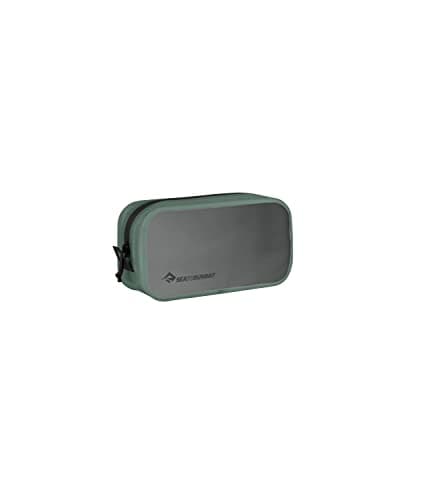
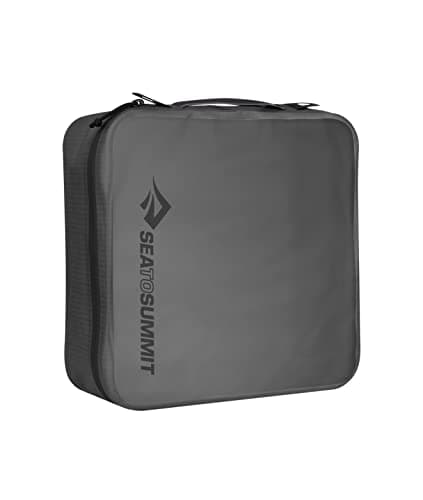
| Hydraulic Packing Cube | The actual cube - treated fabric, zip, see-through window | Sold per size; 7 L and 1.5 L reviewed here |
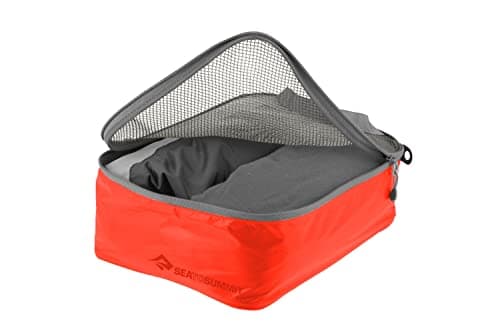
| Garment Mesh Bag | A mesh organizer. No weather spec at all | Given as a size name, not a volume |
| Ultra-Sil Stuff Sack | A stuff sack - unsealed, for compressing in a pack | Published in liters |
| Lightweight / Ultra-Sil Dry Bag | A roll-top dry bag. Waterproof, not a cube | Published in liters |
The last row is where most of the confusion lives, because "sea to summit waterproof packing cubes" is a search for a product that does not exist. The cubes are water-resistant; the dry bags are waterproof; they are different objects with different closures. We put the two mechanisms head to head in packing cubes vs dry bags, which features this brand's dry bags, and the short version is that a zipper is a row of holes and a roll-top is not an opening at all.
There is also a boxed Hydraulic three-cube set at published capacities of 0.75, 1.5 and 3.5 liters. We have not ranked it here, and the reason is procedural rather than a judgment on the product: the listing we were served carried no brand token in its title, which fails our own rule that a product title must match brand plus model before we will put a buy link on it. It exists; if you find it from the brand directly, the per-cube arithmetic is better than buying three individually.
Liters instead of inches: better, and worse
Why it is better.A liter is a real measure of what a soft bag holds. "Medium" is not, and even a published inch footprint tells you the shape of a cube rather than its capacity - two cubes with the same 14-by-10-inch face hold very different amounts depending on depth, which is why packing cube sizes is one of the hardest comparisons in this category to make honestly. The outdoor industry settled on volume decades ago. Sea to Summit brought that habit with it, and it means you can compare a 7-liter cube against a 7-liter dry bag or stuff sack directly - something you cannot do anywhere else in travel.
Why it is worse. You pack a suitcase in inches. The question you actually have standing in front of your open carry-on is whether two of these sit side by side across the floor, and a liter figure cannot answer it. Nor can we: no inch dimension was published on any of the three listings we were served on the day this page was written, so we have not printed one and we have not estimated one. If you are buying for a case with a known awkward width, or for a slim personal item where an inch decides it, that is a genuine reason to buy a brand that publishes a footprint instead.
Sold one at a time: the real decision
Nearly every cube brand sells you a box. Sea to Summit sells you a cube, the way it sells you a dry bag or a stuff sack, and that changes the arithmetic in both directions.
- In your favor: you buy the sizes you will use. The standard complaint about a 7-piece set is that you use three cubes and store four, and buying individually makes that impossible. If your packing is really one big cube and two small ones, you can own exactly that - and how many packing cubes do I need suggests most people need fewer than they own.
- Against you: there is no set discount, so a three-cube system assembled one bag at a time costs several times what a complete premium set costs, and many times what a budget set costs. A single 7-liter cube here costs more than an entire budget 7-piece set. That is the number to sit with before buying.
The honest conclusion: this brand makes sense as one or two cubes added to a system you already own, or as the cube for a specific bag that needs the dust and damp spec. It makes much less sense as the way you buy your first three cubes. If a complete premium set is what you want, the premium roundup ranks those, and Eagle Creek and Peak Design are the two direct comparisons at this level.
Who the dust-and-damp spec is actually for
"Dust- and water-resistant" is an unusual pair of words in the travel aisle and a very ordinary one in outdoor gear, and the first half is the part worth noticing. A hotel-to-hotel trip has no dust problem. A bag that spends time in a truck bed, on a trail, in the back of a jeep, on a boat deck or on a hostel floor does, and dust in clothing is the thing you notice three days later rather than at the time.
So the buyers this brand genuinely suits are the ones whose trips look like gear trips: overlanding, trekking with a stop in a city, dive or surf travel, anything where the bag is put down on ground rather than a luggage rack. Our backpacking roundup ranks cubes for that kind of trip, and the safari roundup is the one where dust is the stated problem rather than a bonus.
If your trips are flights and hotels, you are paying for a specification that will never be tested, and a cheaper treated cube or a plain premium set is the better buy - which is exactly the kind of trade how to choose packing cubes walks through in order.
Four questions, and the first two will decide it for most people.
Do you need a cube, or a cube system?
This is the question with this brand. One or two cubes added to what you own: a sound purchase. Three cubes bought individually as your packing system: you will spend several times what a complete premium set costs. There is no set discount here, and a single large cube costs more than an entire budget seven-piece set. Decide which purchase you are making before you look at prices.
Does your bag need the dust and damp spec?
If your trips are airports and hotels, no - and you are paying for something that will never be tested. If your bag gets put down on ground, rides in a truck bed, or travels on a boat, the spec is real and the first half of it (dust) is the part nobody else in travel addresses. That is the honest line between buying this brand and buying a cheaper treated cube.
Do you need to know the inches?
If you are buying for a specific awkward case or a slim personal item, buy a brand that publishes a footprint. No inch dimension was published on any of the three listings we were served, so neither we nor you can check these against a known width. In a standard carry-on this will not bite; in a tight compartment it will.
Is water the actual problem?
Then you want the dry bags, not the cubes. The Hydraulic cube is water-resistant because its closure is a zipper, and no treatment changes that. The same brand makes roll-top dry bags that are genuinely waterproof, and packing cubes vs dry bags sets the two mechanisms against each other and ranks both. Buying a Hydraulic cube to keep clothes dry in rain is the most expensive version of a common mistake.
And one note on the mesh bag
The Garment Mesh Bag is in this brand's range and is not a Hydraulic cube with the treatment removed - it is a mesh organizer with no weather spec at all, and it is cheaper for that reason. It is a good pick for a backpack, where weight and breathability matter more than a seal, and a bad pick for anyone who came to this brand for the Hydraulic specification. Mesh vs solid packing cubes is the general version of that trade-off.
Where selling singly actually makes sense
This brand's one-cube-at-a-time model is unusual enough to deserve its own page: individual packing cubes ranks every cube we know of that is sold alone, lists which brands only sell boxes, and names the three situations where buying one beats buying another set. These cubes also turn up as the fabric-and-capacity answer on both of our alternatives pages - Peak Design alternatives and Eagle Creek alternatives - because a published dust-and-water claim plus a capacity in litres is more than either original tells you.