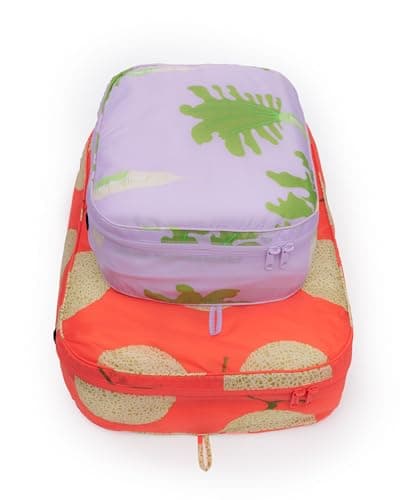
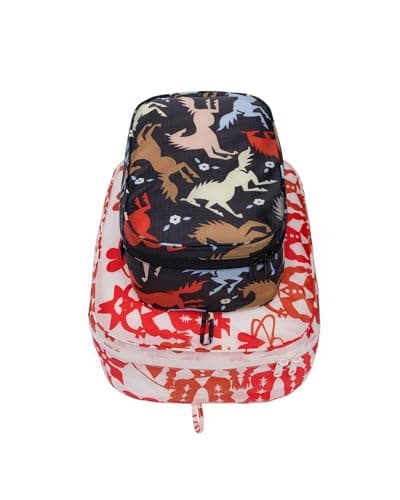
"Are BAGGU packing cubes worth it" is one of the questions people actually type, and the reason they type it is obvious the moment you look at a listing: the prints are loud, the brand is fashion-adjacent, and it is entirely reasonable to suspect you are paying for a pattern. The fair answer is more interesting than yes or no. The fabric is a real technical choice, not a cosmetic one — and the price is still hard to defend against the specific alternatives.
The ripstop argument
BAGGU builds these in ripstop nylon, and that is the substantive difference from the sets you find at the bottom of a search. Ripstop is woven with a reinforcing grid — visible as faint squares in the fabric — that stops a small puncture propagating into a long tear. That failure, a snag becoming a rip, is precisely how a cheap cube dies. Ripstop is also light for its strength, which is why it dominates in outdoor gear where every gram counts.
So the fabric is a real answer to a real problem. The complication is that ripstop is not exclusive to BAGGU — several mid-priced sets use it, including some that cost meaningfully less. The fabric justifies BAGGU costing more than a bargain set. It does not by itself justify BAGGU costing what it costs. Our guide to the best material for packing cubes covers how ripstop, plain polyester and coated fabrics differ and what each is worth paying for.
Standard set or large set?
The standard set is the one to start with: three cubes across the sizes that map to how most people sort — tops, bottoms, small items. The large set is two large cubes, which is a supplement rather than a system. If you pack bulky layers or check a bag, the large set is the better second purchase; as a first purchase it leaves you organizing your whole suitcase in two big boxes, which is barely organizing at all. If you are unsure what those size words translate to in practice, packing cube sizes maps the common footprints to what actually fits inside.
The honest comparison
Against Eagle Creek, BAGGU loses on the thing that matters most at this price point: warranty. The Pack-It range sits in similar territory and is backed for the long term, which is a stronger argument than fabric alone. Against Bagail or Amazon Basics, BAGGU wins on fabric and finish and loses badly on price — those sets organize a bag identically for a fraction of the money, in thinner material. Against Peak Design, BAGGU loses on engineering: Peak Design build compression into the cube itself, which is a functional capability BAGGU does not offer at any price.
So — worth it?
Yes, if you want light, genuinely well-made cubes and the prints are part of the appeal rather than something you tolerate. That is a real reason to buy and it does not need apologizing for; cubes you like are cubes you use. Also yes if weight is your binding constraint, because the ripstop is legitimately light.
No, if you are optimizing cost per cube — a Bagail set does the job for far less. No, if you want the set to outlast a decade of hard travel — buy the warranty instead. And no if your problem is space rather than order, because no regular cube solves that and compression cubes do. Where BAGGU sits against the whole field is set out in the best packing cubes roundup.