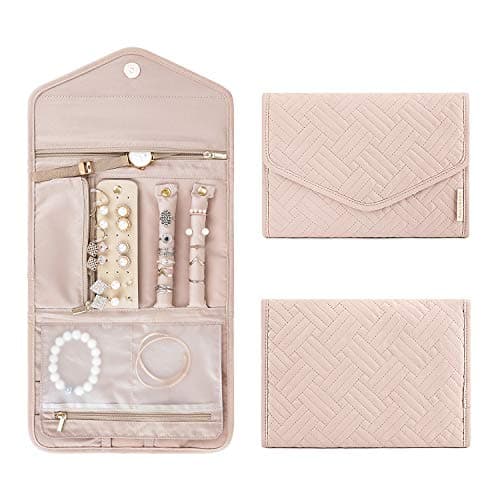
Search for a travel jewelry case and you get six genuinely different products wearing the same label: a soft fold-over roll, a two-layer zip box, a binder of clear pouches, a hooked necklace panel, a full-length hanging organizer, and a rigid little column with a hard shell. They are not competing versions of one thing — each solves a different problem, and buying the wrong shape is the most common way this purchase goes wrong. So this page sorts the shapes first, then ranks inside them.
The six shapes, and what each one is actually for
- The fold-over roll. A flat quilted panel with a few defined compartments that folds in on itself and buckles or zips shut. Packs better than anything else here because it has almost no thickness. Right for a normal amount of jewelry on a normal trip.
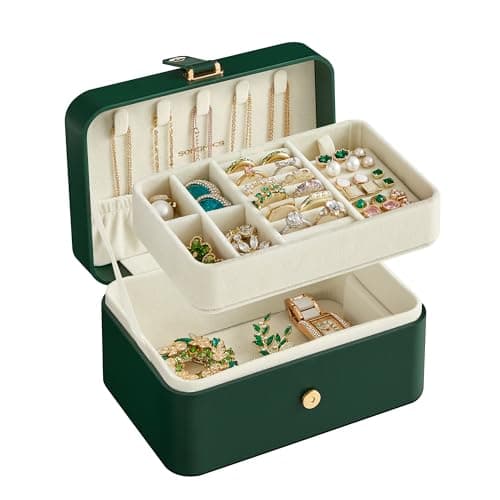
- The two-layer zip box. A clamshell with a lid partition, a stud plate and a ring cushion. The best small-piece organization of any format — ring grooves and stud holes are things a roll cannot really do — at the cost of taking up rigid, box-shaped space.
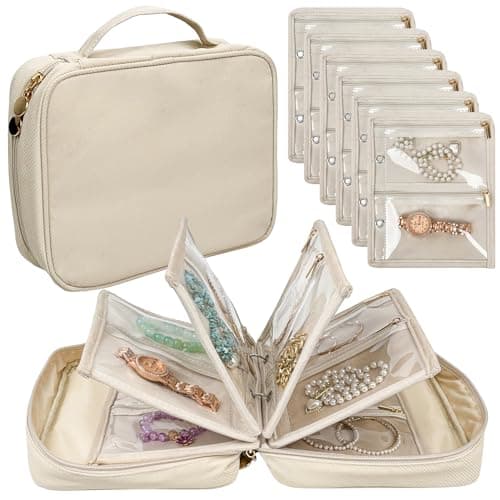
- The pouch binder. Loose-leaf pages of individually zipped clear pouches. Every piece gets its own sealed compartment, which is the most complete answer to tangling and scratching there is. It is also the heaviest and bulkiest way to solve it.
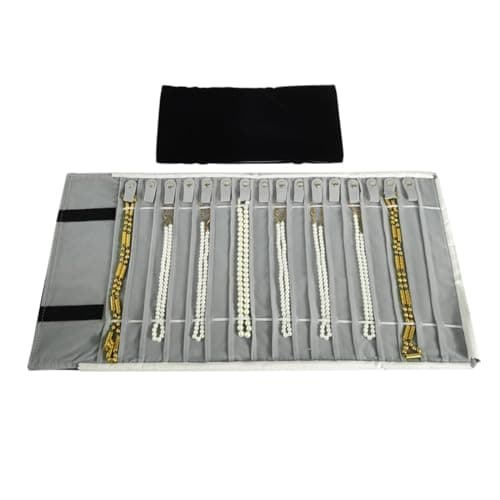
- The necklace roll. A row of hooks on a velvet panel that rolls or folds. Does one job — long chains, individually hung — better than any general-purpose case, and does nothing else at all.
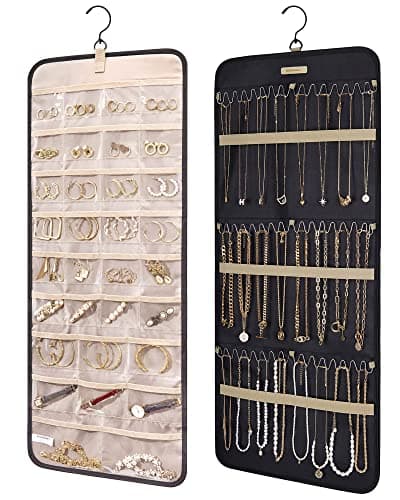
- The hanging organizer. A long two-sided panel of pockets and hooks with a hanger at the top. Built for the trip where you unpack into a room, and it doubles as wardrobe storage between trips, which no other shape here does.
- The hard-shell case. A rigid box, usually small. The only format that protects against crushing rather than just scratching. Capacity is always the price you pay for the shell.
What a jewelry case actually protects against
It is worth being precise, because the listings are not. A travel jewelry case solves three things: chains tangling into each other, small pieces getting lost inside your own bag, and polished surfaces scratching against other polished surfaces. Those are real problems, and an inexpensive organizer genuinely fixes all three.
It does not solve theft, and nothing on this page should be read as security. It is not crush-proof either, with the partial exception of the one hard-shell pick — a soft roll under a packed suitcase is protecting your earrings from your necklace, not from the weight of the bag on top of it. And it does nothing about plating wearing thin, tarnish, or a stone working loose in its setting. Anything you would be genuinely upset to lose belongs on you rather than in any bag, which is what the TSA advises as well: keep valuable items such as jewelry with you and out of checked baggage, and you can ask to be screened privately with them if you would rather not do it on an open table.
How we ranked them
Five criteria, weighted in this order. Tangle control — how many chains get their own hook, hole or pouch instead of sharing a strap. Capacity — the compartment count and type the listing publishes, read against a realistic week of packing. Protection — lining material, shell material and rigidity as described by the maker. Packability — footprint and weight, because a jewelry case competes for space with clothes that have nowhere else to go. Value — price against what you actually get, not against the brand on the label.
Every score is a judgment from documented specs and listing detail rather than a measurement we took — we do not run a testing lab, and our methodology page says so in those words. Every dimension, weight and compartment count on this page traces to the product's own Amazon listing, and each is named in Sources at the bottom. Prices are pulled live from Amazon and date-stamped, so nothing here anchors you to a number that expired two seasons ago.
Who should skip a dedicated jewelry case
- Anyone packing one pair of studs and a watch. A zip pocket in your toiletry bag does that job. Buy the organizer once the collection is big enough to tangle.
- Anyone hoping a case makes checked baggage safe. It does not, and the advice above is the whole answer: valuables travel with you.
- Anyone tempted to use a spare packing cube instead. A cube is an unlined fabric box with one big compartment, so everything inside it finds everything else. It is the wrong container for the same reason it is wrong for cables — the point what to pack in each cube makes at length.
- Anyone who travels in one necklace. Fasten the clasp and thread the chain through a drinking straw before you pack it. It costs nothing and it does not tangle.
The buyer's guide: what to check before you click
Count your pieces by type, not in total
A claim like “holds 24 pieces” tells you almost nothing, because these cases are not general-purpose volume. What matters is how many of each kind you carry. Six necklaces means you need six anchor points, and the difference between a case with one buckled strap and a roll with sixteen hooks is the entire purchase. Eight pairs of studs means you want a perforated plate, which only the two-layer boxes here have. Four rings means grooves. Write those three numbers down before you shop and the field narrows itself in about a minute.
Closure is the specification people skip
There are three closures across this page and they are not equivalent. A zip that runs all the way around — the ProCase, and the LingLingo binder's outer shell — cannot be levered open by whatever is pressing on it inside a case. Snaps, like the VLANDO's, are secure enough because they hold a rigid shell that keeps its own shape. A magnetic lid, like the SONGMICS, is the one to think twice about if the case will ride loose in a tote rather than buried in a suitcase: magnets hold against gravity, not against a corner catching the lid. It is the same logic that decides zip versus drawstring on a shoe bag, and it matters more here because the contents are smaller.
Soft packs around; rigid protects
A soft roll has no fixed shape, so it slides down the side of a packed case or lies flat under the lid and costs you effectively nothing in usable volume. A rigid box has to be given its own rectangle, the same way a shoe does. Neither is better in the abstract — it depends on whether your bag has spare corners or spare gaps. If you already pack with cubes you know which one you have: a case packed tight with cubes has gaps at the edges and no rectangles left, which is an argument for the roll.
Velvet, flocking and clear PVC are doing different jobs
The interior material is not decoration. Velvet and flocking are soft enough not to scratch a polished or plated surface, which is why almost every pick here puts one or the other against the metal — the SONGMICS, the SCIKHEFT roll, the VLANDO and the binder's inner pages all specify it. Clear PVC does the opposite job: it is there so you can see what is in a pocket without opening it, which is what makes the LingLingo binder and the BAGSMART hanging organizer quick to use. A case that uses both — a clear window over a velvet page — is not overengineered, it is two separate functions doing two separate jobs.
Pack it where nothing rigid can press on it
Wherever you land on the format question, the placement rule is the same and it is free. A jewelry case goes in the middle of the bag surrounded by clothes — not at the wheel end where the impacts are, not flat against the shell, and not under a shoe bag. Soft things packed around a small case do more for it than the case does for itself. That is the same principle behind how to pack a suitcase with packing cubes, applied to the one item in the bag with the worst weight-to-value ratio.
The short version
For most people on most trips the BAGSMART roll is the buy: five compartments, half an inch thick, packs into space you were not using. Want the same job done for the least money, with better small-piece storage and a proper zip? The ProCase two-layer box. Own a lot of jewelry, or travel with mixed and delicate pieces? The LingLingo binder's 24 zipped pouches, minus the pages you do not need. Chains specifically? The SCIKHEFT 16-hook roll. Staying somewhere a week with a real collection? The BAGSMART hanging organizer. Studs and rings above everything else? The SONGMICS tray, as long as it travels inside a suitcase rather than loose. And if what you actually want is a shell that survives being sat on, the VLANDO Viaggio is the only pick here that offers one — provided you accept that it holds three small compartments and no more. The rest of the travel organization hub covers the containers for everything else in the bag.
The method, once you have the case
A case solves separation; the rest is technique. How to pack jewelry for travel covers the three distinct failures - chains knotting, studs vanishing, stones scratching - the fixing-point trick that stops tangling for free, and what TSA says about keeping valuables out of checked baggage.