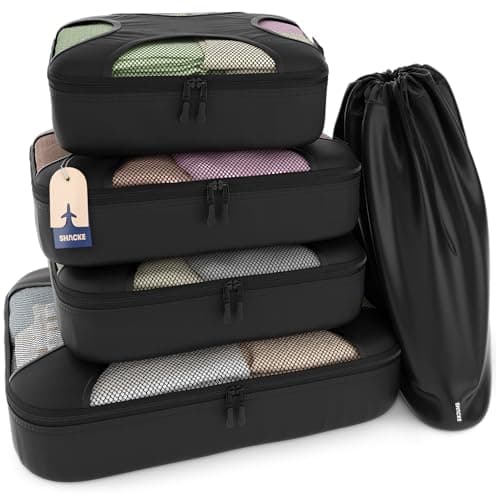
The short version: the Shacke Pak is a good, plain, deep cube set with an unusually useful laundry bag, and the reason to buy it is capacity rather than cleverness. There is no compression zipper, no divided clean-and-dirty compartment and no weatherproof shell. What there is: four cubes deep enough to swallow a real packing load, stitching built to keep them square when they are full, and a dirty-clothes bag big enough that you will actually use it. If that is the problem you have, this set has been solving it, and Shacke dates the cross-web stitching it is built around to 2014.
Two things this review will not do. It will not tell you we packed with these cubes for a year - nobody here has, and our methodology says so plainly. And it will not print a space-saving percentage, because a set with no compression mechanism cannot save space and any number claiming otherwise would be invented. What follows is the published specification, read off the brand's own listing, and the judgments that follow from it.
Is it a 4 set or a 5 set? Both - and it is the same product
This is the single most common confusion in the brand's own search results, and it is worth clearing up before anything else. Amazon sells it as the 5 Set. Inside are four cubes and one laundry bag. So the people searching "Shacke Pak 4 set" and the people searching "Shacke Pak 5 set" are, in almost every case, looking at the same box and counting different things: four packing cubes, five pieces of fabric. There is no separate four-cube-only product to hunt down, and if a listing promises one at a lower price, it is worth checking what is missing.
What is in the box, as published
| Piece | Published footprint | Depth |
|---|
| XL cube | 17.5 x 12.75 in | 4 in |
| Large cube | — | 4 in |
| Medium cube | — | 4 in |
| Small cube | 11 x 6.75 in | 4 in |
| Laundry bag | 20.5 x 15.75 in | Flat sack |
The two blank rows are deliberate. The listing describes the set as running "XL to Small" and publishes the two end sizes; we have never read separate dimensions for the two cubes in between, so we print none. That is the same rule we apply everywhere on this site, and it is why our packing cube sizes guide exists at all - no brand standardizes small, medium and large, and the only defense is comparing published footprints rather than labels.
Four inches deep is the whole design
If you take one thing from this review, take this. Most inexpensive cube sets are about three inches deep. Shacke publishes four across the whole set, and that extra inch changes how the set behaves in three ways.
It holds more per cube, so you carry fewer cubes. A four-inch cube at the XL footprint takes a serious share of a packing load in one container. The practical effect is that a trip which needs five shallow cubes often needs three of these, and three containers are faster to pack, faster to search and faster to repack than five.
It stacks in two layers in a deep case, not three. A hard carry-on is commonly quoted at around nine inches deep, and two four-inch cubes plus the fabric come in under that with room for a flat layer on top. Depths vary by bag and the wheel wells and handle tubes eat into the usable figure, so check your own case rather than trusting a category average - but the arithmetic of two layers rather than three is the reason this set feels orderly in a checked bag and a deep carry-on.
It is the wrong shape for a slim bag. This is the honest cost. A four-inch cube in an under-seat tote or a slim laptop backpack is a brick: it will not lie flat and it wastes the thin space it cannot fill. If that is your bag, a low-profile set is genuinely the better tool, and the personal-item roundup ranks for exactly that constraint.
Cross-web stitching: what it does, and what it does not
Shacke makes a point of its cross-web stitching, and the claim is more specific than marketing usually is, so it deserves a specific reading. The failure it addresses is real: when a cube is packed full, the pressure pushes outward at the seams, the sidewalls bow, and a bowed cube stops being a box. Once two cubes stop being boxes they stop stacking, and the whole point of the system is gone. Reinforced seams are the mechanism that keeps the sidewall square under load.
What it is not is a warranty, a lifetime guarantee or evidence of a service life. We publish no durability figure for this set or any other, because there is no repeatable way for us to measure one - how long do packing cubes last sets out what can honestly be said about cube lifespan. If a stated warranty is what you want behind the purchase, that is an argument for Eagle Creek, not for this set, and it is a fair reason to pay more.
The laundry bag is the best bundled one, and it still only separates
At a listed 20.5 by 15.75 inches, this is the largest bag bundled with any cube set we have ranked. Size matters here more than it sounds: a small bundled laundry bag fills on day three and then the worn clothes go back among the clean ones, which defeats the entire purpose. This one holds a week of a single traveler's laundry.
The honest limit: it is a plain fabric sack. The listing claims no coating, no liner and no seal, so what it does is separate worn clothes from clean ones. It does not contain damp, it does not control smell, and a wet swimsuit does not belong in it - that needs a lined wet bag, which is a different product. How to pack dirty clothes covers the damp case properly, and the bundled-bag roundup ranks this set against the five alternatives, including the divided clean-and-dirty cubes that solve the problem a different way.
No compression, and why that is not a flaw
Plenty of reviews treat the absence of a compression zipper as a miss. It is not; it is a category choice, and conflating the two is how people buy the wrong thing. A plain cube sorts your clothes into findable blocks and keeps them that way. A compression cube does that and then squeezes trapped air out of soft items with a second zipper. Those are different jobs with different costs - compression adds fabric, weight and creasing pressure, and it does nothing at all for shoes, books or toiletries.
The rule we keep coming back to is this: compression buys volume, never weight. If your bag is over an airline's weight limit, a compression set will not help you and neither will this one. Compression vs regular packing cubes is the full argument, and do packing cubes save space is the honest yes-and-no. Decide which problem you have, then come back to this page.
The other thing Shacke sells, briefly
A fair slice of the brand's search traffic is looking for a Shacke travel wallet rather than cubes - the hidden belt wallet and the neck pouch are both still sold. They are a different category and this review does not rank them, so we will not pretend to have assessed them. If a passport-and-cards organizer is what you are actually shopping for, our travel document organizer roundup is the page that does that work properly.
Who should not buy this set
Three readers should buy something else, and none of them is a criticism of the product. If your case is already full and you need room back, you need compression and this set has none. If your bag is a slim personal item or a thin daypack, four inches of depth works against you. And if you want a stated warranty standing behind the purchase, a premium brand is a reasonable thing to pay for. Everyone else - a checked bag or a deep carry-on, a full trip's clothes, and a wish to stop digging - is exactly who this set is for.
Almost everyone weighing the Shacke Pak is weighing it against three specific alternatives, so here is the decision in the plainest terms we can put it.
Shacke Pak vs a high-count budget set
The eight- and ten-piece sets win on sticker price and piece count and lose on depth. If you want the most zippered bags for the least money, they are the right answer, and the Bagail review covers the best-known one. If you would rather pack three deep cubes than six shallow ones, Shacke is the better shape. Count is not capacity, and a set of ten small bags is not more storage than a set of four big ones.
Shacke Pak vs a compression set
This is not a close call once the question is framed properly. If your clothes fit and you want them organized, buy plain cubes. If your clothes do not fit, buy compression - no amount of tidy sorting creates volume. The compression roundup ranks the sets that do that job, including ones that bundle a laundry bag too.
Shacke Pak vs a premium set
What a premium set buys is a lighter and better fabric, cleverer features such as a divided compartment or a weatherproof shell, and in some cases a stated warranty. What it does not buy is more room. If the extra outlay is comfortable and you travel constantly, it is defensible; if you travel twice a year, this set does the same core job for a good deal less. Our how to choose packing cubes guide walks the whole decision in order.
One practical note on using it
A four-inch cube rewards a different packing technique than a shallow one. Fill it in vertical files rather than flat stacks - clothes stood on edge like books - so you can see and remove one item without unpacking the layer above it. The method is in how to fold clothes for packing cubes, and it matters more on a deep cube than a flat one. If you are buying this set for a specific trip, the length that uses the bundled laundry bag hardest is ten days - how to pack a carry-on for 10 days is built around the single mid-trip wash that bag exists for.