Search for travel bottles and every single result claims to be TSA approved. None of them are, because that is not a thing the TSA does — it approves no bottle, no jar and no bag. What the TSA actually publishes is a rule about containers, and understanding it correctly is the difference between buying the right bottles and buying bottles that cause an argument at a checkpoint.
The rule, stated properly
Liquids, aerosols, gels, creams and pastes in a carry-on must be in containers of 3.4 ounces (100 milliliters) or less per item, and they must fit in one quart-sized bag. Two consequences follow, and both are routinely misunderstood.
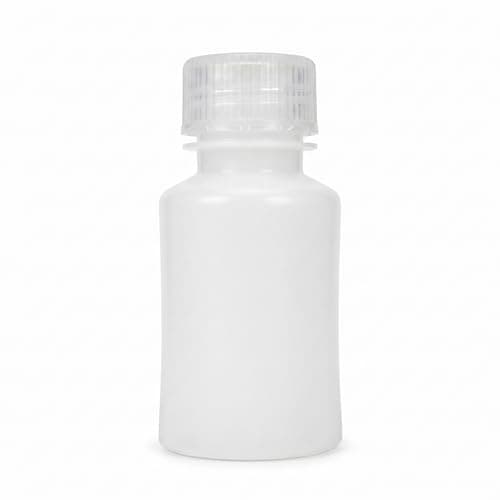
First, the limit is the container's capacity, not the amount of liquid in it. A half-empty 8-ounce shampoo bottle with two ounces left is not allowed, and this is the single most common way people lose a product at security. The bottle is the thing being measured. Second, the quart bag is the real constraint on how much you can take — roughly six to nine bottles of this size, depending on shape. That is why squat bottles like the United Scientific HDPE ones pack a quart bag better than tall thin ones, and why the number of bottles in a set matters less than whether they tessellate.
A third point worth knowing: 3.4 ounces is a ceiling, not a target. A bottle marketed as 3.4 ounces sits exactly on the line, and some are moulded slightly generously. A 3-ounce bottle has margin, which is a small reason to prefer the 3-ounce sets here over the 3.4-ounce ones for no real loss of capacity. Medications are exempt from the limit entirely, which is a separate subject covered in our pill organizer roundup. And none of this applies to a checked bag.
The three shapes, and what each is for
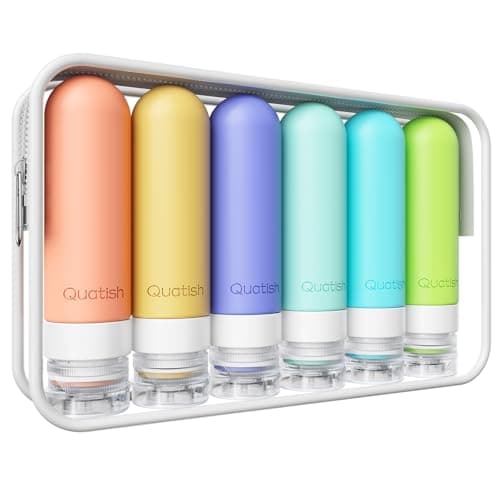
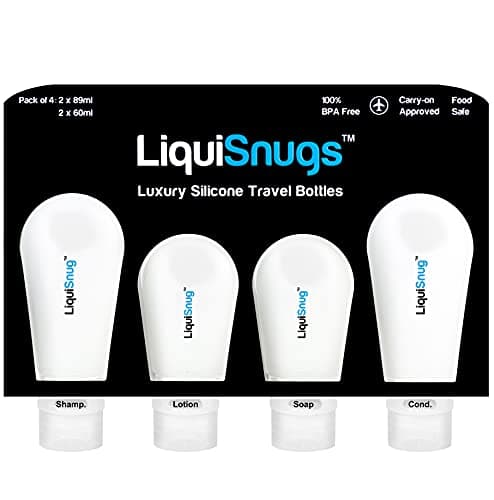
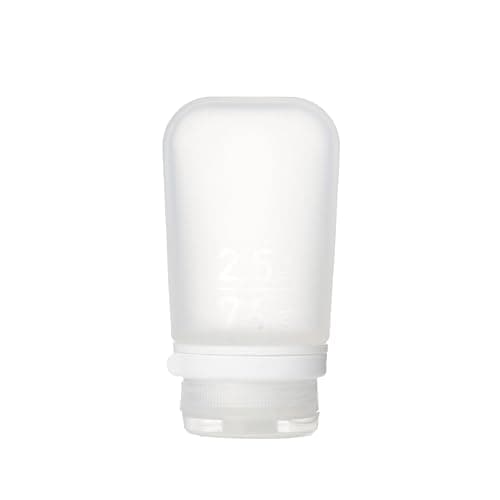
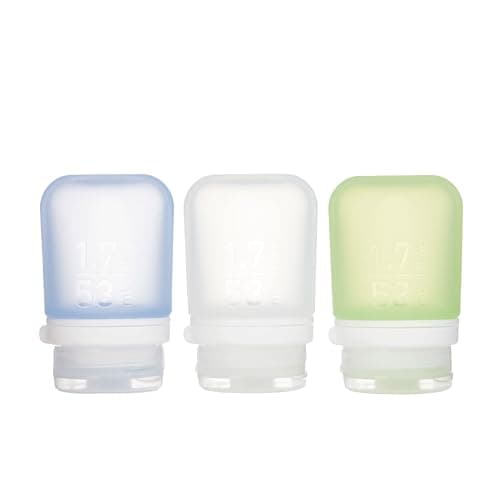
- The silicone squeeze tube. Soft walls you can squeeze flat to get the last of a product out, a wide mouth that takes a cleaning brush, and a flip-top or locking cap. The default for shampoo, conditioner and body wash. The GoToob+, Quatish and LiquiSnugs sets are all this shape.
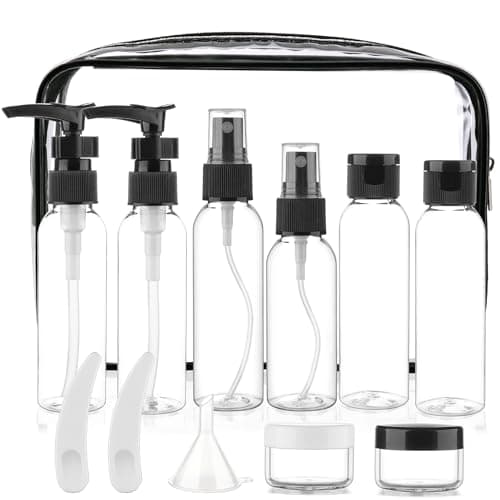
- The rigid bottle. Hard HDPE or PET walls and a screw cap over a narrow mouth. A structurally better seal and a shape that stands up, at the cost of not being able to squeeze the dregs out. The United Scientific set is this shape, and the pumps and sprays in the Cosywell kit are variations on it.
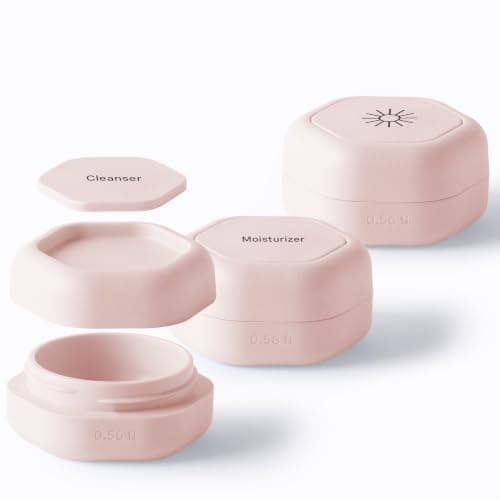
- The hard capsule or jar. A wide shallow pot with a screw or magnetic lid, for everything you scoop rather than pour — moisturizer, balm, clay, powder, a solid bar. The Cadence capsules are this shape and the Cosywell kit includes two small jars. No squeeze bottle does this job well.
Why bottles leak, and what actually fixes it
Almost every leak has one of three causes, and only one of them is the seal's fault. The most common is pressure: cabin pressure drops in flight and the air trapped in a part-full bottle expands against the cap. The free fix is to squeeze the air out of a soft bottle until the liquid reaches the neck before you cap it — the same trick our how to pack a toiletry bag guide leads with, and the reason silicone beats rigid plastic on a plane despite the worse closure.
The second is a cap pressed open under load. A flip-top with something heavy packed on it opens, and no amount of seal quality prevents that. This is the exact problem the GoToob+ LoopLock collar solves and the reason it is our top pick — it is also why a screw cap, as on the United Scientific bottles, is inherently safer than a flip-top. The third is overfilling, which leaves no room for the contents to move and forces product past the seal the first time the bottle is squashed. Fill to the shoulder, not the brim.
Whatever you buy, double-bag the liquids. No bottle is a sealed vessel and no toiletry bag is either — the point the toiletry bag roundup makes about coated linings applies here from the other direction. A zip bag inside the toiletry bag is what turns a burst bottle into a contained mess.
How we ranked them
Five criteria, weighted in this order. Leak resistance — closure type first, because that is the failure mode that ruins a bag. Dispensing — whether you can get a controlled amount out one-handed with wet hands, which separates a cross-slit or a pump from an open hole. Capacity vs the rule — published capacity read against the 3.4 ounce ceiling, with margin scored as a positive and sitting on the line scored down. Refill and clean — mouth width, whether a brush fits, and whether it survives being reused rather than thrown away. Value — cost against what you get, which for sets we also publish as a live per-bottle figure you can check yourself.
Every score is a judgment from documented specs and listing detail rather than a measurement we took — we do not run a testing lab, and our methodology page says so in those words. Every capacity, dimension and material claim traces to the product's own Amazon listing, named in Sources. Where a listing contradicts itself — LiquiSnugs publishes a 3.4 ounce size field against its own 3 oz and 2 oz description, and its dimensions are the package — the page says so. Leak claims are attributed to the maker and never presented as our test result. Prices are pulled live from Amazon and date-stamped.
The buyer's guide: what to check before you click
Buy 3 ounces, not 3.4
There is no meaningful capacity difference and there is a meaningful margin difference. A 3-ounce bottle is unambiguously inside the rule; a 3.4-ounce bottle is exactly at the ceiling, printed on a moulding that was not made to laboratory tolerance. The Quatish and United Scientific sets are both 3 ounces, and the GoToob+ sizes at 1.7 and 2.5 ounces have margin to spare. This costs you nothing and removes the only genuine risk in the category.
Count what fits the quart bag, not what is in the pack
An 18-piece bottle set sounds generous until you remember everything has to fit one quart-sized bag alongside your toothpaste and sunscreen. Six to nine bottles is the real ceiling, and shape decides where in that range you land: squat cylinders like the United Scientific bottles tessellate, tall thin tubes waste the corners. Buying a bigger set than the bag holds is buying bottles for a drawer.
Match the vessel to the viscosity
This is the decision most people get wrong. Thin liquids — shampoo, body wash, micellar water — are happy in anything, and a pump or spray is a genuine upgrade. Thick liquids — conditioner, heavy lotion — need a soft squeeze tube with a wide mouth, because a narrow rigid bottle will keep a third of the product forever. Creams, balms, clays and powders need a wide shallow pot, which is the Cadence capsules or the Cosywell jars, and putting them in a squeeze tube is simply the wrong choice. And oils are their own problem: the Quatish listing explicitly advises against oil-based products, which is unusually honest for the category.
Closure beats seal
If leaks are your worry, rank the closure mechanism above any leakproof claim. A locking collar, as on the GoToob+, cannot be pressed open by a packed bag. A screw cap, as on the United Scientific bottles, has to be rotated to fail. A flip-top only has to be pushed. Every set here claims to be leakproof and several cite drop tests; none publish an independent result, and we have not run one. The mechanism is the thing you can actually verify by looking at it.
Label them, or buy ones that are labeled
Three identical clear bottles of clear liquid is a solved problem that people keep re-creating. LiquiSnugs ships adjustable labels, Cadence ships interchangeable icon tiles, the GoToob+ has a textured patch you can write on, and Cosywell includes a sticker sheet. Use them on day one. The alternative is washing your hair with body wash in a dark hostel bathroom, which is a small misery that is entirely avoidable.
Decanting is a chore; make it a one-time one
The reason people end up buying hotel miniatures forever is that refilling bottles over a sink is irritating. A funnel and a spatula — both in the Cosywell kit, both a couple of dollars separately — turn it from a mess into a two-minute job. Then keep the bottles permanently filled between trips, the way the two-kit toiletry system works: fill once, top up occasionally, never start from scratch.
Where it all goes in the bag
The quart bag goes somewhere you can pull it out in one movement, because at the checkpoint it has to come out. Inside the suitcase, the toiletry bag holding it goes low and near the wheels where weight helps rather than crushes, with cubes on top — the same loading order as how to pack a suitcase with packing cubes sets out. Nothing liquid ever goes above something you would mind losing.
The short version
For most people, the Quatish 6-pack at 3 ounces: enough bottles to fill a quart bag, margin under the limit, and a dispensing cap that does not dump product. Want the one bottle that genuinely cannot be pressed open in a packed bag? The humangear GoToob+, as a 3-pack if you need a set or as a single Medium if you only want to protect one product. Tired of flip-tops entirely? The United Scientific HDPE six, with screw caps and a shape that stands up. Showering somewhere with no shelf? LiquiSnugs, for the suction pads and the labels. Carrying creams and balms rather than shampoo? Cadence capsules, accepting that you are paying a lot for 0.56 ounces. Starting from nothing and want pumps, sprays and jars in one go? Cosywell's kit, remembering it is eight containers and not thirteen. And whatever you buy, squeeze the air out before you cap it and put the lot in a zip bag. The rest of the travel organization hub covers the containers for everything else in the bag.