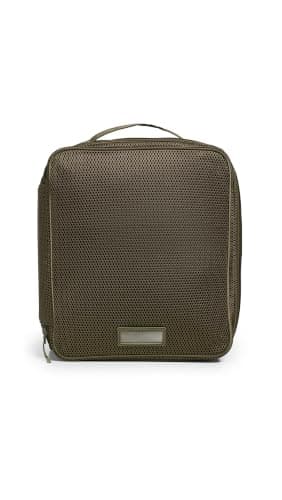
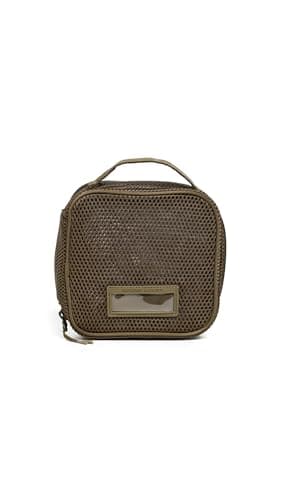
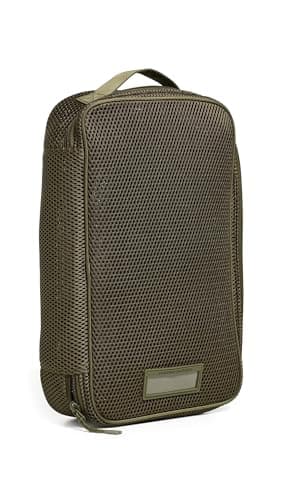
Almost every packing cube on this site is sold as a set. Dagne Dover sells the Roma Cube one size at a time, and that single commercial decision changes how you should evaluate it. You are not choosing a set and hoping the sizes suit you — you are building a system one cube at a time, at a price per cube that is among the highest we track. That can be a genuinely good deal if you buy the two sizes you use and skip the ones you would not, and a bad one if you buy three and discover a boxed set would have cost less.
What a structured cube actually does
The Roma Cube's defining feature is that it holds its shape. A conventional mesh-and- polyester cube is a soft bag: fill it two-thirds and it slumps, and a slumped cube does not stack, does not sit square against the wall of a case, and lets the things around it shift. A structured cube keeps its rectangle whether it is full or half empty, which means your packing stays where you put it for the whole trip rather than settling into a heap by day three.
That is a real benefit and it has a real cost: structure is material, and material is weight. In a weight-limited carry-on, a set of structured cubes is a measurable share of your allowance spent on the containers rather than the contents. It is the same trade-off that runs through the whole category — see the best material for packing cubes for how fabric choice drives weight, durability and shape retention.
Which size to buy first
The medium, in almost every case. It holds a useful quantity — a stack of tops, a few days of mixed clothes — without dominating a cabin bag, and it is the size where structure pays off most clearly relative to its weight. The large is the right second purchase if you pack bulky layers or check a bag; the small is the right third, for underwear and accessories. Buying in that order means each cube earns its place before you commit to the next, which is the one real advantage of a brand that sells singly.
The cost-per-cube problem
Here is the honest arithmetic. Because the Roma cubes are sold individually, the per-cube figure on each card above is the price — there is no set discount doing the work. Buy all three and you will have spent more than most complete sets on this site cost, for three cubes instead of five or eight. That is not automatically wrong: three cubes you chose deliberately beat eight cubes where you use four. But it does mean the value case rests entirely on you being disciplined about which sizes you actually need. If you are not sure yet, a cheap multi-size set is a better way to find out which sizes you use.
Who it is for, and who it is not
It is for the packer who already knows their system — who can say "I use one medium and one small on every trip" and would rather own two excellent cubes than eight adequate ones. It is also for anyone who values a cube that looks like a piece of luggage rather than a gym bag, which is a fair thing to care about.
It is not for first-time cube buyers, because you learn which sizes you need by owning several and noticing which ones stay empty. It is not for weight-limited carry-on packers, because structure costs grams you may want for clothes. And it is not for anyone with a space problem rather than an organization problem, because like every cube here it does not compress — that job belongs to the compression sets.
The verdict
The Roma Cube is a very good structured cube sold in a way that rewards people who already know how they pack and punishes people who do not. Start with the medium. Add the large if you pack bulk, the small if you need an accessories cube, and stop there. If that discipline sounds unlikely, buy a set instead — the main roundup ranks the field on exactly that basis.