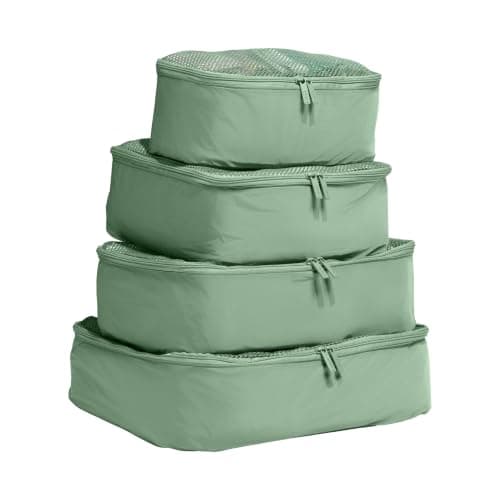
Away is a luggage company that also sells cubes, and that ordering matters. Most packing cubes are made by companies that make only packing cubes; the Insider set exists because people who bought an Away suitcase wanted the organizers that go inside it to look like they belong. That is a completely reasonable thing to want, and it is also the honest frame for this review — because assessed purely as fabric boxes with zips, a four-cube set at this price is competing against sets that cost a fifth as much and do the same job.
What you actually get
Four cubes across two sizes. That is a deliberately restrained spread: where budget brands push eight- and ten-piece sets, Away sells the number of cubes a considered packer actually uses — one or two large for tops and bottoms, one or two small for underwear and accessories. The cubes are light, which matters more than it sounds. Cubes are dead weight in a weight-limited bag, and a heavy eight-piece set can quietly cost you a kilo of allowance before a single shirt goes in.
What you do not get is compression. These are regular cubes: they sort and shape, they do not reclaim volume. That is the correct design decision for a set built to slot neatly into a hard-shell case where the lid already does the compressing, but it does mean the set cannot solve a space problem. If space is what you are short of, this is the wrong product category entirely and the compression cube roundup is the page you want.
The value math, stated plainly
The honest comparison across cube sets is cost per cube — live price divided by the number of pieces — because a "cheap" three-cube set can cost more per cube than a pricier eight-piece one. The card above computes that figure from the live Amazon price the moment you load this page. It lands, unsurprisingly, at the premium end of everything we track, several times the figure for a Bagail set and comfortably above the mid-range names. We compute that number the same way for every set on this site, which is what makes the comparison mean anything — see how we research and score.
Where the premium is real, and where it is not
It is real in finish and in weight. Zip pulls that run smoothly rather than catching, binding that does not fray at the corners after a season, fabric that is light without feeling like a carrier bag — these are genuine differences you notice every time you open the cube, and they are exactly what separates a $12 set from a good one. They are also what you get from mid-range sets at a third of the price.
It is not real in function. A cube holds folded clothes in a rectangle. There is no mechanism here that a $20 Amazon Basics set lacks, no compression zipper, no clever structural trick, no material with a property the cheap sets do not have. Anyone telling you a premium cube organizes better is selling something. What it does is organize identically, for longer, while looking like it belongs in your suitcase.
Away versus the obvious alternatives
Against Monos, the closest direct-to-consumer luggage rival, the trade is compression: the Monos compressible set squeezes and this one does not, so if you are choosing between two luggage-brand sets and space matters at all, Monos wins that specific argument. Against Eagle Creek, the trade is warranty and heritage — the Pack-It range is built for people who will still be using it in a decade, and it is backed accordingly. Against Bagail or Amazon Basics, the trade is honest and simple: those sets do the same job for a fraction of the money and look like what they cost.
The verdict
Buy the Away Insider set if you own Away luggage, or if a coherent-looking suitcase is worth real money to you. Both are legitimate reasons and neither needs defending. Do not buy it expecting a functional upgrade, because there is not one — the set organizes exactly as well as sets costing far less, and a little better than the very cheapest. If you want the field ranked on function per dollar instead, that is the best packing cubes roundup.