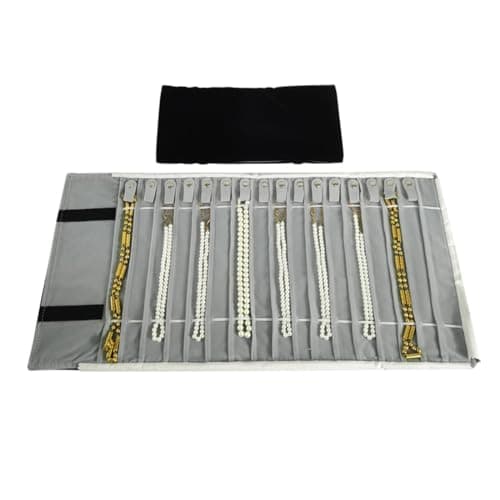
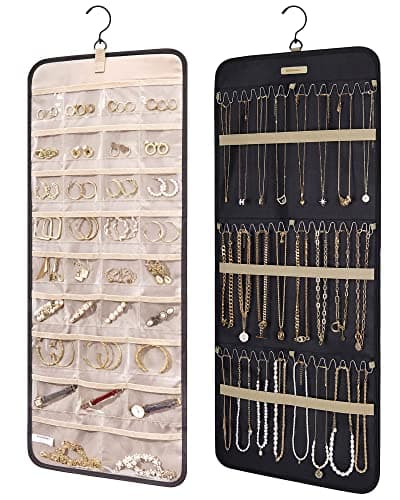
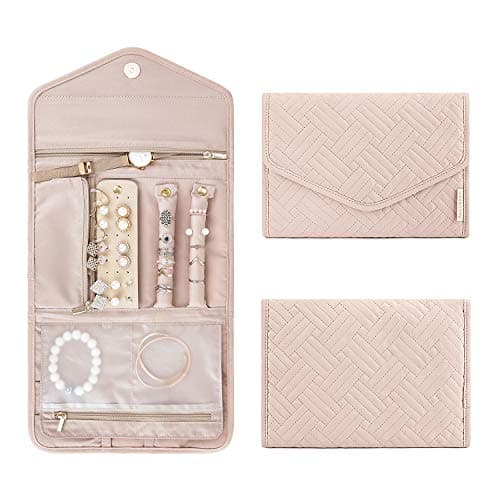
The verdict first. The BAGSMART Travel Jewelry Organizer Roll is the one to buy, and it is also the budget pick — the cheapest soft jewelry organizer in our catalog happens to win the two numbers that define the format, publishing 1.5 cm flat and 0.26 lb empty. It is for the traveler packing a trip's worth of jewelry into an already-full case. If your problem is specifically necklaces, buy the SCIKHEFT necklace organizer instead for its sixteen published hooks; if you are packing a lot and will have a wardrobe to hang things in, the BAGSMART hanging organizer publishes the best capacity per ounce on the page.
And now the finding, which is the reason this page exists separately from our jewelry case roundup: "jewelry roll" is sold as one format and the published dimensions show it is two.
The arithmetic that splits the category in half
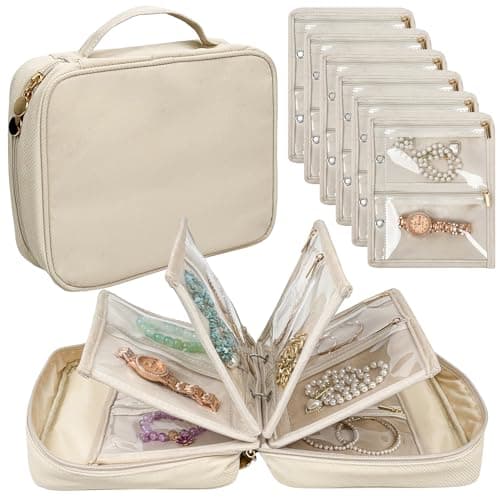
Take the two products at the ends of this page and compare only what their listings publish. The BAGSMART roll publishes 1.5 cm of thickness and 0.26 lb. The LingLingo binder publishes 9 x 7.25 x 3 inches and 0.95 lb. Multiply out the published outside dimensions and the binder occupies roughly six times the volume of the roll, at about three and a half times the empty weight. Those multiples are our arithmetic on published figures, not measured capacity — but the conclusion does not need precision: a three-inch-thick object weighing nearly a pound is not a roll, whatever the category page calls it.
That matters because the entire promise of a roll is disappearance. You buy one so that jewelry stops being a thing you allocate space for — it goes down the side of the case, in the laptop sleeve, under a folded layer. A container that is six times the volume does not do that; it is a small case, and it should be judged as one. So the ranking above is ordered on thinness and weight first, and the binder is ranked last with its virtues intact: it is the best thing here for earrings and pairs, and it is the wrong thing here if you are packing light.
Capacity per ounce, which nobody publishes and everybody needs
The second piece of arithmetic is more flattering, and it belongs to the hanging organizer. BAGSMART publishes up to 42 necklaces at 0.55 lb empty. The binder publishes 24 pouches at 0.95 lb. Work those out per ounce of empty weight and the hanging organizer carries about three times as many pieces per ounce as the binder does.
Which is a genuinely useful way to choose, and it is not how this category is ever sold. Listings advertise compartment counts; what you actually care about is pieces carried per ounce of bag, because the bag is competing with your clothes for allowance. On that measure the order is: hanging organizer, then the necklace roll, then the flat roll, then the binder — and it is close to the inverse of the price order.
Tangling is the real job, and only one mechanism addresses it
Here is what actually goes wrong with jewelry in a suitcase, and it is not crushing. It is that a fine chain, left loose in any container, knots against itself while the bag is handled. Compartments do not prevent that — a chain in a compartment is a chain in a small dark room, free to coil.
The mechanism that prevents it is a hook: hold the clasp at one end and the chain hangs straight. Exactly one pick here publishes a real count of them — sixteen, plus two retaining bands — and the hanging organizer uses the same principle at scale. If necklaces are most of what you carry, that single property should decide your purchase, and it should outrank thickness and weight. For the packing technique that goes with it, how to pack jewelry for travel covers the straw trick and the cling-film trick, both of which work with any of these.
What a soft organizer does not do
Nothing on this page protects anything from being crushed. These are fabric containers — quilted cotton, velvet, PVC grids — and a raised stone setting in a soft roll at the bottom of a checked bag is taking the same impact the roll takes. If you are carrying something with a setting that matters, you want a rigid shell, and that is a different product: see best travel jewelry cases for the hard-shell options, or jewelry cases under $25 if a ceiling is how you shop. The honest division of labour: soft rolls for chains, studs and everyday metal; a rigid case for anything you would be upset to lose.
How we picked these, and what we could not check
Every pick above carried a live price and a buyable offer in our feed on the day this page was written, and the as-of date of that check is printed under the comparison table. No price appears in this page's text.
What we could not check, stated plainly. We have not handled these, weighed one, or filled one with jewelry. Every dimension, weight, compartment count, hook count and material above is the manufacturer's own published figure, read off the listing on the date in Sources. The volume multiples and the capacity-per-ounce figures are our arithmetic on those published numbers — bounding boxes from published outside dimensions, not measured interior capacity — and we would rather say that than present them as specifications. One real gap: the SCIKHEFT listing publishes no empty weight at all, so it is absent from the weight arithmetic rather than estimated into it. No crush rating, drop rating or tarnish claim is made for anything here, because no brand in this category publishes one. Our scores are judgments from published listings and documented research, which is what our methodology says in exactly those words.
Three questions, in the order that decides this.
1. Chains, or pairs?
Settle this first, because the two needs have different mechanisms and no product does both well. Necklaces and bracelets need hooks — something that holds one end so the chain hangs instead of coiling. Earrings, studs and rings need individual closed pouches, because the failure mode is migration, not tangling. One pick here publishes sixteen hooks; one publishes twenty-four zip pouches. Buy for your actual jewelry.
2. Does it have to disappear?
If your case is already full, this is the whole decision and the answer is the flattest, lightest option — a published half-inch of thickness and four ounces, which packs in gaps you already have. If you have room and will unpack at a hotel for a week or two, the hanging organizer carries several times more per ounce and turns into storage when you arrive. Those are opposite purchases and the published dimensions tell you which is which.
3. Is anything here precious?
Not sentimental — fragile. A soft roll gives no crush protection at all, and nothing on this page claims any. If you are carrying a raised setting or anything you would not replace, that piece travels in a rigid case, in your personal item, not in a fabric roll in the hold.
What not to buy
Do not buy on compartment count: it is the number every listing leads with and it tells you nothing about tangling, which is the actual problem. Do not buy a "roll" that publishes three inches of thickness expecting it to pack like a roll — read the dimensions, because the word is doing no work in this category. Do not assume velvet means protection; it is a kind surface for polished metal and nothing more. And do not pack a long hanging organizer on an itinerary with no wardrobe — a three-foot container you refold every two days is worse than the problem it solves.