Seven days in a pack is the same wardrobe arithmetic as seven days in a suitcase, loaded in the opposite order and judged by a different limit. A suitcase stops you when the lid will not shut. A pack stops you earlier and less obviously: it gets heavy on your shoulders, and it changes shape until it carries badly. Those two limits are why a week in a pack is its own problem, and why the single most useful change you can make is to load it in reverse - day seven at the bottom, day one at the top.
If you have not settled the mechanics of using cubes in a pack at all - top-loader versus panel-loader, keeping weight against your back, reaching one cube without unpacking all of them - start with how to pack a backpack with packing cubes. That is the method. This page is the week: the counts, the order, and the three things that change when the bag goes on your back.
A pack is a weight problem, not a volume problem
This is the whole difference, and it is worth sitting with before you pack anything. A wheeled case has one hard limit - the sizer - and inside that limit you are free. A pack has two soft limits, and both of them are you.
The first is weight. You carry a pack through a terminal, up a staircase with no lift, and along whatever walk sits between the station and the bed. That walk is your real limit, and it is personal: it depends on your body, your fitness and how far you are going. We publish no figure for it, because there is no honest number we could give you that would apply to anyone else. What we will say is that the limit exists and that you will meet it on day one, not day four - so the test is to load the pack fully and walk fifteen minutes with it before you leave.
The second is shape. A suitcase is a rigid box: fill it badly and it is merely untidy. A pack is a fabric bag with a frame, and an overfilled one bulges away from your back, which moves the load off your hips and onto your shoulders, and a pack carried on the shoulders is a pack you notice. A lumpy pack also rubs. This is the limit people never anticipate, and it is the reason "it fits" is not the same as "it carries".
One honest note on pack sizes, since the searches ask: a pack's marketed capacity in liters is the manufacturer's own figure, and brands measure it differently - some count every pocket, some count the main compartment. Treat a 40-liter claim as a rough guide rather than a specification you can plan a week around, and compare your cubes' published footprints against your own main compartment instead.
The week, category by category
The counts are the same as the suitcase version, because seven days is seven days whatever carries it. What changes is how hard you hold the line, because every item costs you twice in a pack - once in volume and once on your shoulders.
| Category | Seven days | The pack-specific note |
|---|
| Tops | 4 to 5 | Three bottoms against five tops is fifteen combinations - more than a week can use |
| Bottoms | 2 to 3 | The heaviest pair travels on your legs; denim is the single worst thing to carry |
| Underwear | 5 to 7 | The one category counted in days; quick-dry fabric lets you wash in a sink and skip two |
| Socks | 4 to 5 | Also the gap filler - socks go inside shoes, never in a cube of their own |
| Layers | 1 to 2 | Fleece and down are mostly air, so they are what compression is for |
| Shoes | 1 to 2 pairs | Dense, incompressible, and the one place a pack is stricter than a case - wear the heavy pair |
The shoe row is where a pack and a case genuinely diverge. In a suitcase a second pair of shoes is an inconvenience. In a pack it is dense dead weight you carry for a week in exchange for a few hours of use, and it is the first thing to cut. If that leaves you one pair, make it the pair that can do a long walk and a dinner, and keep them in a bag - how to pack shoes with packing cubes covers the placement.
Load it in reverse: day seven at the bottom
Here is the change that makes a week in a pack feel organized rather than endured. A suitcase is a tray you look down into; a pack is a stack you reach into from the top. What goes in first comes out last, so the order should follow the trip rather than the clothes.
Pack the things you need at the end of the week at the bottom, and the things you need on night one at the top. In practice:
| Position in the pack | What goes there | Why |
|---|
| Bottom | Sleep clothes, the second-half clothes, spare shoes | Needed last, and soft items at the bottom cushion the load |
| Middle, against your back | The heaviest cube - usually bottoms and anything dense | Weight close to your spine and near the hip belt is weight you barely feel |
| Middle, away from your back | Lighter cubes: tops, layers | Bulk belongs where it does not lever the pack off your back |
| Top | Night-one clothes, wash kit, rain layer | Everything you want on arrival without unloading the pack in a doorway |
| Hip pockets and lid | Documents, phone, snacks, anything needed standing up | The only places you can reach with the pack still on |
The reverse-chronological rule and the weight rule occasionally disagree - the heavy cube belongs in the middle against your back even if you need it on day two. When they conflict, weight wins, because carrying badly for a week costs more than a minute of digging.
Three cubes, and why not four
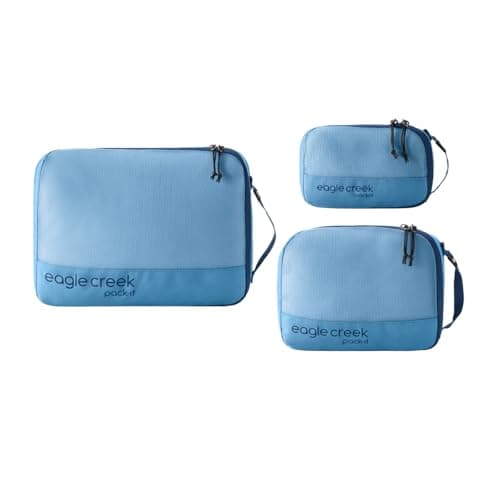
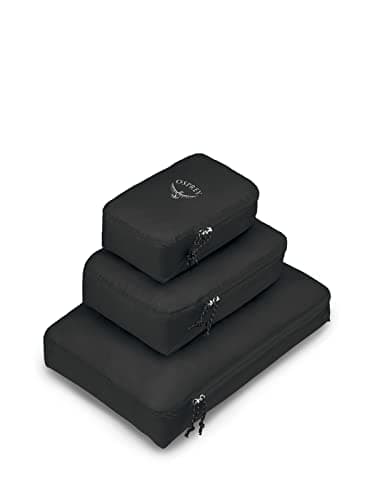
A week in a pack wants exactly three cubes: tops, bottoms, and underwear and socks. Not four, and not six. The reason is not purity, it is that a fourth cube is an invitation to carry a fourth category, and the categories that get added in a pack - a second pair of shoes, a swim kit for a maybe, a smart outfit for a dinner that is not booked - are precisely the things that make a pack carry badly.
Keep socks out of the cube count entirely. Socks are the one thing in a pack that changes shape to fit anything, so they belong inside shoes, down the sides of the main compartment and in whatever space the cubes leave over - which is also how you stop the load shifting while you walk. How to pack underwear and socks covers that properly, and how many packing cubes do I need has the count for other trip lengths.
Compression in a pack: yes, but a different kind
Compression is worth more in a pack than in a case, because a pack has no spare shape to give. But the usual recommendation - a compression cube set - carries a cost that matters here: a second zipper and a second panel of fabric on every cube, which is weight you carry for seven days to save volume you need for about five minutes at packing time.
The better trade in a pack is a roll-up bag. No zipper, no mechanism, almost no weight: you roll the air out and the volume stays gone. Use it on the lofted things - fleece, down, knitwear, nightwear - and on the worn pile for the journey home. Do not use it on woven shirts, and do not expect it to help with weight, because nothing does. Compression cubes vs vacuum bags compares the two mechanisms properly, and do packing cubes add weight is the honest accounting of what the containers themselves cost you.
The worn pile is the problem by day four
On a seven-day trip roughly half of what you packed is worn by the middle of the week, and worn clothes do not fold as small as clean ones. In a case that just means an untidy lid. In a pack it means the thing will not close, because you packed to the edge of the shape rather than the edge of the volume.
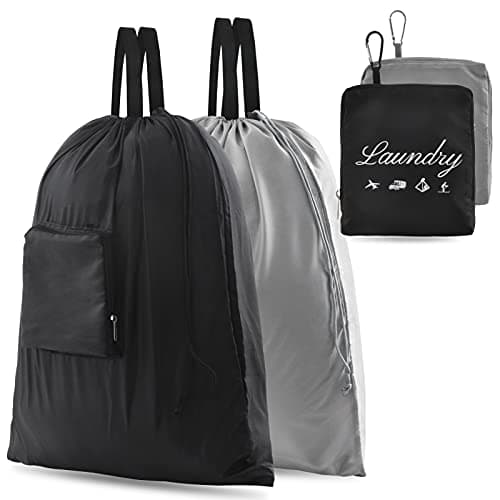
Two fixes, and they work together. Keep the worn pile in its own bag from day one, so it never contaminates a clean cube and you always know what is left. And clip that bag to a haul loop or a daisy chain rather than letting it eat main-compartment space - the carabiner on a travel laundry bag exists for exactly this. If anything is damp, it needs a lined bag instead, and how to pack dirty clothes sets out the difference. A single sink wash around day four also turns a seven-day pack into a four-day pack, which is the cheapest weight saving available to you.
If you want the cube recommendations ranked for a pack rather than for a week, best packing cubes for backpacking is the roundup, and best packing cubes for one-bag travel is the version for a cabin-sized travel pack.