The garment bag category has one dominant problem and it is not build quality. It is that almost every bag here is titled carry-on, and most of them are not carry-on sized when folded — a fact you can establish from the makers' own listings, several of which cheerfully explain in their feature text that the bag is suitable for checked baggage. So this page leads with the folded dimensions, and treats the word in the title as marketing until the numbers back it up.
A garment bag is not a garment folder
These are different products and the search results mix them constantly. A garment folder is a flat, board-backed sleeve that goes inside a suitcase: it limits a shirt to one wide fold over a board and stops the stack shifting in transit. A garment bag is the case: your suit stays on its hanger, the bag folds in half around it, and it travels as its own piece of luggage. If you already have a suitcase you like and want your shirts to arrive flat, you want a folder, and our garment folder roundup is the right page. If you want the suit to stay on a hanger from your closet to the hotel closet, you want a bag, and this is the right page. The full comparison is in packing cubes vs garment bags.
What a garment bag does about wrinkles, and what it cannot
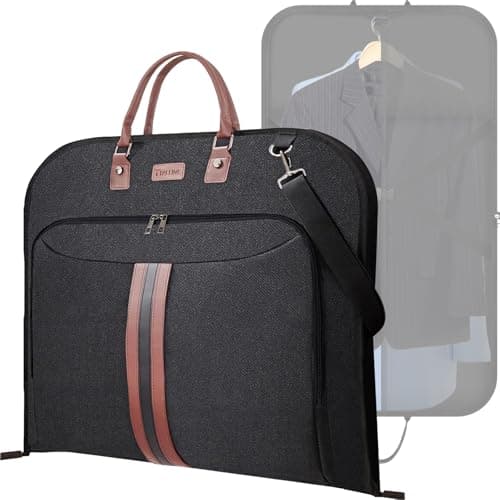
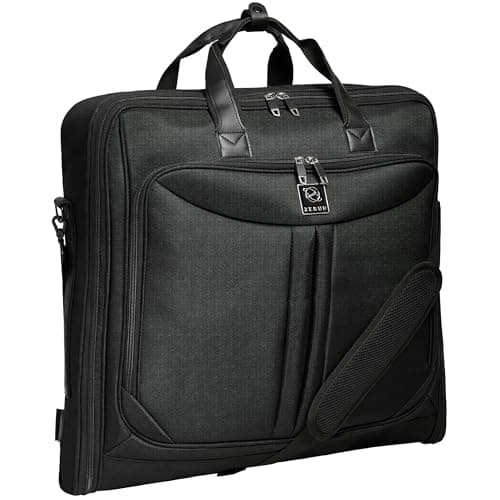
It prevents new ones. Nothing in any suitcase presses anything, and no bag here will remove a crease a jacket already had. What a garment bag does is keep the garment hanging in its own shape, limited to a single wide fold at the middle rather than the several small folds a cube or a suitcase puts in it, and hold the stack still so transit does not add more. The features that actually deliver that are structural: ZEGUR's semirigid piping and dual interior buckle, the foam-padded middle strap on both MATEIN bags, Amazon Basics' EVA foam padding, the tie-down straps everywhere. A bare unstructured cover like the BALEINE or the MISSLO will protect a garment from dust and rain and do very little about movement, which is exactly the right trade for a floor-length gown and the wrong one for a suit you are wearing off the plane.
The carry-on question, answered with numbers
A standard US domestic carry-on sizer is about 22 by 14 by 9 inches. Here is what the listings on this page actually publish, folded:
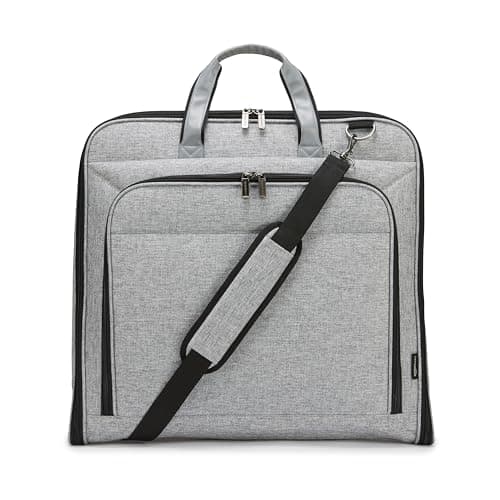
- ZEGUR — 22 inches square, over 4 inches deep, under 3 pounds. The maker explicitly says it fits overhead bins and still tells you to check with your airline. This is the only pick on the page where the claim is credible.
- Amazon Basics — 21.65 by 20.28 by 3.54 inches. Flat, but 20.28 inches wide against a 14-inch sizer. The listing says it can be checked or carried on without committing.
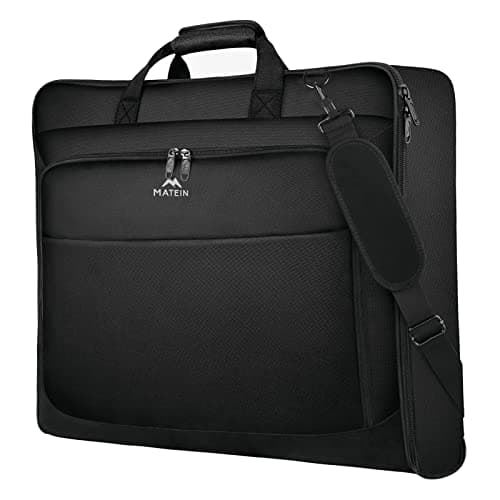
- MATEIN XX-Large— 24 by 21 by 3.5 inches, and MATEIN's own text says it suits checked baggage at a 48.5-inch linear total inside the 62-inch limit. Titled carry-on; positioned checked.
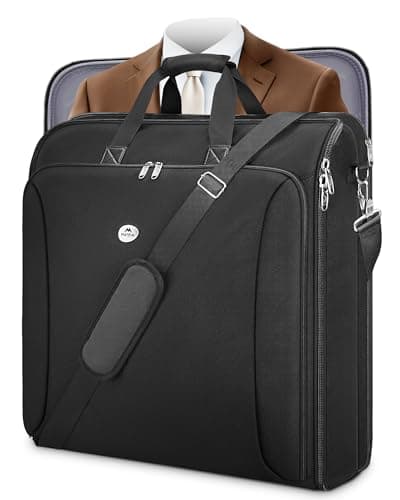
- MATEIN double-layer — 23 by 22.5 by 8 inches, 53.5 linear inches, stated for checked baggage. No pretense, which is to its credit.
- BALEINE — 24 by 21 inches folded. Lightest structured bag here; same width problem as the others.
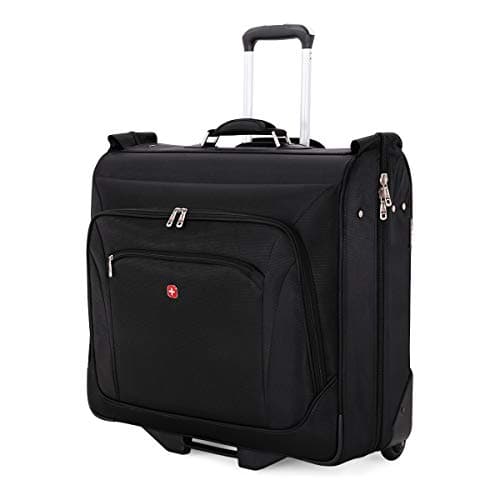
- SwissGear 7895 — 24 by 23 by 9.5 inches with wheels and handles. A checked bag, and an 11.6-pound one.
In practice a soft garment bag is often accepted at a gate when a hard case of the same dimensions would not be, because it squashes and because gate agents treat it as a suit carrier. That is discretion, not policy, and it is not something to plan around on a full flight. If you need a guaranteed bin fit, the ZEGUR is the only pick here whose published numbers support it — and the honest alternative for a carry-on-only traveler is a garment folder inside the case you already own.
How we ranked them
Five criteria, weighted in this order. Wrinkle prevention — structure, padding, piping and tie-downs, because holding the garment still is the mechanism. Capacity — how many garments the maker states will hang, plus pocket and shoe provision. Carry-on reality — published folded dimensions against a standard sizer, scored on the numbers rather than the title; a bag that honestly presents itself as checked luggage is marked down here without being penalized elsewhere. Build — fabric denier, zippers and hardware as published. Value — what you get for the money, not the brand on the label.
Every score is a judgment from documented specs and listing detail rather than a measurement we took — we do not run a testing lab, and our methodology page says so in those words. Every dimension, weight, denier and garment count traces to the product's own Amazon listing, named in Sources. Where a listing contradicts itself — BALEINE publishes a 42 by 24 by 42 inch dimension block that cannot describe the product — the page says so and uses the figures from the feature text instead. Prices are pulled live from Amazon and date-stamped.
Who should skip a garment bag
- Anyone who wears a suit once a year. A garment folder in your existing case costs less, weighs less and takes no extra hand. The bag earns its place when the suit travels often enough that hanging it is worth a separate piece of luggage.
- Carry-on-only travelers. On the published numbers, one bag here fits a standard sizer. If you never check luggage, a folder is the lower-risk answer — see how to pack a suit for the fold that works without either.
- Anyone packing knitwear and t-shirts. A garment bag holds a hanger, so it does nothing for anything that does not hang. Clothes that fold still belong in cubes — the division of labor our what to pack in each cube guide sets out.
The buyer's guide: what to check before you click
Read the folded dimensions, and ignore the title
The word carry-on in a garment bag title carries no information. Every bag on this page except the two MATEIN models uses it, and the MATEIN listings are the ones that honestly state a checked-baggage linear total. Find the folded measurement, compare all three axes to your airline's sizer, and decide from that. If a listing publishes only an open dimension, or publishes a dimension block that cannot describe the product — the BALEINE at 42 by 24 by 42 inches — treat the omission as information.
Count the garments the maker states, not the ones you hope for
Hanging capacity is published and it is specific: ZEGUR says 4 items, Amazon Basics and the MATEIN XX-Large say 3 full suits, the MATEIN double-layer says up to 6 across two compartments, MISSLO rates its 4-inch gusset at 3 to 6 dresses. Those numbers assume suits, not winter coats. A single wool overcoat occupies roughly the space of two suits, so if a coat is in the plan, size up one tier.
Empty weight is the number people forget
Garment bags are heavy for what they hold, and the spread here is enormous: 0.64 pounds for the MISSLO pair, 1.63 for the BALEINE, 2.65 to 2.93 for the structured soft bags, and 11.6 for the SwissGear. That last figure is about a quarter of a standard 50-pound checked allowance consumed before you pack anything. Convenience is a legitimate reason to pay it; not noticing until the scale at the counter is not.
Look for the trolley pass-through
A garment bag is a second item in your hands, which is the real reason people stop using theirs. A pass-through belt or an attachment point that stacks the bag on a rolling case turns two hands into one — ZEGUR, Amazon Basics and both MATEIN bags all have one. It is a small strap that decides whether the bag gets packed next time.
Shoe pocket, or plan for shoes elsewhere
Dress shoes travel with dress clothes, and a hook-and-loop or zipped shoe compartment keeps soles off a white shirt. Amazon Basics, the MATEIN XX-Large and the SwissGear all have one; the ZEGUR has interior zip pockets that hold shoes among other things; the BALEINE and MISSLO have nothing. If your bag has no shoe provision, that is what a travel shoe bag is for, and a zip closure beats a drawstring for exactly this reason.
Pack the bag so the fold lands in the right place
A garment bag folds once, in the middle, and where that fold crosses the garment decides what you unpack. Hang jackets buttoned with the shoulders square in the hanger loops, use every tie-down strap so the stack cannot shift, and let the fold fall at the natural break around the hips rather than across the chest. Put shirts and lighter items on top of the jacket, not under it. Shoes, toiletries and anything hard go in the outer pockets so they are never pressing into fabric — the same principle as how to pack a suit, applied to a bag that hangs instead of a case that lies flat.
Hang it up the moment you arrive
The last step is free and it is the one that does most of the work. Unfold the bag and hang it in the hotel closet immediately, ideally in the bathroom while you shower — steam relaxes most light creasing without a thing touching the fabric. A garment bag left folded on a luggage rack overnight has spent the whole trip preventing wrinkles and then set one in at the end.
The short version
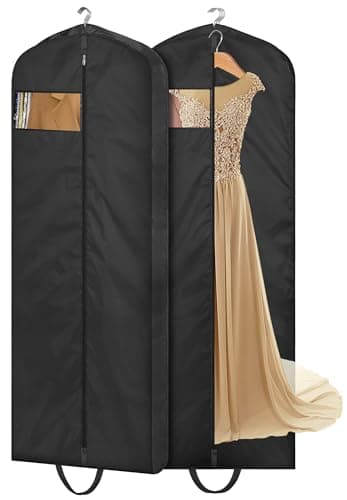
If you want a garment bag that credibly goes in an overhead bin, it is the ZEGUR, and it is the only one here on the published numbers. If you wear a suit occasionally and want the sensible cheap answer, Amazon Basics, which publishes both dimensions and includes a shoe pocket. Carrying three to six suits and checking the bag anyway? The MATEIN double-layer, which is refreshingly honest about being checked luggage. A gown, a wedding dress or a long coat? MISSLO's 65-inch pair, where the garment hangs fully extended and the whole thing weighs nothing. Want it to barely register in your luggage? The BALEINE at 1.63 pounds. One suit plus shirts, checking the bag, want pockets? The MATEIN XX-Large. And if you would rather roll your clothes to the closet and hang the whole case up, the SwissGear 7895 does exactly that, as long as you have made peace with 11.6 pounds before you pack. Clothes that fold still belong in cubes — the rest of the travel organization hub covers the containers for everything a hanger cannot hold.