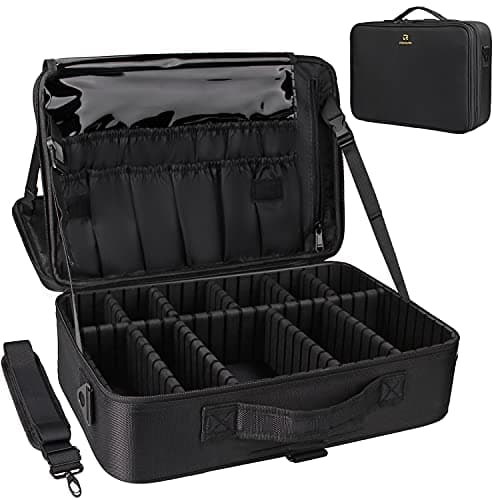
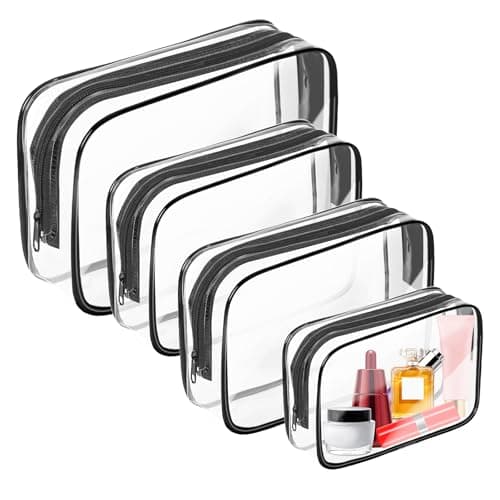
Pack makeup by failure mode, not by category: things that crack go in something rigid, things that leak go in clear plastic, and things you need at 6am go where you can see them. In practice that is a flat-opening bag for the kit, a clear quart bag for everything liquid, a rigid slot or a padded pocket for palettes and brushes, and - the step everyone skips - a rubber band or a cotton pad inside every pressed powder.
This is the method page. If what you want is the bag itself ranked against the alternatives, that is best travel makeup bags, which separates the five shapes sold under one search term. What follows assumes you have a bag and need to know what to do with it.
What counts as a liquid, and the rule as published
More of a makeup kit is a liquid for carry-on purposes than people expect. Foundation, concealer in a tube, liquid lipstick, mascara, setting spray, micellar water, remover, serum, primer and anything gel or cream all count. Pressed powder, eyeshadow palettes, blush, pencils, lipstick bullets and brushes do not. The published rule is travel-sized containers of 3.4 ounces (100 ml) or less, together in one quart-sized resealable bag, one bag per passenger.
Two things worth stating plainly. First, the limit is on the containersize, not on how full it is - a half-empty 8-ounce bottle does not qualify, which is the single most common misreading. Second, no bag of any kind is “TSA approved”: the TSA approves, certifies and endorses no luggage or pouch, and sellers using the phrase mean compliance with the rule. We take the same position in are packing cubes TSA approved, and the full rule with its common misreadings is in how to pack liquids in a carry-on. Rules differ outside the US, so check the airport you depart from.
Why palettes crack, and the fix that costs nothing
A pressed powder is compressed pigment with no give. It does not crack from being dropped as often as it cracks from flexing - the pan bends a fraction when something presses the closed compact, the pressed cake does not bend with it, and it fractures. Two fixes, both free. Put a cotton pad or a folded square of kitchen paper inside the closed palette, which takes up the air gap and stops the cake moving against the lid. And put a rubber band around the closed compact, which stops it springing open under pressure and means a crack stays a crack rather than becoming a bag full of powder. A cracked palette that has not escaped its compact is still usable; one that has is a cleaning job.
Brushes, and the damage that does not come back
Of everything in a makeup kit, brushes are the most expensive per item and the easiest to ruin permanently: a bristle bundle crushed sideways for a week does not recover. The hierarchy is individual elastic loops, then a dedicated lined pocket, then a covered holder, then loose in the main compartment, which is how brushes get bent. If you have nothing purpose-made, roll the brushes in a clean flannel with the bristles toward the centre and band it - that is better than a pouch.
The travel-specific problem is drying. A brush washed in a hotel sink at 11pm is damp at 7am, and a damp brush sealed in a pouch grows mildew and marks the lining. Dry brushes bristles-down, hanging over the edge of a counter or clipped to a hanger, never standing upright - water running down into the ferrule is what loosens the glue and starts the shedding. If it is still damp when you pack, it goes in a clear bag on its own, not against fabric.
The minimal kit that covers a week
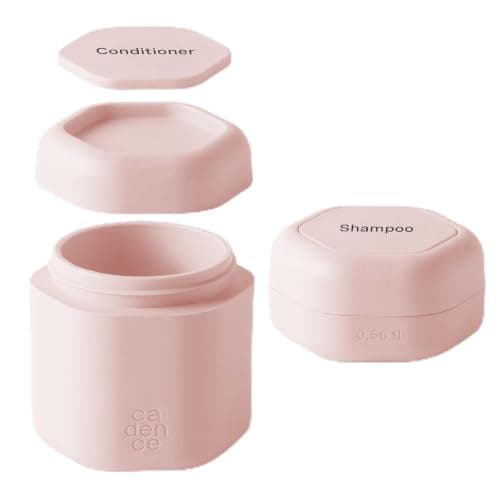
The honest version of a travel kit is not your kit made smaller, it is a different kit. Base in one decanted container, a cream product that works on cheeks and lips, one neutral palette rather than three, a pencil, mascara, and two brushes plus a sponge. That is a kit that fits a 9-by-6-inch bag and covers a week including an evening, and the reason to build it deliberately is that the alternative - taking everything and hoping - is both the heaviest and the most breakable option. Anything you have not used in a month at home will not be used on a trip.
| Item | Failure mode | Where it goes |
|---|
| Foundation, serum, primer, remover | Leaks; counts as a liquid at security | Decanted, under 3.4 oz, in the clear quart bag |
| Pressed powder, blush, eyeshadow palette | Cracks under flex | Rigid slot or padded pocket, cotton pad inside, banded shut |
| Brushes | Bristles crushed sideways, permanently | Individual loops or a lined pocket, never loose |
| Pencils, lipstick bullets | Snap; melt in heat | Small internal pocket, away from a car or a sunny window |
| Mascara, liquid lipstick | Pressure change pushes product past the seal | Clear quart bag, upright, in a cabin bag not a hold bag |
Two more things the category gets wrong
Heat matters more than impact. A car, a sunny windowsill or a hold on a long tarmac wait will soften lipstick bullets, split cream products and warp pencils. Anything wax-based travels in the cabin where you are, not in a checked bag. A makeup bag is not a toiletry bag. They fail differently - a toiletry bag is built around bottles and the design problem is containing a leak, while a makeup bag holds small rigid objects that must keep their orientation. Carrying both is not over-buying; it is the only arrangement where nothing is in the wrong container. See best travel toiletry bags for the bottles half.