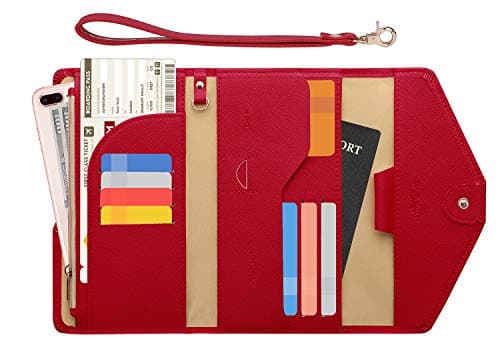
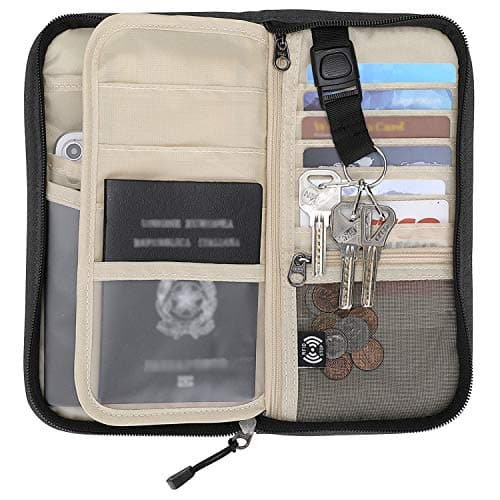
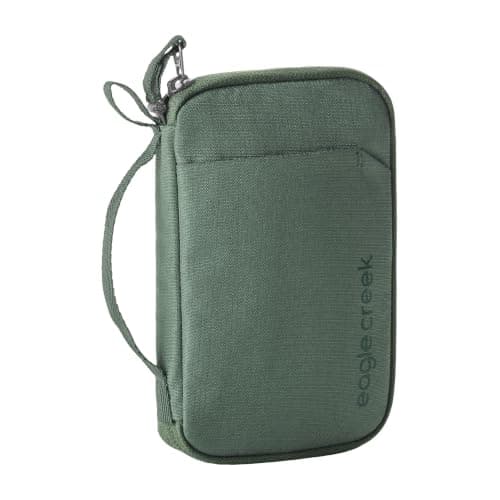
The verdict first. The Eagle Creek Stash RFID Passport Wallet is the one to buy for most travelers, because it wins the two properties on this page that can actually be checked: it publishes 0.13 lb and 0.75 in of thickness, the lightest and slimmest body in the group, plus a water-resistant treatment. It is for the person who keeps documents in a jacket pocket. The budget pick is the ZOPPEN Passport Holder Travel Wallet (Ver.5), which is the cheapest RFID wallet in our catalog and gives you seven card slots — at nearly three and a half times the empty weight.
And now the thing that shaped this entire ranking, stated as plainly as we can: every wallet on this page claims RFID blocking, and not one of them publishes a standard, a frequency range or a test result. Not an ISO number, not a decibel of attenuation, not a laboratory, not a frequency band. The claim is on five listings and the evidence is on none of them.
Which means the claim cannot rank anything
We are not going to tell you RFID blocking does not work, because we have not tested it and nobody on this page has published figures we could check. What we can say is the thing that matters for buying: it cannot differentiate these products. Five wallets make the same unquantified claim, so the claim is a tick-box. Using it to rank them would mean inventing a difference, and inventing differences is what this site exists not to do.
So we ranked on what is published, which turns out to be the right axis anyway. A passport wallet is a thing you carry in a pocket and take out at a counter, a desk, a gate and a hotel reception. Weight and thickness are paid at every one of those moments. They are the product.
The arithmetic, and how it inverts the price order
Take the published figures and compare the cheapest wallet here with the lightest:
- Eagle Creek Stash: 0.13 lb, 6.5 x 4.25 x 0.75 in — roughly 21 cubic inches.
- ZOPPEN Ver.5: 0.44 lb, 7.8 x 4.7 x 1.0 in — roughly 37 cubic inches.
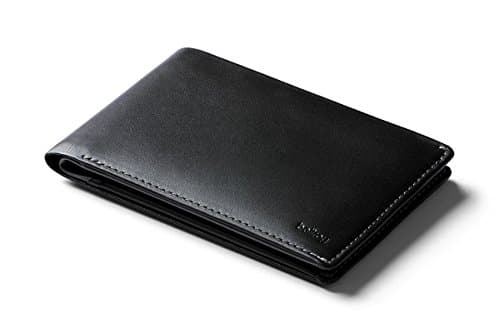
That is nearly three and a half times the empty weight and roughly three-quarters more volume, for the cheaper product. Both figures are our arithmetic on published outside dimensions. The pattern repeats at the top: the Bellroy wallet publishes 0.17 lb — within an ounce of the lightest here — while carrying a passport and up to ten cards. Which gives the honest summary of this category: in RFID travel wallets, money mostly buys you LESS wallet, and that is the opposite of how the listings read. The cheap option's real cost is bulk.
One gap we will not paper over: Bellroy publishes a footprint but no thickness, and the Zero Grid neck wallet publishes no empty weight at all. Both are therefore absent from parts of the arithmetic rather than estimated into it.
The security mechanism you can actually see
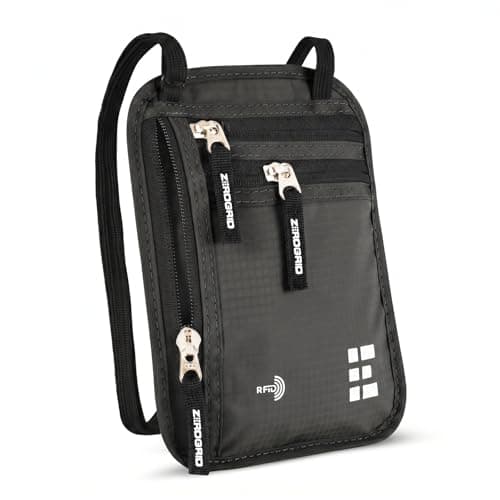
There is one product here whose protection does not depend on anybody's test data. The Zero Grid neck wallet is published as being worn under clothing, with a neck strap and belt loops. You do not need a standard to evaluate that: a wallet inside your shirt is not reachable by a hand in a crowd. Whatever you believe about contactless skimming, the documented way travel documents go missing is a crowded station, a slashed bag or a pocket, and being under a layer of clothing addresses all three.
It also has the most honest failure mode on the page, which is human: a wallet you have to reach inside your clothing to open is one you will stop using, and once it is in your bag it is just a pouch. Buy it for transit days and crowded cities, not as your everyday holder.
One passport or five, and why that is the real decision
The quiet truth about this category is that the shape question beats both the price and the RFID question. A single-passport wallet and a family holder are not the same product with a different capacity — they are different behaviours at a desk. With a family holder you hand over one pouch; without one you fan out five documents and hope. With a family holder you can confirm at the end of the day that everything is back, because the empty pouch is obvious.
So the honest buying order is: how many passports, then pocket or bag, then price. RFID comes last, because it is on every listing and substantiated on none. For the broader organization question — cards, boarding passes, vaccination records, currency — best travel document organizers ranks the whole category on organization rather than on this page's weight axis, and how to organize travel documents is the method.
How we picked these, and what we could not check
Every pick above carried a live price and a buyable offer in our feed on the day this page was written, and the as-of date of that check is printed under the comparison table. No price appears in this page's text.
What we could not check, stated plainly. We have not handled these wallets, weighed one, or attempted to read a card through one — and that last point is the important one, so we will repeat it: no RFID shielding performance is claimed anywhere on this page, because not one listing in this category publishes a standard, a frequency range or a test result. Every dimension, weight, slot count and material above is the manufacturer's own published figure, read off the listing on the date in Sources; the cubic-inch figures and all multiples are our arithmetic on those published outside dimensions. Bellroy's three-year warranty is its listing's claim and we have not read the terms. Our scores are judgments from published listings and documented research, which is what our methodology says in exactly those words.
Three questions, in the order that decides this.
1. How many passports?
Settle this first. One: buy the slimmest, lightest thing you can, because it lives in a pocket and you will handle it twenty times a trip. Two or more: buy the family holder with a pouch per person, because handing over one pouch instead of fanning out five documents is the actual benefit, and so is seeing at a glance that everything came back.
2. Pocket or bag?
A published one-inch-thick folio at seven ounces is a bag item whether the listing says so or not. A published three-quarter-inch body at two ounces is a pocket item. This is the single most predictive published figure in the category and almost nobody shops on it.
3. Is the worry skimming, or is it theft?
Be honest about which. If it is theft — crowds, stations, a slashed bag — buy the thing worn under your clothing, because that mechanism is visible and needs no test data. If it is skimming, understand that you cannot choose between these five on that basis: they all claim it and none of them publishes a standard, so pick on weight and shape and take the RFID lining as a bonus you cannot verify.
What not to buy
Do not pay a premium for RFID blocking as a feature — it is on every listing here, including the cheapest, and substantiated on none, so paying extra for it buys a claim you already have. Do not buy on card slot count if the wallet goes in a pocket: slots are what make a folio an inch thick. Do not buy leather for a wet destination when a treated shell is published as water-resistant — the thing that actually destroys a passport is a drink, not a skimmer. And do not keep everything in one holder if you are travelling as a group with two adults: split the documents across two people, which costs nothing and is the only real protection against losing the lot.