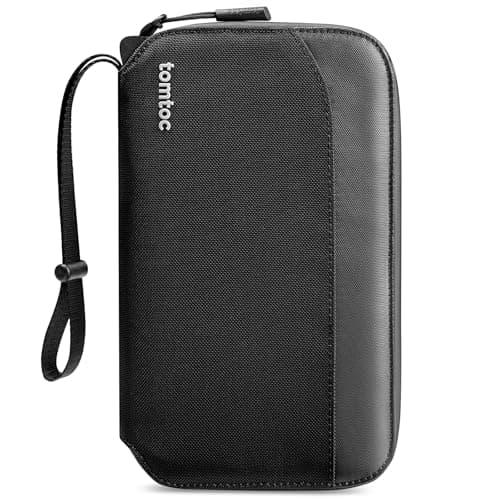
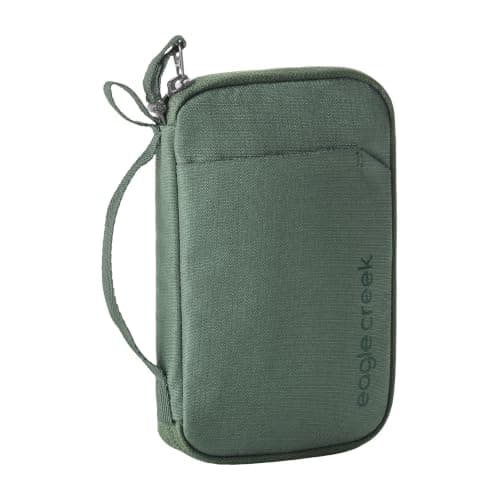
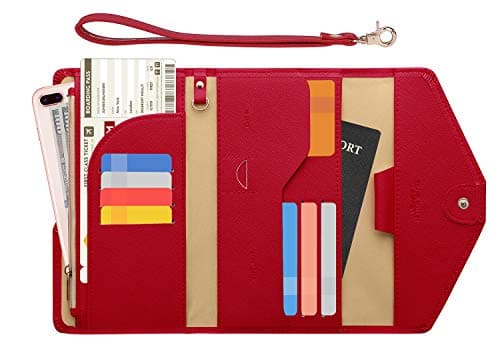
The system is two rules. First, everything that proves who you are goes in one container that lives in the same place for the whole trip - passport, licence, trusted traveler card, visas - and that container never goes in checked baggage. Second, everything that proves what you booked exists in two forms, on your phone and on paper, with only the first day printed. For one person the container to buy is the ZOPPEN Ver.5 travel wallet; for a family it is the tomtoc four-passport holder.
Separate identity from itinerary - everything follows from that
Almost every travel-document mess comes from putting two different kinds of paper in the same place. They have opposite properties.
Identity documents are few, irreplaceable, rarely needed and catastrophic to lose. You want them in one fixed, protected place that you open two or three times a trip. Itinerary documents are many, replaceable, needed constantly and trivial to lose. You want those in a reachable outer pocket you can get at while standing in a queue with a bag on your shoulder.
Put both in the same wallet and you get the familiar failure: the passport comes out and goes down on a check-in desk six times a day because the boarding pass was behind it. One container, two zones - or better, two containers.
What TSA actually accepts as identification
Worth knowing before you optimise a wallet around the wrong card. TSA states that adult passengers 18 and older must show valid identification at the checkpoint, that the list of acceptable IDs is subject to change without notice, and that travelers should check the list again before travelling. The list includes state-issued REAL ID-compliant driving licences or identification cards, enhanced driving licences and enhanced identification cards, certain mobile driving licences from approved states, US passports and passport cards, DHS trusted traveler cards (Global Entry, NEXUS, SENTRI, FAST), Department of Defense IDs including dependants', permanent resident cards, border crossing cards, tribal photo IDs, HSPD-12 PIV cards, foreign government-issued passports, Canadian provincial driving licences, TWIC cards, employment authorization cards, merchant mariner credentials and Veteran Health Identification Cards. TSA also notes that a temporary driving licence is not acceptable.
The practical consequences for your wallet: the card you rely on has to be on that list, a temporary licence will not do, and if your licence is not REAL ID-compliant the simplest fix is to carry the passport domestically as well. Check the list yourself before each trip - we are quoting it as fetched on 2026-10-11 and TSA says explicitly that it changes.
What to look for in a document container
- Enough passport pockets for your party. This is the only hard requirement and the one people get wrong. One pocket is a solo wallet; four is a family holder. A family trying to share a solo wallet ends up with loose passports.
- Card slots, counted. Count your actual cards - ID, two bank cards, transit, insurance, loyalty - and buy a wallet with that many slots plus one. Cards that do not have a slot live loose, and loose is how things go missing.
- Water resistance. The realistic way to lose a passport is not theft; it is a bottle leaking in a bag. This is the spec that actually earns its place.
- A strap, a tether or a tracker slot. Loss, not theft, is the dominant risk. A wrist strap stops you walking away from a desk; an AirTag slot tells you where the wallet went.
- A separate outer sleeve for itinerary paper. So the passport is not what you handle every time you need a boarding pass.
- Treat RFID blocking as a free extra. Every holder in this category claims it, almost none name a standard, and no listing publishes an independent test. Buy a wallet for the layout and the fabric and take the RFID claim as a bonus you cannot verify. We make the same point on our document organizer roundup.
Where each document goes
| Document | Where it lives | Backup |
|---|
| Passport | Travel wallet, on your person or in your personal item | Photo of the data page, offline and in the cloud |
| Driving licence or state ID | Travel wallet card slot | Photo of both sides |
| Trusted traveler card | Travel wallet card slot | Known Traveler Number saved in notes |
| Visas and entry permits | Travel wallet, with the passport | Photo plus the issuing reference number |
| Boarding passes | Phone wallet, plus printed for day one only | Airline app and the confirmation email |
| Hotel confirmations | Phone, with the first night printed | Email, and the address written down |
| Travel insurance | Phone, with the policy number memorable | Policy number and the 24-hour line in your contacts |
| Vaccination or health records | Travel wallet if a paper copy is required | Photo |
| Spare bank card | Separate from the wallet - a different bag entirely | Bank app, and the lost-card number saved offline |
| Car hire voucher and licence endorsement | Phone, printed if hiring on arrival | Email confirmation |
The digital half, done properly
Photographs of documents are only useful if you can reach them when the situation is bad, and bad situations involve a dead phone, no signal or a stolen bag. So store them twice: once in your phone's offline storage, where they open with no data connection, and once in a web-accessible account you could log into from a hotel computer or a stranger's laptop. One copy in a notes app you cannot reach offline is not a backup.
The one thing worth writing on actual paper and keeping separately from your phone and your wallet: the address of your first night's accommodation, your insurance policy number and the emergency line for your bank. That index card has solved more problems than any wallet.
Separate the spares, physically
Everything in one wallet is a single point of failure. One spare bank card and a small amount of local currency should be in a different container in a different bag - not in the travel wallet, not in the same pocket. A tech pouch works well for this, because it is the bag you open for a charger and never put down on a counter.
How we scored the three picks
Fits the documents - passport pockets and card slots against a real document set. Reachability - whether it goes in a pocket or needs a bag. Durability - published fabric and closure, with water resistance weighted heavily because it is the realistic failure mode. Loss resistance - straps, tethers and tracker slots, which address loss rather than theft. Value - live price against the layout you get. Our methodology states plainly that these are judgments from documented specs and listings, not measurements we took. No RFID claim on this page has been tested by us or, as far as any listing shows, by anybody independent.