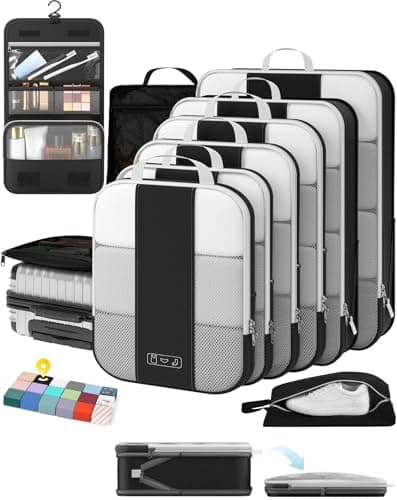
If you want one purchase that organizes most of a suitcase, buy the OlarHike 10-set: compression on every piece, enough pieces to cover a long trip or split across two cases. But read the next section before you order anything, because the honest headline of this page is that no kit sold as a complete travel organizer set actually organizes your whole bag — every one of them is a packing cube set with one or two extras, and the liquids, cables and paperwork are not in the box.
What a travel organizer set actually contains
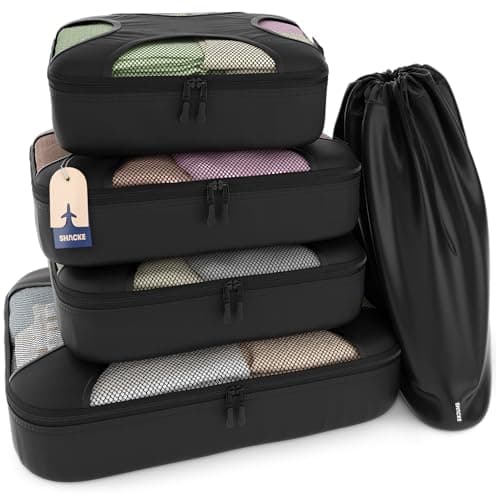
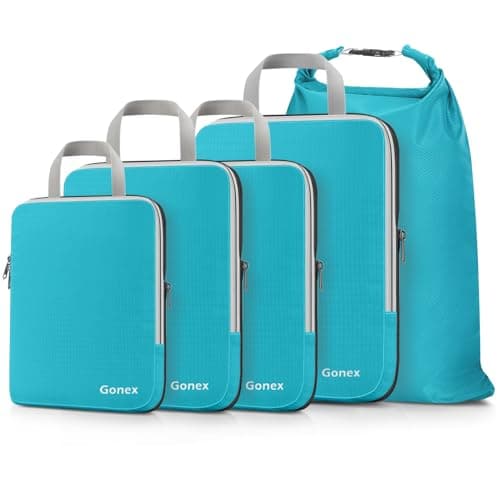
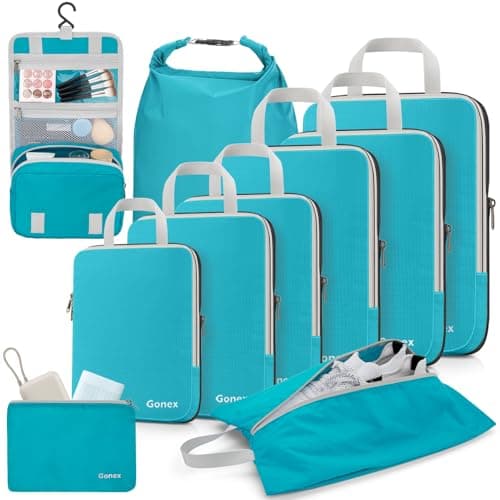
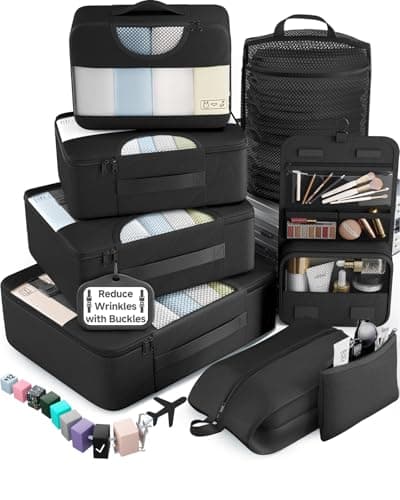
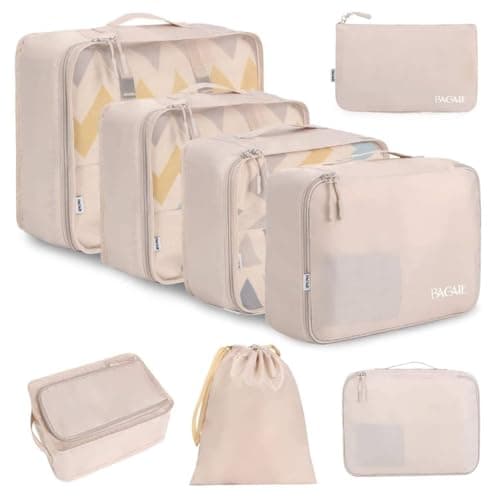
Search this term and you get ten-piece and twelve-piece kits photographed in a flat lay that looks like a complete packing system. Look at what is in the photograph and it is always the same thing: four to eight fabric cubes in descending sizes, a drawstring shoe pouch, a laundry bag, and sometimes two small zip pouches. That kit organizes clothes, which is one of four jobs in a packed bag.
The other three are liquids, electronics and documents, and no kit on the market includes a real container for any of them. That is not a conspiracy, it is manufacturing: a toiletry bag needs a wipe-clean lining and a hanging hook, a tech organizer needs elastic loops and a stiffened spine, and a document wallet needs card slots. None of those are made from the same flat panels on the same production line as a cube, so none of them end up in the box. The kits that gesture at it include a small clear pouch, which is a liquids bag for the security tray rather than a toiletry bag.
So the real question is not which kit is best. It is whether buying one kit plus three purpose-built containers beats buying a cube set plus three purpose-built containers — and since both routes end in the same three purchases, the kit only wins if its bundled shoe bag and laundry bag are ones you would have chosen anyway. Sometimes they are. Our shoe bag roundup and laundry bag roundup will tell you in about two minutes whether the bundled versions are good enough for how you travel.
What is in the box, and what is not
Published listing contents only. Every figure in the dimensions column is the product's own published spec; blank means the brand publishes none, and we have not substituted an estimate.
| Kit | Pieces, per the listing | Compression | Laundry bag | Published dimensions |
|---|
| OlarHike 10-Set | 10, expandable | Yes, all pieces | No | None published |
| Shacke Pak 5-Set | 4 cubes + laundry bag | No | Yes, 20.5 x 15.75 in | Cubes 4 in deep |
| Gonex 5-Piece Compression | 4 compression cubes + laundry bag | Yes, all cubes | Yes, 20 x 11 in | XL 17.3 x 13 x 3.54 in |
| Gonex 10-Piece | 10, cubes + pouches | Yes | No | None published |
| Veken 10-Set | 10, cubes + pouches | No | No | None published |
| Bagail 8-Set | 8 cubes | No | No | None published |
Not in any box above: a toiletry bag, travel bottles, a tech organizer, a document wallet, a jewelry case, a garment folder or a first aid kit. Those are seven separate containers, and the travel organization hub has a roundup for each.
Why there is no cost-per-piece figure on this page
Everywhere else on this site we publish a per-unit value number, because dividing a live price by a piece count is a reproducible figure nobody else bothers with. We have deliberately not done it here. In a kit, a “piece” can be an XL compression cube or a drawstring pouch the size of a sock, so a cost-per-piece column would reward whichever seller padded the count hardest — and padding the count is the main way this category competes. The quick picks table still shows the per-unit figure where the pieces are genuinely comparable, and for the mixed kits it shows nothing rather than something misleading. This is the same reasoning our first aid kit roundup uses for refusing a cost-per-piece line on a 300-piece box of plasters.
How we ranked them
Coverage — how many of the four jobs in a bag the kit actually touches, scored against what is published as being in the box rather than what the photograph implies. Compression — whether the pieces have the second zipper, and on how many of them. Build — published fabric and construction, with no score inflation for brands that publish nothing. Kit logic — whether the pieces are the right pieces, which is where the five-piece sets beat the ten-piece ones. Value — the live price against what the kit genuinely replaces.
Every score is a judgment from documented specs and listing detail, not a measurement we took; our methodology page says so in those words and we do not run a testing lab. Prices come from the live Amazon price layer and carry an “as of” date.
The buyer's guide: one kit or an assembled system
Count the jobs in your bag, not the pieces in the box
Write down what is actually in your suitcase and group it: clothes, liquids, electronics, paperwork, shoes, dirty laundry. A kit handles clothes, usually shoes, often laundry. That is three of six for most people, and the three it misses are the three that cause the most trouble — a leaked bottle, a lost charger, a bent passport. A ten-piece kit does not get you closer to those than a five-piece one does.
Buy the kit for the pieces you would have bought anyway
The kit is a good deal exactly when its bundled extras are ones you want. A full-size laundry bag at 20.5 by 15.75 inches, like the Shacke's, is a real bag that will serve a two-week trip; a token drawstring pouch is not, and you will replace it. Check the published dimensions of the bundled piece before you let it influence the decision — and if the brand publishes none, assume it is the token version.
Compression on some pieces is not compression
Several kits in this category advertise compression and deliver it on the two largest cubes only. That is enough to make the claim and not enough to change how the bag packs, because the clothes you most want to squeeze are the lofted mid-size items. Both Gonex kits and the OlarHike put the second zipper on every cube, which is why they score where they do. The mechanism itself, and its hard limit, is in our how compression cubes work guide: it removes volume and no weight at all.
The assembled system, costed honestly
Buy an eight-piece cube set, a toiletry bag, a tech organizer and a shoe bag chosen on their own merits and you have a bag where every container was picked for its job. It generally costs somewhat more than one kit and it is the only route that gets the liquids and cables right. The four pages to read are toiletry bags, travel bottles for what goes inside one, tech organizers and shoe bags. If you travel internationally, add a document organizer.
If you are buying this as a gift, buy the kit
The assembled-system argument is right for you and wrong for a present. A kit arrives as one box that looks generous, needs no sizing and no knowledge of how the recipient packs, and gives them something useful on their next trip without you having guessed which toiletry bag they would like. Our gifts for travelers guide takes that argument further, and are packing cubes a good gift answers the yes-or-no first.
The short version
One purchase, most of a suitcase, compression throughout: the OlarHike 10-set. One carry-on and the right pieces rather than the most pieces: the Shacke Pak five-set, which publishes real dimensions. Compression and laundry from one box: the Gonex five-piece. A fortnight or a shared case: the Gonex ten-piece for compression, the Veken ten-set for price. And if you would rather every container in your bag was chosen for its job: the Bagail eight-set plus the four purpose-built roundups above. Whichever you pick, nothing in the box handles liquids, cables or your passport — see packing cubes with a laundry bag if the bundled bag is the only extra you care about. And for the brand-level detail behind the kit at the top of this page, our OlarHike packing cubes review covers what that brand publishes and what it does not.