Hang the bag up before you load it, put the heaviest garment against the back panel, use hangers broad enough to carry the shoulder line, and make the bag's fold land below the hem of the longest jacket. Those four decisions account for almost every difference between a garment bag that works and one that arrives looking like a suitcase would have done the job. The seven steps above are the full sequence; the sections below are why each one is there, and what to do when the bag has to go inside a case.
Why a badly packed garment bag loses to a folded suit
A garment bag has exactly one advantage over a case: the suit is not folded across the shoulders and chest. Every mistake in packing one erodes that advantage, and three of them erase it entirely.
Sliding. Garments that are not secured at the top and not supported from the sides move as a mass whenever the bag is carried. They bunch at the fold, and a bunched jacket creases worse than a deliberately folded one, because nothing chose where.
Shoulder load.A narrow hanger concentrates the garment's weight on two small points. In a case, a jacket's weight is spread over its whole surface; in a bag it hangs from the shoulders for the entire journey. That is why a dented shoulder line is a garment bag problem specifically, and it is the one kind of damage that does not steam out.
Folding in the wrong place. Nearly every garment bag folds in half to be carried, and if that fold crosses the middle of the jacket you have reproduced the exact crease the bag exists to prevent — while also carrying two to three pounds of bag for the privilege. The fix is bag length, not technique, which is why the opened dimension is the spec worth checking before you buy.
The loading order, and why it is that order
Load from the back panel outward in descending order of weight: coat or suit jacket, trousers, shirts, light layers. The back panel is the side with structure and the side that rests against you when the bag is carried, so weight there is supported. Weight on the outer layer does the opposite — it pulls the whole stack forward and presses a line into whatever is behind it.
Then face everything the same direction and fasten the top button of each jacket. Facing matters because garments hung alternately interlock at the lapels and bunch; facing the same way they slide across each other. The button matters because a jacket front held closed keeps its own shape, which is a small amount of free structure.
Trousers go over the hanger bar rather than hanging from the waistband. Hanging by the waistband lets the legs swing and drag into a diagonal crease across the thigh; folded over the bar, the only fold is at the knee, where fabric is loose and a crease falls out in an hour. The same logic drives the fold in how to pack a suit, which is the page to read for the suitcase version.
Fill the air, or the bag works against you
The defining difference between a packed suitcase and a packed garment bag is that a suitcase is full. Fullness is what stops contents moving, and a garment bag with four hanging items in it is mostly air. So use the internal pockets deliberately: folded shirts, underwear, a flat tech pouch and socks all belong there, both because they need to go somewhere and because they occupy the space the suit would otherwise swing through.
What should not go in: anything liquid. A garment bag has no coated lining and no containment, it is stored and carried vertically, and a leak at the top runs down every garment below it. Liquids belong in a toiletry bag in the other bag, decanted into travel bottles that hold up at altitude. Shoes are the other exclusion from the main compartment — an outside pocket or a shoe bag of their own, always below the clothes rather than above them.
Where the fold goes
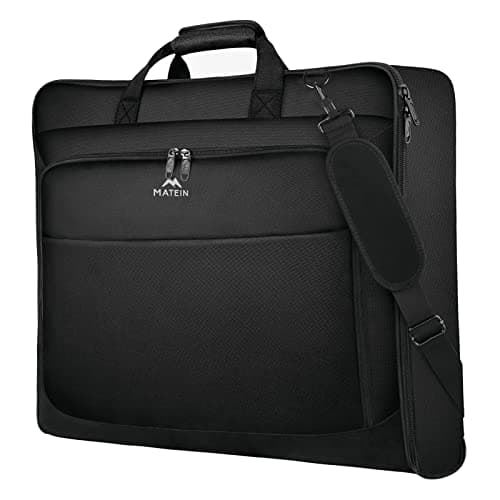
This is the step people get wrong, and the fix is measurable rather than a matter of skill. A suit jacket is roughly 30 to 32 inches from shoulder to hem. A bag that opens to 47 inches, like MATEIN's XX-Large, leaves you about 15 inches of clearance below the hem — plenty of room to put the fold in empty bag rather than in wool. A bag that opens to 42 inches, like the BALEINE, leaves around 10 inches, which still works for a suit and gets tight for a long coat. Below that, the fold starts landing on fabric.
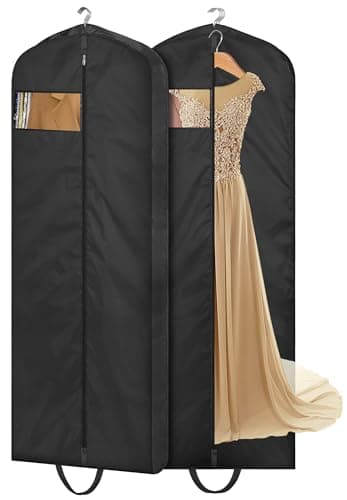
So before you fold, look at where the hem of the longest garment actually sits and fold beneath it. If there is no room beneath it, you have two honest options: fold at the hem and accept a crease at the bottom edge where it shows least, or carry the bag at full length without folding it at all, which is realistic in a car and not on a plane. For a floor-length dress, the question does not arise — a 65-inch bag like MISSLO's has no fold in it, which is why a gown is the one garment with an unambiguous answer in this whole category.
Packing a garment bag in a suitcase, and why not to
A frequent version of this question is how to fit a garment bag inside a carry-on or a checked case. The honest answer is that you should usually not. A folded garment bag inside a case is a worse container than a garment folder on every count: its own fabric adds two to three pounds and several inches of bulk, its fold lands wherever the case shape dictates, and it fights your packing cubes for rectangular space instead of stacking with them.
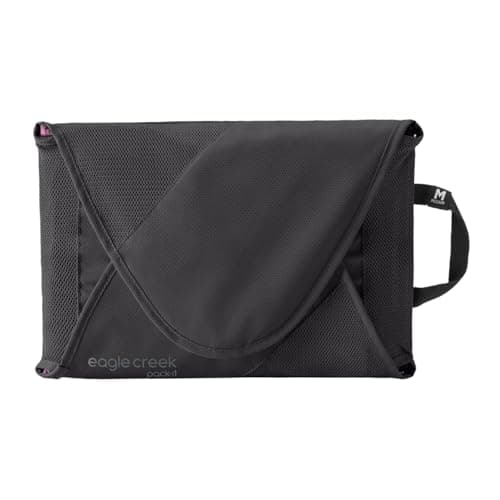
If you are going to use a suitcase, take the suit out of the garment bag and put it in a folder. A medium folder at 14 by 10 by 1 inch and 0.59 lb gives you a controlled crease at the waist, stacks flat, and leaves the rest of the case usable. If the bag itself must come along — because you need it at the destination to hang the suit, say — pack it empty and flat against the back panel of the case, and treat it as a hanger rather than as luggage. Our garment folder roundup ranks six on published dimensions, and garment bag vs suitcase works through the whole decision if you have not made it yet.
Taking it on the plane
Two practical points, both of which are airline-specific rather than universal. First, folded footprint: a bag folding to roughly a 22-to-24-inch square is wider than the approximately 14 inches a standard US domestic carry-on sizer allows, whatever the listing title says. Soft bags squash and gate agents vary, so this works often and is not a guarantee — check your own airline's stated allowance, and IATA's cabin baggage guidance for the general shape of the rules. Second, in the cabin, a garment bag does better laid flat across the top of the other bags in the bin than stood on edge, and some aircraft have a closet at the front of the cabin — asking at boarding rather than after everyone is seated is the difference between getting it and not.
On arrival, unzip and hang the bag immediately, and leave it open. Garment bags are not breathable, and a suit left zipped in a warm bag holds both moisture and the fold it arrived with. Twenty minutes hanging in a bathroom while you shower does more for a suit than any product on this page.
The things that actually decide how well this goes
Buy broad hangers before you buy anything else
The cheapest improvement available in this entire category is replacing wire hangers with wide-shouldered ones. A garment bag hangs a jacket from its shoulders for the whole journey, which is a load a jacket is not designed to carry on two narrow points. Contoured wooden or thick plastic hangers spread it across the full shoulder line, and a dented shoulder is the one kind of travel damage steam does not fix.
Check the opened length, not the folded size
Folded size tells you whether the bag fits an airline. Opened length tells you whether the fold lands in fabric, which is what decides whether the bag works at all. Our picks publish 47 inches (MATEIN XX-Large), 50 inches (MATEIN double-layer), 42 inches (BALEINE) and 65 inches (MISSLO). Against a jacket of about 30 to 32 inches, longer is straightforwardly better, and the one number worth reading before you buy.
Structure is what preserves your loading order
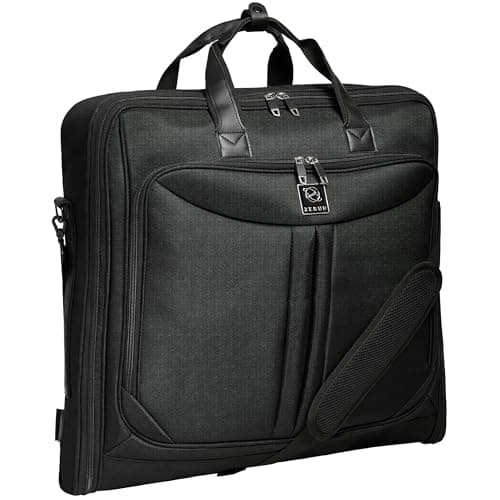
You can load a soft envelope perfectly and have it arrive bunched, because the bag has no shape of its own and the garments slide. A piped or panelled bag — ZEGUR publishes a piped structure in 1800D polyester — holds the arrangement you built. If you are choosing between two bags at similar weights, structure is worth more than an extra pocket.
Count what is not a hanging garment
A garment bag holds hanging clothes and, at best, one pair of shoes. Toiletries, laptop, folded layers, dirty laundry and chargers all need somewhere else to be, which means a garment bag is nearly always a second bag. Plan the second bag at the same time, or you will discover the gap while packing. The travel organization hub has the right container for each of those, and how to pack dirty clothes covers the return leg, which a garment bag has no answer for.
Be honest about whether you need the bag at all
If there is a hotel room between the airport and the event, a folded suit in a garment folder is genuinely fine: hang it on arrival and the waist crease relaxes. The garment bag earns its weight when there is no such interval, when three or more suits travel, when the garment is floor-length, or when you are driving. Outside those, you are carrying two to eleven pounds of container to avoid a crease that two hours on a hanger would have removed. The full argument, with the published weights side by side, is in garment bag vs suitcase.
The short version
Hang the bag before you load it. Broad hangers, secured at the top. Heaviest garment against the back panel, everything buttoned and facing the same way, trousers over the bar. Fill the empty space with folded items so nothing swings. Put the fold below the longest hem. Shoes in their own pocket at the bottom, liquids in the other bag entirely. Then unzip and hang it the moment you arrive — and if the bag was never going to make it onto the plane, put the suit in a garment folder instead and take one bag.