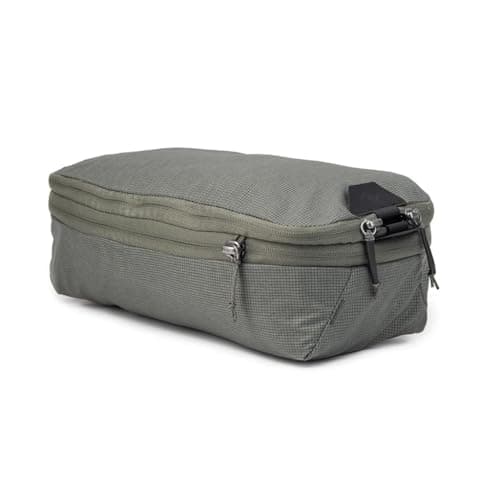
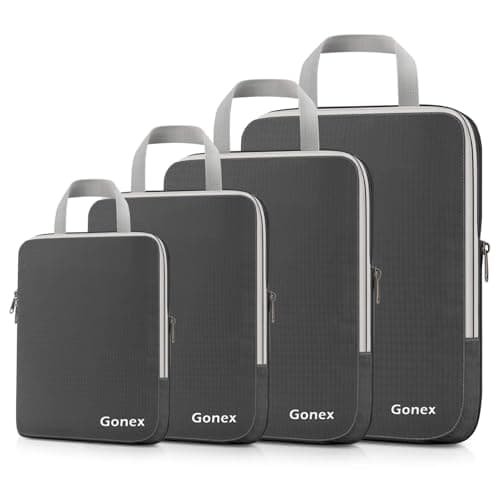
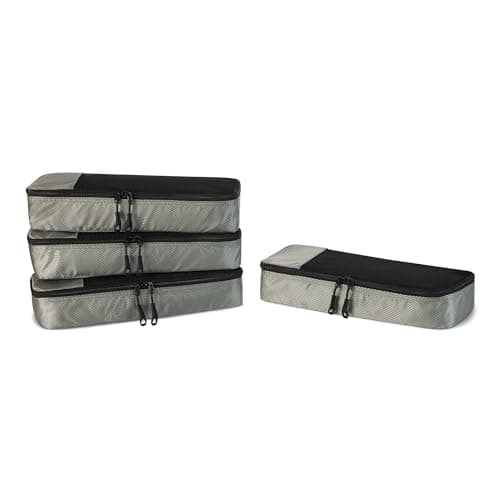
For most personal item bags the buy is the Amazon Basics slim four-piece set, and it is the cheapest thing on this page for a reason that has nothing to do with being cheap: a personal item is a shallow bag, and a slim cube is the only shape that uses the whole opening. If the fare you booked makes the personal item your only bag, buy the Gonex compression set instead and spend the second zipper on turning loft into flat.
A personal item is not a small carry-on
This is the distinction the whole page turns on, and it is why there is a page here at all rather than a line on our carry-on roundup. A carry-on is limited by footprint: it has to fit a sizer, and the thing that defeats you is length and width. A personal item is limited by depth: it has to slide into a footwell, and the thing that defeats you is height. Those two constraints reward opposite cubes. The cube that makes brilliant use of a carry-on is a standard four-inch-deep rectangle, and that same cube in a flat under-seat bag either refuses to lie down or claims the entire opening for one layer.
Every airline publishes its own personal item allowance and they differ, including between fare classes on the same carrier, so check yours rather than trusting a number from a roundup. We have deliberately not printed one here: we could not fetch an authoritative current figure at the time of writing, and an invented dimension is worse than no dimension. What is stable regardless of carrier is the shape of the problem. The bag is wider and longer than it is deep, and the cube has to respect that.
What to look for, in order
- Depth first, capacity second. A slim or low-profile cube, or a compression cube you can flatten, beats a bigger cube you cannot close the bag over. This is the one category where the spec-sheet word “slim” is doing real work rather than marketing.
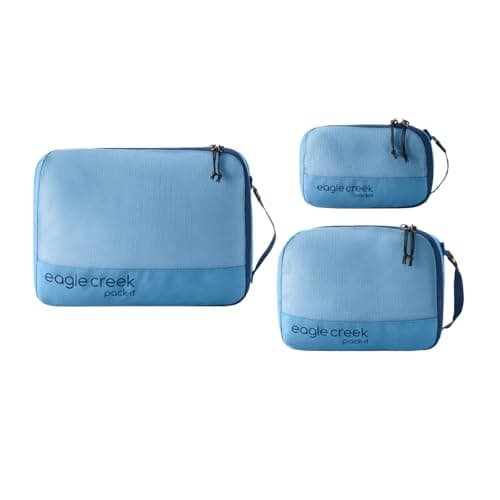
- Side visibility, not top visibility. An under-seat bag is read from the side in bad light. A mesh window on the face of a cube, like Eagle Creek's Reveal set has, tells you more at that angle than a mesh top panel does.
- More, smaller cubes. Three or four small cubes in a shallow bag outperform one large one, because you can lift the top one out and still reach the bottom. One big cube turns the bag back into a sack with a zipper on it.
- Compression only if the bag is your only bag. A second zipper costs money and a little weight, and it pays for itself exactly when you are trying to fit a long weekend into one shallow bag. On a two-night trip it is dead weight.
- Empty weight, if the brand publishes it. Most do not. Eagle Creek and Thule publish empty weights on some lines; the budget brands on this page publish none, so no figure is printed for them here. See how much weight packing cubes add for the four published numbers the catalog actually holds.
The sorting table
Every figure below is the product's own published listing detail, carried in our catalog from the day the entry was created. Where a brand publishes no depth or weight, the cell says so rather than guessing.
| Pick | Pieces | Profile, per the listing | Compression | Visibility |
|---|
| Amazon Basics Slim | 4 | Slim / low-profile (no dimension published) | No | Mesh top |
| Peak Design Small | 1 | Weatherproof, dual-compartment | Yes, built in | None (solid) |
| Eagle Creek Pack-It Reveal | 3 (XS / S / M) | Standard depth, ripstop | No | Mesh windows |
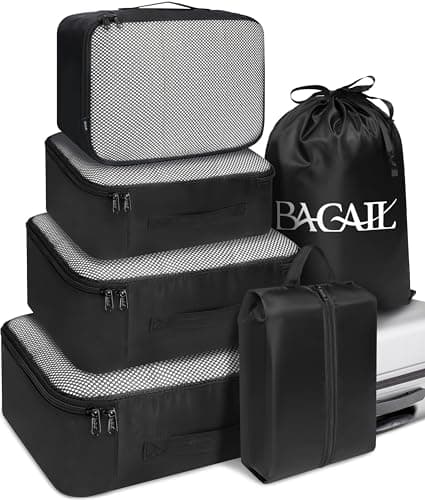
| Bagail 6-Set | 6 (S / M / L) | Standard depth, polyester | No | Mesh top |
| Gonex Compression | 4 | Expandable, ripstop nylon | Yes, second zipper | Partial |
How we ranked them
Five criteria, in this order. Fit in a shallow bag — the profile of the cube against the one dimension this bag is short of, which is why the cheapest set wins. Findability — whether you can identify a cube without pulling it out, from the side, in a footwell. Capacity — how much actually goes in, read against the bag rather than in the abstract. Weight — empty weight where a brand publishes one, and fabric and construction where it does not. Value — live price divided by pieces, shown on every row of the quick picks table and recomputed on every price refresh.
Every score is a judgment from documented specs and listing detail rather than a measurement we took. We do not run a testing lab and our methodology page says so in those words. Prices come from the live Amazon price layer with an “as of” date, so nothing here anchors you to a number that expired two seasons ago.
The buyer's guide: packing a bag that is wider than it is deep
Measure the bag, not the allowance
The number that decides your cube is your bag's internal depth with the laptop sleeve full, which is almost always less than the external figure on the tag. Put the laptop in, lay a book flat on top of it, and see what height is left. That is the depth a cube has to live inside. Most people buy a cube against the airline's published allowance and then discover the sleeve, the water-bottle pocket and the structured base have eaten two inches of it.
Three small cubes beat one medium
In a suitcase, one big cube is efficient. In a bag you open on your lap with a tray table down, it is a disaster: everything you want is underneath something you do not. Split by category and keep the one you need most in the top position — chargers and a change of shirt up, tomorrow's clothes down. This is the same logic as what to pack in each cube, applied to a bag where retrieval order matters more than density.
Compression is a depth tool here, not a space tool
Everywhere else on this site compression is described as a way to reclaim volume. In a shallow bag its real value is different: it converts a tall soft pile into a flat soft pile, which is the one transformation this bag needs. It still works only on lofted clothing and still adds no capacity to a jeans-and-trainers trip. If you want the full mechanism, our how compression cubes work guide takes it apart, and the compression roundup ranks the category properly.
Keep the things you cannot replace out of the cubes
A personal item is where your passport, medication and chargers live, and a cube is the wrong container for all three — one unlined compartment at the bottom of a bag is how a passport gets bent and a cable gets lost. Those belong in fixed, dedicated pockets: a document organizer for the paperwork, a pill organizer for medication, and a tech organizer for the cables. The cubes handle clothes. That division of labor is the whole premise of the travel organization hub.
If the personal item is your only bag
On a basic-economy or ultra-low-cost fare, this bag is the whole trip, and the packing problem changes from tidiness to arithmetic. Buy the compression set, pack two bottoms and layerable tops rather than complete outfits, plan on a sink wash rather than a clean shirt per day, and put the day-one clothes in the top cube so you never fully unpack. Our how to pack light guide is the long version of that argument, and how to pack a personal item bag is the step-by-step method for this specific bag.
The short version
Slim bag, normal trip: the Amazon Basics slim four-piece set, and spend the difference on nothing. One cube's worth of clothes and a two-day trip: the Peak Design small, with its clean and worn compartments. A bag you open constantly and want to read at a glance: the Eagle Creek Reveal set, for the XS cube and the side windows. A roomier tote or boxy under-seat bag, and a suitcase at home that could use the rest of the set: the Bagail six-piece. And the fare where this bag is the only bag: the Gonex compression set, which buys you depth back. The rest of the best packing cubes hub splits the recommendation by every other trip shape.
What a personal item actually holds
A bag this size comfortably covers about three days, and the cubes are the easy part of that pack - it is the shoes and the toiletry bag that decide whether it closes, because neither one compresses. How to pack a carry-on for 3 days has the one-cube layout and the two-rigid-objects rule that follows from it.