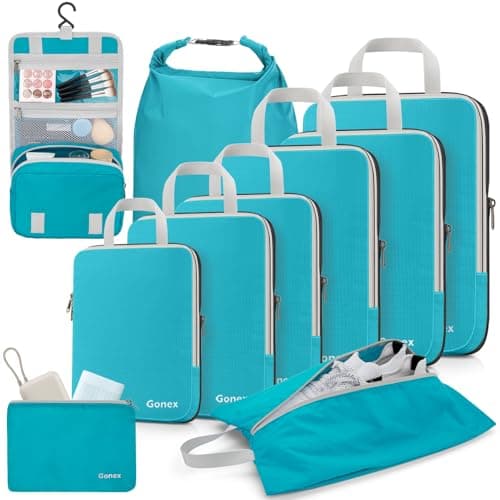
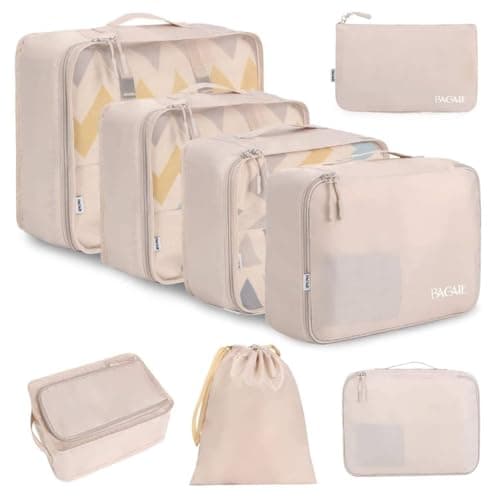
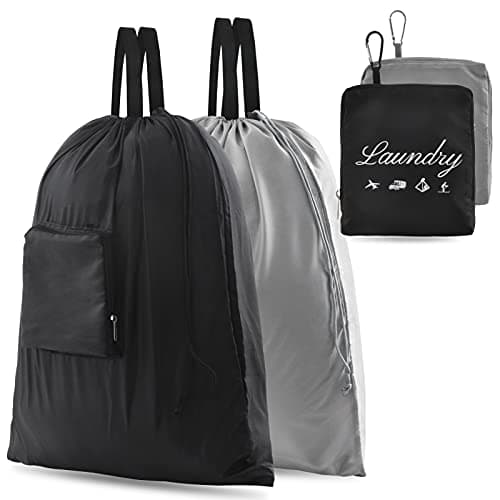
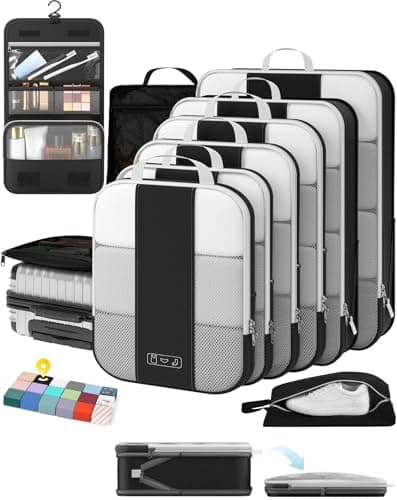
Buy the OlarHike 10-set compression cubes. For a house move it is the only pick here that solves both halves of the problem at once - enough separate containers to split a whole wardrobe by category, and a compression zipper on each one so the soft, lofted, worthless- but-bulky majority of your clothes stops eating van space. Add the Chestnut roll-up bags for off-season coats and spare bedding, and a pair of big laundry bags for moving day itself.
Why cubes beat boxes for the soft half of a move
Everything you own splits into two moving problems. Hard things - books, crockery, electronics - need a box, because a box protects and stacks. Soft things - clothes, bedding, towels, coats - need neither. Put them in a box and you get the three failures every move repeats: the box is enormous and still half air, nobody can tell which box holds what, and the one thing you need on night one is at the bottom of the heaviest one.
A cube fixes all three for soft goods specifically. It is sized to one category, so a label means something. It compresses loft, so the volume shrinks toward the actual volume of the fabric. And it goes straight into a drawer or onto a shelf at the other end without being unpacked at all, which is the part people only discover once they have done it - the cube you labelled “socks and underwear” is a drawer organizer the moment it arrives.
What compression does and does not do to a moving load
It removes volume. It removes no weight whatsoever. This is worth being blunt about, because a move is the one context where people get it badly wrong: a compressed cube of jeans is the same weight as the loose pile of jeans, it is just smaller and much harder to lift, because all of that mass is now concentrated in a block the size of a cereal box. Pack two medium cubes rather than one large one for anything dense - denim, towels, books that somehow ended up in the wardrobe - and leave the big cubes for knitwear, puffer jackets and bedding, which is where compression actually pays. Our guide on whether packing cubes add weight has the published empty weights our catalog carries.
What to look for, for a move specifically
- Piece count over piece quality. A move is a one-off volume event. Ten mid-priced cubes beat three excellent ones, because the thing you are buying is the number of labelled categories, not the zipper life.
- A visible or writable identity. Mesh tops, clear panels and colored sets all do the same job: tell you what is inside without opening it. If every cube in your set is identical grey nylon you have recreated the cardboard-box problem in nicer fabric. Our color-coded cubes page exists for exactly this.
- Compression only where loft exists. Compression acts on trapped air. Knitwear, coats, bedding and towels are mostly air and shrink dramatically. Jeans, shoes and folded shirts are already dense and barely move.
- Sealed bags for the long tail. Anything you will not open before next season belongs in a sealed roll-up bag, not a cube. A sealed bag is a terrible container to live out of and a superb one to store.
- Something unstructured for the last hour. Every move ends with a pile of things that were in use that morning. Two large laundry bags absorb it.
A room-by-room split that works
| What you are packing | Container | Why |
|---|
| Everyday clothes you need in week one | Compression cubes, one per category | Openable, labelled, and goes straight into a drawer |
| Knitwear, coats, puffer jackets | Largest compression cubes | Maximum loft, so maximum gain from the zipper |
| Out-of-season clothes | Sealed roll-up bags | You will not open them, and the seal keeps van dust off |
| Spare duvets, guest bedding, pillows | Largest sealed bags | The bulkiest, most compressible load in the house |
| Towels and bath linen | Mesh-top cubes | Dense, so compression adds little; visibility adds a lot |
| Cables, chargers, keys, paperwork | Pouches from a mixed kit | The things that get lost loose in a box for a month |
| Worn clothes and stripped bedding on the day | Large drawstring laundry bags | No structure needed; in last, out first |
| Damp towels, swimwear, cleaning cloths | Waterproof wet/dry bags | A drawstring bag wicks through onto everything else |
The mistake that costs the most
Packing the whole wardrobe into the biggest cubes available. It is tempting - fewer containers, less folding - and it produces four blocks so heavy that they get dragged rather than carried, which is how zippers fail and how backs go. The useful rule is to let the category decide the size, not the other way round: underwear and socks into small cubes, t-shirts and tops into mediums, only knitwear and bedding into the extra-larges. A mixed-size set exists for this reason, and a 10-piece set gives you the range to do it.
How we scored these five
Capacity for a move - total volume and piece count, judged against a whole-wardrobe job rather than a trip. Compression- how much the mechanism can physically remove, judged on the mechanism and not on any brand's percentage claim; we publish no compression percentage anywhere on this site because we have not measured one and the brands selling these do not publish a method. Sorting and labelling - whether you can tell what is in it without opening it. Durability - fabric and zipper, under loads heavier than a suitcase ever asks for. Value - live price against what it replaces in cardboard and in time. Our methodology states plainly that these are judgments from documented specs and listings, not measurements we took. We have not moved house with any of them.
Is this different from the big-cube page?
Yes, and it is worth saying which page you want. Best large packing cubes answers a capacity question inside a suitcase - the biggest single cube that still fits a case and still gets lifted. This page answers a different one: how to divide a wardrobe across a van, where there is no sizer, no weight allowance and no airline, and where the binding constraint is whether you can find and carry what you packed. Best packing cubes for checked luggage is the airline version of the same volume problem.
What we would actually buy for a one-bedroom move
The OlarHike 10-set for the wardrobe, one 12-pack of roll-up bags for the duvets and off-season coats, and two large laundry bags for the last sweep. That covers the soft half of a one-bedroom flat completely, and the cubes carry on being useful for every trip afterwards, which is more than any cardboard box manages. If you want to add one thing, add a set of pouches - the small-item loss rate in a move is the single most frustrating part of it, and mixed organizer sets are the cheapest fix.