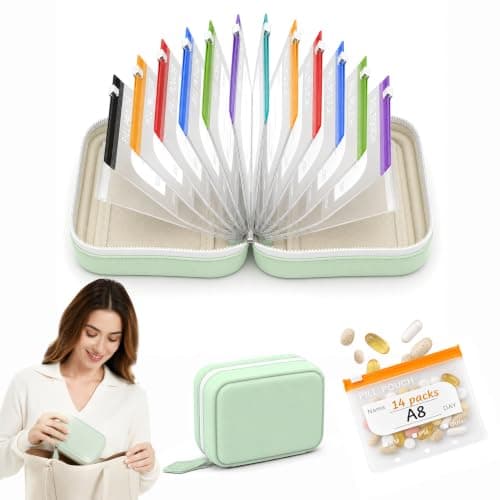
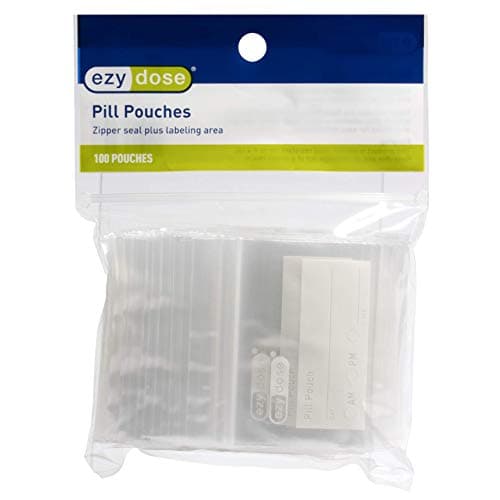
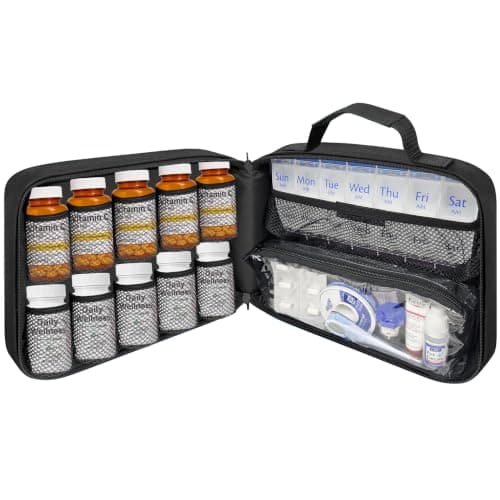
The verdict first. The StarPlus2 Large Pill Bottle Organizer & Medicine Bag is the one to buy if you take prescriptions, because it is the only container in our catalog that carries medication in the original labelled bottles — 10 bottle pockets plus 2 oversized, with lockable zippers. It is for the traveler whose medication list is long enough that re-sorting it in a hotel room is a bad idea. The budget pick is Ezy Dose Zippered Seal Pill Pouches, which publish 0.11 lb for 100 pouches and are, by a wide margin, the lightest way to carry medication anywhere.
And here is the distinction this page is built on, because it is the one the category never makes: a pill organizer and a medicine bag are not the same product. An organizer holds the pills. A medicine bag holds the bottles the pills came in. Only one product in our whole catalog does the second thing, and choosing it has a cost you can calculate.
What keeping your labels costs, in cubic inches
Multiply out the published outside dimensions of everything on this page and the gap is larger than anyone would guess:
- StarPlus2 bottle bag: 11 x 9 x 4.5 in published — roughly 446 cubic inches.
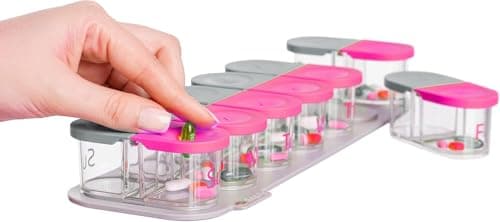
- Sagely weekly organizer: 12.5 x 3.75 x 1.5 in — roughly 70 cubic inches, the largest of the organizers.
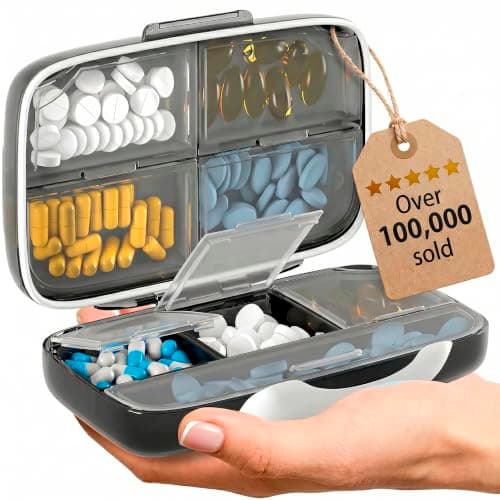
- BEXEEN airtight case: 5.7 x 3.93 x 1.77 in — roughly 40 cubic inches.
- Zannaki metal tube set (ranked on our pill organizer page): 6.5 x 1.77 x 1.77 in — roughly 20 cubic inches.
So the bottle bag occupies about six times the space of the largest organizer here and about twenty-two times the smallest. Those are our arithmetic on published outside dimensions — bounding boxes, not measured interior capacity — and they are the honest price of keeping a pharmacy label attached to the medication it describes. Whether that is worth a fifth of a small packing cube is your call, but it should be a decision rather than a surprise, which is what this page is for.
The weight finding, which runs the other way
Volume favours the organizers. Weight favours something else entirely, and the numbers are almost comic. Ezy Dose publishes 0.11 pounds for one hundred zip pouches — under two ounces for the whole box. The aluminium tube set publishes 0.42 pounds for seven tubes. Per day of medication carried, by our arithmetic, the zip pouch is lighter by roughly fifty times. Even the sturdy options are heavy next to it: the Sagely weekly organizer publishes 0.97 lb empty, which is more than the bottle bag's published 0.63 lb for a fraction of the capacity.
That is the second real decision on this page, and it is independent of the first. If you are weight-counting — one bag, a long trek, a strict cabin allowance — the correct container for pills is a labelled zip pouch and nothing else, and the only reason not to use one is crushing.
What each format actually protects against
Three risks, and the published features map onto them cleanly:
- Humidity. The quiet one, and the reason tablets go soft or chalky in a tropical climate. Exactly one product here publishes a mechanism against it — the BEXEEN case's silicone gasket. Nothing else in the category publishes a seal of any kind. Note that "airtight" is the listing's word and not a rating: no brand here publishes an ingress figure.
- Crushing. A rigid case solves it; a soft pouch does not. If anything you carry can be powdered, the zip pouch is the wrong container no matter what it weighs.
- Losing the information. The underrated one. A week of unlabelled pills in an eight-compartment box is fine until you are tired in a different time zone. The published answers, in descending order of reliability: the original bottle (StarPlus2), writable pouches (Funzooka, Ezy Dose), printed labels on a case (BEXEEN), or nothing.
One rule worth knowing, and the limits of what we can tell you
The TSA's published liquids rule — the quart-bag, 3.4-ounce-per-container rule — lists medications among its exemptions, which is why liquid medication does not have to compete for space in your quart-size liquids bag. That is the only regulatory fact on this page and it is quoted from the TSA page linked in Sources, read on the date given there.
Beyond that, we are a packing site and we will not pretend otherwise: we have no sourced information about what any airline, border authority or destination country requires of you, and we are not going to invent some. Check your airline and your destination directly, and talk to your pharmacist about anything that needs a letter, a cool chain or a controlled substance declaration. What this page can tell you is which container does which job, which is a question about products.
How we picked these, and what we could not check
Every pick above carried a live price and a buyable offer in our feed on the day this page was written, and the as-of date of that check is printed under the comparison table. No price appears in this text.
What we could not check, stated plainly. We have not handled these, weighed one, sealed one or left one in a humid room. Every dimension, weight, pocket count, compartment count and material above is the manufacturer's own published figure, read off the listing on the date in Sources. All cubic-inch figures and every multiple on this page are our arithmetic on those published outside dimensions, not measured capacity. The Funzooka listing publishes no empty weight, so it is absent from the weight arithmetic rather than estimated into it. "Airtight", "water-resistant" and "lockable" are the listings' words with no ratings behind them. Nothing here is medical advice, and our scores are judgments from published listings and documented research, which is what our methodology says in exactly those words.
Three questions, in the order that decides this.
1. Do the labels need to travel?
This is the fork, and nothing else matters until it is settled. If you want prescriptions in their original labelled bottles, exactly one product in our catalog does it and you should buy it and accept the volume. If you are content to decant, every other option opens up and you save something like five-sixths of the space. Decide this before you look at a feature list.
2. How many doses, and split how?
Count the actual doses for the actual trip. Eight compartments is a week once, not a week twice daily — a twice-a-day week needs fourteen, which is why the pouch formats exist. A weekly pod system suits someone in one place for seven days; removable pouches or rings suit someone moving, because you carry only the days you need.
3. Where are you going, and how much can you carry?
Humid destination: buy the one with a published gasket, because moisture is the failure mode nothing else here addresses. Weight-critical trip: buy labelled zip pouches, which are roughly fifty times lighter per dose than a tube set and pack completely flat. Both at once: pouches inside the gasketed case.
What not to buy
Do not buy on compartment count — a case with more small compartments is not better, it is just harder to read at 6am. Do not treat "airtight" as a rating: no brand in this category publishes an ingress figure, so it means a gasket exists, not that a figure was met. Do not put anything crushable in a soft pouch in a checked bag. And do not buy a bottle bag because it looks thorough if you only take one tablet a day — that is about a fifth of a small packing cube spent on a problem you do not have.