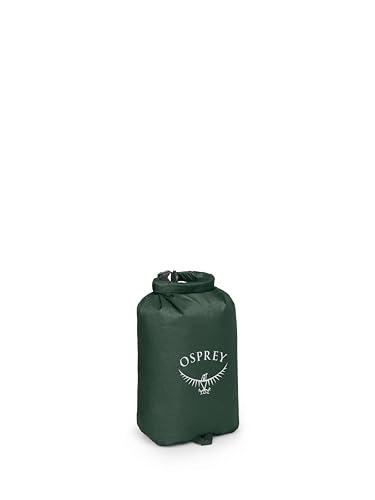
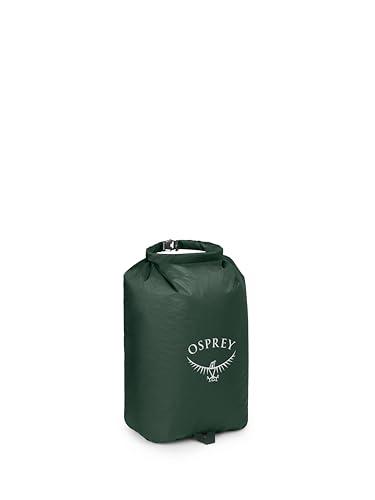
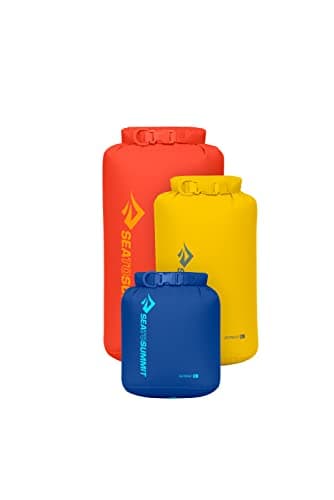
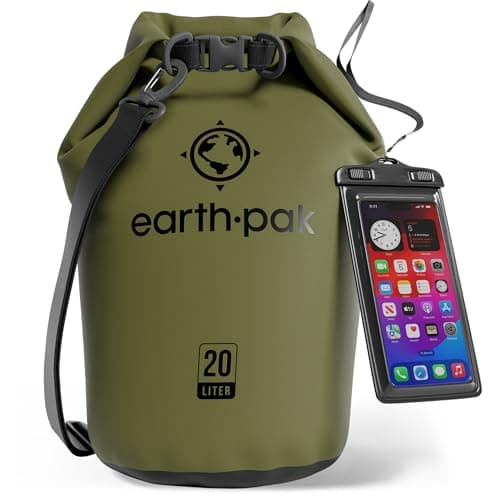
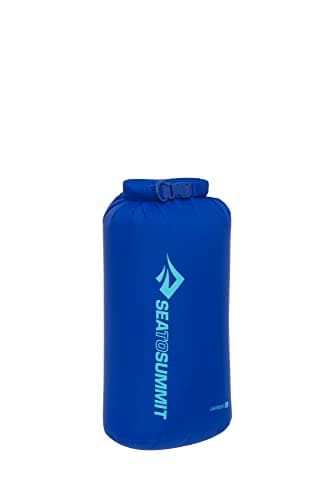
The short version. For one dry bag to travel with, buy the Sea to Summit Lightweight 8 L - taped seams, a Hypalon roll-top and a white interior coating published specifically so you can see what is inside, which is the detail that decides whether you keep using a dry bag. The budget pick is the Osprey Ultralight 6 L, which publishes an extraordinary 0.07 pounds empty and - unusually for this category - a rectangular shape meant for packing. If you want one bag for a day of clothes, the 12-liter version is the size to get; if you want to replace a cube set, the three-piece set is the only set here; and if your trip involves an actual boat, the Earth Pak 20 L is the heavy-duty answer.
Now the split that this whole search hides."Dry bag" is sold as one product and is really two, separated by an order of magnitude of empty weight. On one side, coated-nylon sacks that publish 0.07 to 0.15 pounds and are designed to shed rain. On the other, 500D PVC roll-tops at 0.85 pounds designed to be thrown around a boat. They look alike in listing photos and they are not interchangeable in either direction.
The weight arithmetic, which is the whole decision in one number
Three of the five picks publish an empty weight. The Osprey 6-liter is 0.07 lb, the Osprey 12-liter 0.1 lb, and Sea to Summit's 8-liter bag 0.15 lb by its own description - 0.32 pounds, about five ounces, for 26 liters of waterproof capacity. The Earth Pak 20-liter publishes 0.85 pounds on its own: more than two and a half times all three combined, for less total volume.
That is not a criticism of the PVC bag. It is the price of a material that survives being dragged across a deck, and no coated-nylon sack does that. But it does mean the choice is a genuine fork rather than a budget ladder:
- If the bag goes inside your luggage - which is what most travelers are actually buying for - weight and packability dominate, and the ultralight sacks win outright. Two or three of them cost a few ounces total.
- If the bag IS the luggage for part of the day - a boat transfer, a beach, a motorbike, a rafting trip - abrasion resistance and a shoulder strap dominate, and only the PVC bag has either.
The Sea to Summit three-piece set publishes no empty weight at all, so it is absent from that arithmetic rather than estimated into it.
The rating nobody on this page claims
This is the part most dry bag roundups get wrong, so it is worth being exact. Nothing on this page is published as submersible.
Osprey publishes a rating and states its limit in the same breath: IPX5, waterproof non-submersible. That means a jet of water or sustained rain, not a trip overboard. Sea to Summit publishes no IP rating at all for the Lightweight range - it publishes construction instead (PU-coated 70D nylon, DWR finish, double-stitched and tape-sealed seams, a Hypalon roll-top), which is informative in a different way but is not a number you can compare. And the Earth Pak bag's IPX8 figure belongs to the phone case in the box, not to the bag; the bag itself is described by its material and its roll-top seal.
The practical reading: a roll-top closure folded three or more times and clipped is extremely good at rain, spray, a wet towel and a leaking bottle. Treat full submersion as a thing you have not bought unless a listing says otherwise in a specific number - and if you need genuine submersion, that is a different product class again, with a welded seam and a published submersion depth.
A dry bag is not a packing cube, and it should not try to be
The reason this site keeps the two apart: a cube's value is a square footprint and a top-down view. It stacks against the walls of a case with no wasted corners, and you open it and see everything. A dry bag gives up both. It is a cylinder - or in Osprey's case a rectangle, which is why that detail is worth paying attention to - it closes blind, and you load it standing up and retrieve things by feel.
So the honest advice is to use dry bags for the three jobs where water genuinely appears in a suitcase, and cubes everywhere else:
- The wet item. A swimsuit, a towel, a rinsed shirt. One small sack sized to the item is all you need, and it goes home dry gear rather than damp clothes.
- Damp dirty laundry. A dry bag is the only container that stops day-four laundry wetting and scenting everything around it - which is also why travel laundry bags and dry sacks overlap, and the wet/dry split is worth reading about before buying either.
- Gear that must survive weather. A down jacket, electronics in a monsoon, a change of clothes on a trek, anything going on a boat.
For a full side-by-side of the two containers, including what each one costs you in bag space, packing cubes vs dry bags is the comparison; if what you actually want is a cube that resists water rather than a sack, best waterproof packing cubes is the page for that, and it is a genuinely different shortlist.
Capacity, and the number brands rarely explain
Dry bags are sized in liters, which is unhelpful next to a packing cube sized in inches. Useful anchors from the published figures on this page: 6 liters is a swimsuit, a towel and a shirt; 8 liters is two or three days of soft layers; 12 liters is roughly a large packing cube, which is a day or two of clothes plus a fleece; 20 liters is a day bag you carry rather than pack.
The complication nobody mentions is that a roll-top's capacity depends on how much of the top you surrender to the roll, and a closure needs at least three folds to seal properly. Sea to Summit is the only brand here that addresses it head on: it publishes that its stated volume is measured with the closure rolled three times, so the figure is what you actually get. Where a brand does not say, assume the stated volume is the unrolled maximum and that you will lose some of it to the closure.
How we picked these, and what we could not check
Every pick carried a live price and a buyable offerin our feed on the day this page was written, and the as-of date of that check is printed under the comparison table. No price appears in this page's text, because text does not update and a price written into a sentence is a claim that quietly rots. If a figure cannot be verified fresh, the number disappears and the button reads "check price" instead.
The criteria are build (named fabrics, named closures, seam construction, a published rating where one exists), weight (published empty weight, because this container competes with your clothes for allowance), usability (can you see inside, does it stand up, is the buckle replaceable), capacity and value, which the live price and the published piece count work out below.
What we could not check, stated plainly.We have not handled these bags and we have not put any of them in water. Every dimension, weight, denier, material and rating above is the manufacturer's own published figure, read off the listing on the date in Sources. The Sea to Summit 8-liter listing publishes twodifferent empty weights - 0.15 lb in its feature text and a slightly higher figure in its spec table - so we quote the lower published number and tell you the listing disagrees with itself rather than choosing one silently. The three-piece set publishes no weight. Earth Pak's five-year warranty and its 2024 Wirecutter mention are the listing's own claims, not terms or awards we verified. No submersion depth is claimed for any bag here because none is published. Our scores are judgments from published listings and documented research, which is what our methodology says in exactly those words.
Three questions, in the order that actually decides this.
1. Is the bag going inside your luggage, or is it the luggage?
This is the fork, and nothing else matters until it is settled. Inside a case, you are buying weight and shape: an ounce-and-a-half coated-nylon sack that rolls to nothing, ideally a rectangular one. Out in the world - a boat, a beach, a bike - you are buying abrasion resistance and a strap, which means PVC and roughly half a kilo of empty bag. Buying the wrong side of this fork is the only real mistake available in this category.
2. How wet is wet?
Rain, spray, a damp towel and a leaking bottle are what every bag here handles, and what the one published rating on this page (IPX5) covers. Being dropped in a lake is not, and no listing here claims it. If your honest answer is "it might go under", you want a welded-seam bag with a published submersion figure - a different product from anything ranked above, and worth the search.
3. One bag, or a set?
Most trips have exactly one wet item, and for those a single small sack is the whole answer. A set earns its keep when you are using dry bags as your organization system - on a trek, in a monsoon season, in a pack with no internal dividers - because then the sizes are doing the same work a cube set does on a suitcase trip. If you are packing a suitcase, start with one sack and a cube set rather than a dry bag set.
What not to buy
Avoid treating "waterproof" as a single property: ask what rating is published, and accept that most of this category publishes construction instead of a number. Be skeptical of an IP rating quoted in a bundle - on this page the only IPX8 figure belongs to a phone case included with a bag, which is not the same as the bag being rated. Do not buy a heavy PVC bag to pack clothes inside a suitcase: its empty weight is paid on every leg of the trip and its stiffness wastes space. And do not expect a dry bag to compress anything - a roll-top removes air as you roll it, which is not the same as the sustained squeeze of a compression bag, and the two are often confused.
The set-versus-singles question, settled by arithmetic
Best travel dry bags under $25 applies a live-price cap to this shortlist, and the cap turns out to exclude exactly one product — the three-piece set. Which is useful, because of what the published capacities then show: the 6-litre and 12-litre Osprey sacks bought separately are 18 published litres against the set's 16, for a combined price still below the set's, in two rectangular bags rather than three cylinders, with published weights and an IPX5 rating the set does not publish at all.