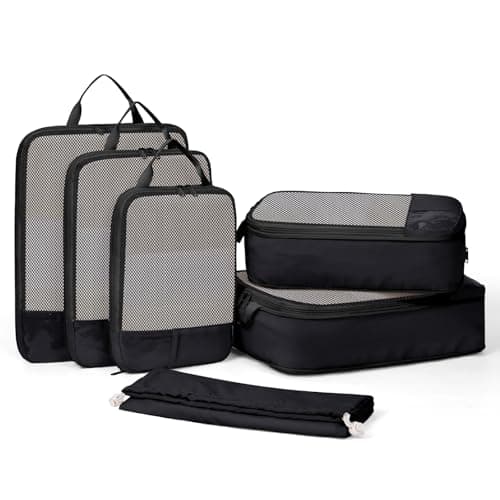
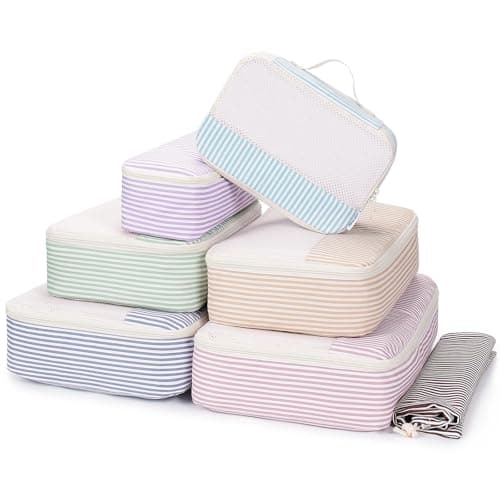
Narwey is the only budget cube brand on this site that competes on how the cubes look, and that is a more defensible strategy than it sounds. Every set in this price bracket is the same object: soft polyester, a mesh top, a zip, a few sizes. There is no meaningful spec war to win down here, because nobody publishes enough to have one. So Narwey stopped pretending and went after the one thing a cube can actually differentiate on at this price - being instantly recognizable - and sells sets in patterns while the rest of the aisle sells gray.
That turns out to matter in exactly one situation, and it is a common one. In a shared case, the failure is never space. It is ownership: four identical gray cubes in a family suitcase and nobody knows which holds the kids' socks. A patterned set answers that at a glance, with no labels, no colored tags, and no system to remember. It is, in effect, the cheapest color-coding system available, and it arrives pre-built.
Two things this review will not do. It will not tell you we packed with these - nobody here has, and our scores are judgments from published listings and documented research, which is what our methodology says in those words. And it will not print a cube dimension, because Narwey publishes none on these listings that we were able to read. That is worth its own section, below, because it is the single biggest limitation on buying this brand.
What is actually in the box
Narwey's cube range splits into two products, and the search results blur them together because the brand name and the word "cube" are doing all the work in both titles.
| Set | Pieces | Compression | Finish |
|---|
| Packing Cubes | 7 | No | Patterned fabric, mesh tops |
| Compression Packing Cubes | 6 | Yes - second zipper | Plain black |
Those are the only two decisions you have to make with this brand: do you want the patterns, or do you want the volume back. You cannot have both, because the patterned range is the plain-cube range. If the case closes comfortably, take the seven-piece set and the patterns. If it does not, take the compression six and accept plain black. Everything else in the brand's listing copy - cute, soft, durable, vivid, for women, for kids, for family travel - is positioning rather than specification.
What the listings do not publish, and why it matters here
We check availability and read the published specification off every listing before a product goes on this site. For Narwey's cubes on the day this page was written, the listings gave us a piece count, a mesh top, a fabric description and - on the compression set - a compression zipper and an expandable claim. They gave us no cube dimensions. Amazon served a reduced detail page to our fetcher for this whole category, so we have no figure for the largest cube, the smallest cube, or the depth of any of them.
We have not guessed one, and the reason to make a point of that is that this brand doespublish figures elsewhere. Narwey's makeup bag, which already sits in our catalog and is ranked on the makeup bag roundup, publishes a large size of 8.5 by 5.9 by 3.9 inches and an empty weight of 4 ounces. So the absence on the cube listings is a choice about those listings rather than a brand that never publishes anything, and it has a practical cost to you as a buyer: you cannot check these cubes against your case before you order them.
How much that matters depends on your bag. In a standard carry-on, usually quoted at about 22 by 14 by 9 inches with the exact figure varying by airline, a seven-piece set will physically fit regardless of how the sizes break down. In a slim personal-item bag or a panel-loading backpack, size is the whole question and buying blind is a real risk. If that is you, packing cube sizes explained is the page for working out what you need, and buying a brand that publishes its footprints is the safer move.
Seven cubes is a lot of cubes
The seven-piece count deserves skepticism, because piece count is the one number every budget brand competes on and it is the one that misleads most. Count is not capacity. Seven small bags are not more storage than four large ones, and a cube you pack half full is actively costing you space - the empty volume inside it is volume your case cannot use for anything else.
So seven is right for some people and wrong for others, and the dividing line is clean:
- Two or more travelers sharing a case.Seven is right. Three or four cubes each, visually distinct, ownership solved. This is the set's best case and it is a genuinely good one - the family roundup and the kids roundup rank this job against rivals.
- One traveler, one week or less. Seven is too many. You will use three and pack four half-empty, or leave four at home and wonder what you paid for. A three-cube set is the honest answer, and how many packing cubes do I need works it out by trip length.
- One traveler, long trip with laundry. Seven is defensible, because the spares become the dirty-clothes cubes and the rotation is real rather than imagined.
Where Narwey sits against the brands we rank
Plainly: Narwey is a budget Amazon-native brand, and it should be judged against the other budget Amazon-native brands rather than against Eagle Creek or Peak Design. Against Bagail, which is the default in this bracket, Narwey loses on published information and wins on identification - Bagail sells the same object in solid colors and publishes a little more about it. Against Veken and OlarHike, it is a genuine coin toss on everything except looks.
Against a premium set, the comparison is not close and not really a comparison. What a premium set buys is better fabric, a published footprint, sometimes a weatherproof shell, and in Eagle Creek's case a stated warranty. What it does not buy is more room in your case. If you travel constantly, that is money well spent; the premium roundup is the page for it. If you travel twice a year with your family, a patterned seven-piece set does the job you actually have.
Four questions decide whether this brand is for you, and two of them eliminate it immediately.
Do you need the sizes to be known before you buy?
If you are packing a slim personal item, a panel-loading backpack or any bag where a cube either fits the width or does not, buy a brand that publishes its footprints. Narwey's cube listings do not, and no amount of liking the patterns compensates for ordering a cube that is an inch too wide for the compartment it was bought for. In a standard carry-on this question does not arise.
Is the case already full?
If yes, nothing in the patterned range helps - plain cubes do not create volume. Take the compression six, or read compression vs regular packing cubes first to be sure compression is the tool you want, since it costs you creasing and buys you nothing on weight. If your problem is the scale rather than the zipper, do packing cubes add weight is the uncomfortable answer.
Is the case shared?
This is the question Narwey is built for. A shared case with identical gray cubes in it is a daily argument; a shared case with seven distinguishable ones is not. If you are packing for children, the patterns do a second job - a child can be told to get the clothes out of their own cube and will actually find it. The color-coded roundup ranks the alternatives, including solid-color sets that do the same thing more quietly.
Does it need to look serious?
If the cubes are coming out of a bag in front of colleagues, take the plain black compression set or buy a different brand. The patterned range is not trying to look discreet and does not. The business-trip roundup covers that case.
One practical note on using them
Soft-sided cubes with no structure reward being filled properly. A slumped half-full cube is the worst-value object in a suitcase, so pack fewer cubes fuller rather than more cubes lightly, and file garments on edge like books rather than stacking them flat so you can take one item without disturbing the rest - how to fold clothes for packing cubes has the method. For a short trip, the layout in how to pack a carry-on for 5 days uses three cubes and explains why a fourth is a trap.