Five days is the longest trip most people can pack without washing anything, and that single fact is what makes it a different problem from four days or seven. At four days the worn clothes barely accumulate. At seven, one sink rinse or one hotel laundry run resets the whole bag and the arithmetic restarts. Five days is the awkward middle: too long for the pile to ignore, too short for a wash to be worth the evening it costs. So the question stops being "how do I fit five days in" - you can, easily - and becomes where do five days of worn clothes go.
That reframing changes what you buy and how you pack. Most five-day advice is about compressing the clean side harder. It is aimed at the wrong half of the bag. The clean side of a five-day trip is small. The dirty side grows every day and ends up the biggest single block in the case, and if you have not given it a home, it ends up stuffed back into the cube the clean shirts came out of.
What actually fits: the five-day count
Below is a worked example, not a measurement, and the assumptions are printed with it so you can argue with them. It assumes one person, mild weather, a trip with no formal evening, and the clothes you fly in counting as day one - which is the single most commonly dropped term in this arithmetic and the reason so many five-day lists come out a garment too heavy.
| Item | Wash nothing | One sink rinse | Why |
|---|
| Tops | 4 | 3 | One worn on the flight, three packed. A rinse saves one, not two. |
| Bottoms | 2 | 2 | Worn one, packed one. Bottoms are the garment that reuses best. |
| Underwear | 5 | 3 | The only item where a rinse really pays, because it dries overnight. |
| Socks | 5 | 3 | Same logic. Socks are also the free gap filler - see below. |
| Layer / sweater | 1 | 1 | Worn or carried, never packed if you can help it. |
| Shoes | 2 pairs total | 2 pairs total | One pair on your feet, one packed. This is the big lever. |
The honest read of that table: the rinse column saves you about four small garments, and four small garments is roughly one cube's worth. If an evening at a sink is worth a cube to you, do it. If it is not, do not - at five days you genuinely have the room, and this is the last trip length where that is true. Our seven-day guide is where the rinse stops being optional, and the ten-day guide is where it becomes a planned event with a date attached.
The two-shoe rule, which beats every folding trick
A second pair of shoes is the largest single object most people put in a carry-on, and it is the only item on the five-day list whose count is genuinely optional. Cutting from three pairs to two frees more usable volume than compressing every garment in the bag, and unlike compression it costs nothing and risks nothing.
The rule that makes it survivable: wear the bulkiest pair and pack the flattest. Boots or sneakers go on your feet; the packed pair should be the one that folds, flattens or at least nests. If your five days contain exactly one event that needs a third pair, the honest trade is to ask whether the shoes or the event is the thing you are really committed to. Packed shoes belong in a bag of their own either way, not loose against clothes - how to pack shoes with packing cubes covers where they sit in the case, and the shoe bag roundup ranks the bags.
The three-cube layout
Five days wants three cubes, not four, and the reason is behavioral rather than geometric. A fourth cube on a five-day trip gets filled, because an empty cube in your hand is an invitation, and what it gets filled with is the "just in case" layer you will carry both ways unworn. Three cubes forces the count above to stay the count above.
| Cube | Contents | Where it sits |
|---|
| Medium | Tops - all four, filed on edge | Floor of the case, against the wheel side |
| Small | Bottoms and the one layer | Beside the medium, filling the width |
| Extra small | Underwear and socks | Top layer, or tucked into the lid pocket |
| No cube | Worn clothes, as they accumulate | A laundry bag, hung up - not back in a cube |
Two notes on that layout. First, file the tops on edge, like books on a shelf, rather than stacking them flat - on a trip this short you are living out of the case and you need to be able to take the third shirt without lifting the two above it. The method is in how to fold clothes for packing cubes. Second, socks are deliberately in the smallest cube and treated as loose gap filler: a pair of socks is the only thing in the bag that will go into the hollow of a shoe or the gap beside a toiletry bag without being wasted there.
Why the dirty side is the whole game at five days
By the last morning of a no-laundry five-day trip, the worn pile is four tops, one or two bottoms, five sets of underwear and five pairs of socks. That is more volume than any single cube you packed, and it has to go somewhere that is not touching the clean clothes. The three ways people solve it, honestly ranked:
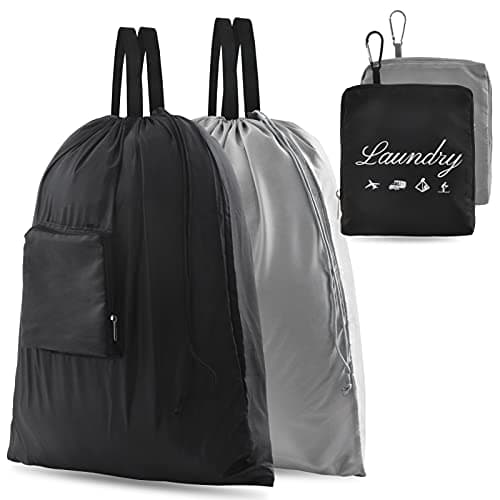
- A dedicated laundry bag. The right answer. It holds the full pile, it hangs out of the way, and it keeps the clean cubes clean so that packing on the last morning takes two minutes instead of twenty.
- An emptied cube. Works, but it contaminates the cube, and a cube is not big enough for five days of worn clothes anyway - you will be on your second by day four.
- The hotel laundry bag. Free and usually present, and genuinely fine for a single trip. It is paper-thin, it has no handle, and it will not survive the flight home in one piece, which is why it is third.
Whichever you choose, the rule is the same: decide before you go. The failure mode is not running out of space, it is arriving with nowhere designated and defaulting to the cube. Our how to pack dirty clothes guide covers the separation properly, and the laundry bag roundup ranks the bags themselves, including lined ones for wet kit.
Liquids, and the phrase on the packaging that is not real
Five days of toiletries fits inside the carry-on liquids rule without any cleverness, which is the quiet reason five days is such a comfortable carry-on length. TSA publishes the limit as travel-sized containers of 3.4 ounces (100 milliliters) or less per item, carried in a quart-sized bag. Note what is notin that: TSA publishes a capacity for the bag, not a dimension, and it does not approve or certify any brand of liquids bag. "TSA approved" printed on a pouch is a seller's phrase, not a status - the same thing is true of cubes, which are packing cubes TSA approved goes through in full.
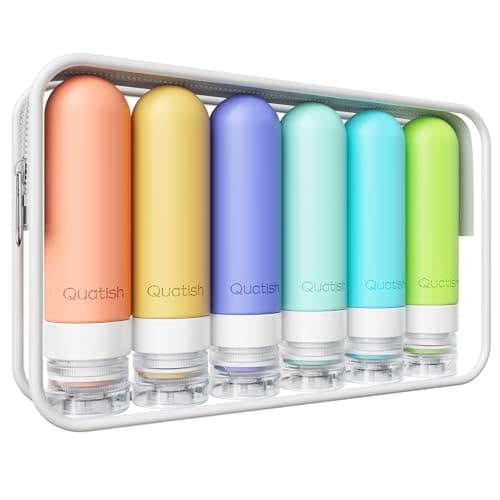
Practically: decant into 3-ounce bottles, put them in one clear quart bag, and keep that bag at the top of the case or in an outside pocket so it comes out at security without unpacking. Which bag to use is a real decision with real trade-offs - the clear toiletry bag roundup ranks the shapes - and how to pack liquids in a carry-on covers the rest of the rule, including what is exempt.
The bag itself
A standard US domestic carry-on sizer is usually quoted at about 22 by 14 by 9 inches, and that figure varies by airline - some are tighter, several budget carriers are tighter still, and the only number that matters is the one your carrier publishes. Check it before you buy a case, not after. Usable interior is always less than the exterior: wheel wells and the handle tubes take a bite out of the floor, which is why the medium cube goes against the wheel side where the floor is already uneven.
Five days does not need a bigger bag. If your five days are not fitting, the cause is almost always the shoe count or an unworn "just in case" layer, not the case - and how to pack light is the page for that argument. If you are working with a backpack rather than a roller, how to pack a backpack with packing cubes has the loading order, since a pack has two soft limits where a case has one hard one.
What to buy for five days, in the order the trip actually needs it - which is not the order most lists put it in.
1. Somewhere for the worn clothes
This is first because it is the thing five days specifically breaks, and it is the cheapest item on the page. A bag sized for the full trip, with a handle so it hangs. Skip this and you will contaminate a clean cube by day three.
2. Three cubes, in the right three sizes
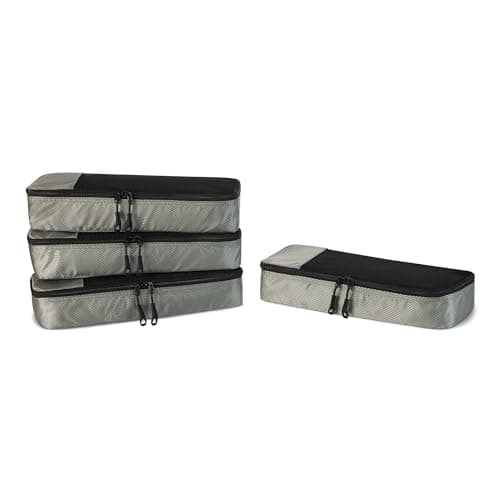
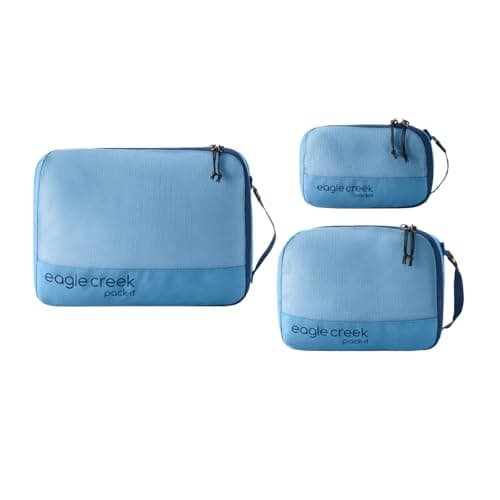
Not a set of six, not a set of ten. Three. A medium for tops, a small for bottoms, an extra-small for underwear and socks. A three-cube set is the clean way to buy that; a four-piece slim set is the cheap way, with the fourth held back for worn clothes until the laundry bag takes over. Count is not capacity, and how many packing cubes do I need works that out by trip length if you want the general case.
3. Bottles, if you are carry-on only
Five days of liquids decanted into 3-ounce bottles, in one clear quart bag. If you are checking a bag, skip this entirely and take the full-size bottles.
4. Nothing else
Specifically: no compression on a five-day trip. Compression is a tool for a bag that does not close, and at five days your bag closes. It also buys volume and never a gram, so if weight is your constraint it does nothing at all - compression vs regular packing cubes has the full comparison, and the weekend roundup ranks sets for anything shorter than this.
If your five days have two contexts
A five-day trip with a wedding, a conference day or a hike in it is not a five-day trip - it is a four-day trip plus a module. Pack the four days to the count above, then add the smallest complete module for the exception: one outfit, one pair of shoes, nothing speculative. The mistake is packing two wardrobes. The business-trip roundup covers the collared-shirt version of that module, and how to pack a suit covers it if the module is tailoring.
Two days shorter, and the bag changes
Five days is the length where the worn pile needs a home of its own. Three days is the only length where an emptied cube genuinely still takes it - and where the honest advice is that you probably do not need a carry-on at all, because three days fits a personal item. How to pack a carry-on for 3 days has that arithmetic, and the two rigid objects that decide a small bag.