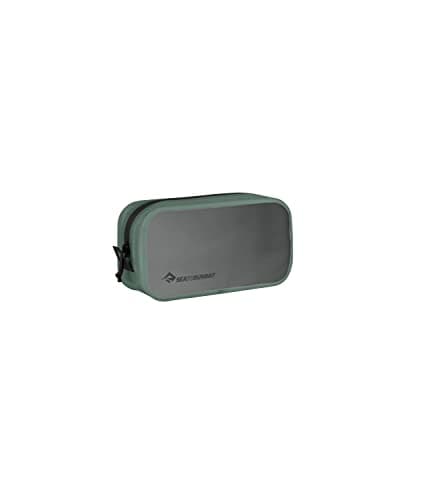
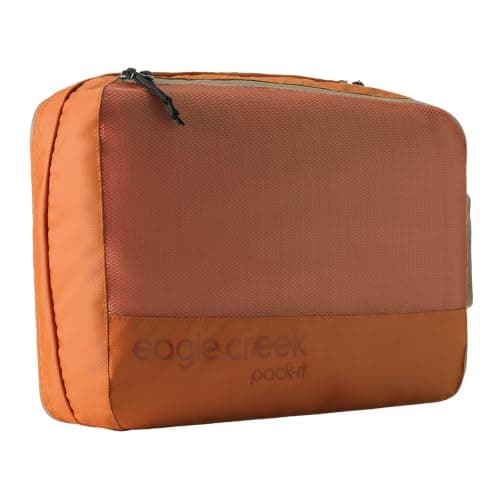
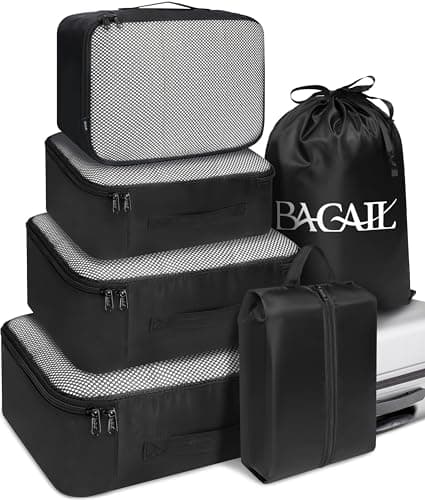
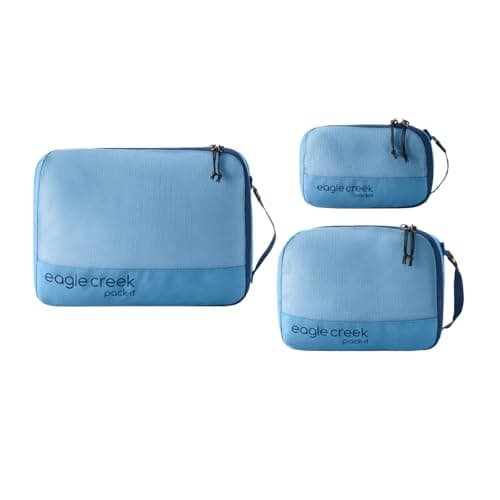
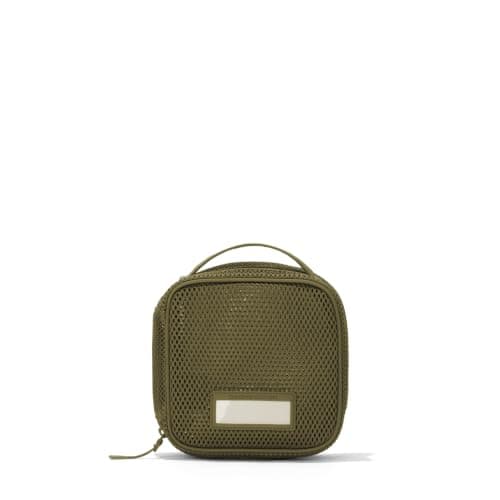
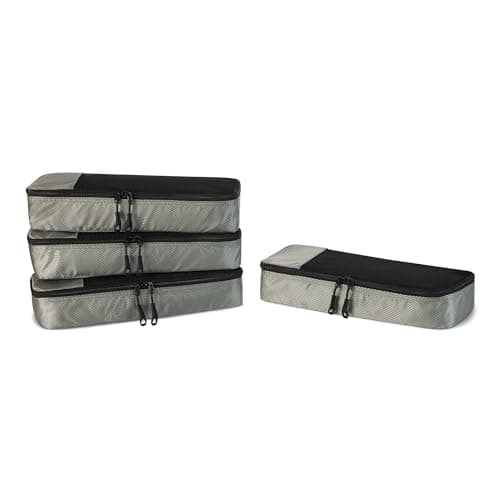
The short version. The best cube for socks and underwear for most people is the Amazon Basics 4-piece slim set, because a shallow cube holds these items in one or two layers instead of burying them three deep - that is the right answer for anyone whose complaint is digging. If you already own cubes and only need the small one, the Sea to Summit Hydraulic 1.5 Lis sold singly and publishes a capacity that happens to be about a week's worth for one person. The budget pick is the Bagail 6-set - the cheapest set here that includes a small cube, and six pieces lets you run two small cubes as a free clean/dirty system.
Socks and underwear are not a smaller version of the general packing problem. They are a different problem, because they are the only clothes you replace every single day. That changes what the container has to do. A shirt cube is packed once and opened twice. A sock cube is opened every morning, in a hurry, usually in bad light, and by day three it is holding a mixture of clean and worn. Compression is irrelevant - these items are already the densest, smallest things in the bag. Retrieval and separation are the whole job, and the ranking above is built on those two.
Why a deep cube is the wrong shape
This is the mistake almost everyone makes, including people who otherwise pack well. The instinct is to put all the small things in one cube, which produces a deep cube holding three or four layers of rolled socks - and a stack that deep has a geometry problem: you can only see the top layer, so finding a specific pair means lifting out everything above it onto a hotel bed. A shallow cube holding one or two layers shows you everything it contains the moment it is unzipped. That is why the slim set leads this page and why a single large cube, however good, does not.
The second-order effect is about the case rather than the cube. Shallow cubes stack predictably in the flat space under a suitcase lid, which is dead volume in most packing plans - how to pack a suitcase with packing cubes covers the layout, and what to pack in each cube has the full allocation. If you want the sizing argument on its own terms, the small-cube roundup ranks on footprint rather than on this job.
The half of this problem nobody writes about: worn pairs
By the third morning of any trip, the cube that held clean socks and underwear is holding some clean and some worn, and there is no good way to tell them apart by sight. People solve this badly - a plastic bag, a hotel laundry sack, or worst of all by simply putting worn pairs back among the clean ones and relying on memory.
There are exactly three honest solutions, and they cost very different amounts.
| Solution | How it works | Cost | Honest limit |
|---|
| Two small cubes | One starts full, one starts empty. Worn pairs move across. | Free if your set has two small cubes | Two similar cubes in a case get confused in a hurry |
| A divided clean/dirty cube | Two zipped compartments in one cube - the piles physically cannot mix. | Premium, for one cube | Holds a few days of worn pairs, not a fortnight |
| A separate laundry bag | All worn clothes, not just these, in one sealed or vented bag. | Low | It is a second item to carry and it does not keep the clean side organized |
For trips up to about five days the divided cube is the neatest answer and the two-cube trick is the cheapest. For anything longer, you want real laundry capacity - travel laundry bags ranks those, cube sets with a laundry bag bundles both, and how to pack dirty clothes is the method including the ventilation point that catches people out.
How we ranked these, and what we could not check
Five criteria: retrieval (can you find one pair without unpacking the cube), shape fit (does the depth suit flat small items), build (fabric, closures, published claims), separation (does it deal with worn pairs) and value, which the live price and the published piece count work out for you below.
What we could not check, stated plainly.Only one pick here publishes a footprint - the Eagle Creek clean/dirty cube at 14 by 10 by 4 inches and 0.34 pounds empty, quoted in the brand's own figures. The Sea to Summit cube publishes a 1.5 litre capacity but no inch dimension, and for the Amazon Basics slim set, the Bagail set, the Reveal XS and the Dagne Dover shell we could read no dimension at allon the listings served to us, so none is printed. That is a real limit: "slim" and "small" are marketing words until a number is attached. Packing cube sizes collects the figures that do exist. We have not packed with any of these; our scores are judgments from published listings and documented research, which is what our methodology says in those words.
Three questions, and the first one costs nothing to answer.
1. Do you already own cubes?
If yes, do not buy a set. Buy one small cube, or use two small cubes you already have as a clean/dirty pair. Individual packing cubes covers the buy-one-cube decision and the arithmetic on when it beats another box.
2. How long is the trip?
Under about five days, a divided cube or two small cubes handles the worn pile completely and you need no laundry bag at all. Beyond that the worn pile outgrows any cube and wants its own container. How many packing cubes do I need has counts by trip length.
3. Does anything go in damp?
Hand-washed socks and underwear are the single most common damp item in a suitcase, because a hotel sink is the easiest laundry there is. If that is your pattern, the water-resistant and dust-resistant picks matter and a plain polyester cube does not - and a sealed compartment is the wrong answer, because damp fabric in a sealed cube is still damp two days later. Vent it instead: mesh cubes and how to pack dirty clothes both deal with this.
What not to buy
Do not buy a compression cube for this job. Socks and underwear are already the densest items in the bag; there is almost no air in a rolled pair to squeeze out, so the second zipper adds cost and weight for essentially no volume gain - and a compressed small cube is harder to search, which attacks the one thing this cube is for. Do not buy one big cube for all small items: a wash kit, chargers and socks in one container is three different problems in one box, and each has a better container. Tech organizers and toiletry bagsare those. And be wary of any cube described only as "small" with no figure behind it.