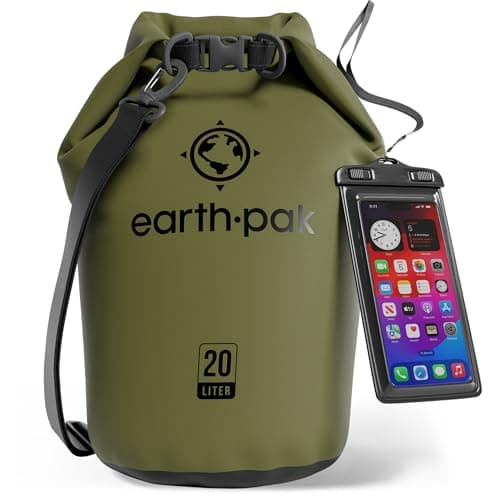
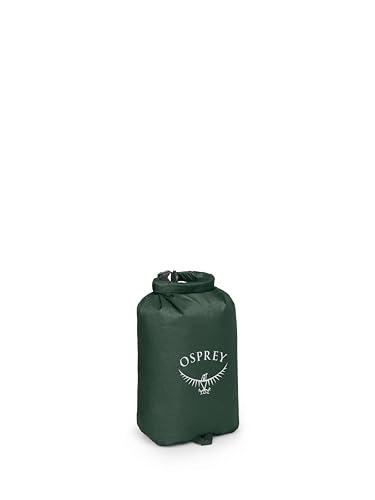
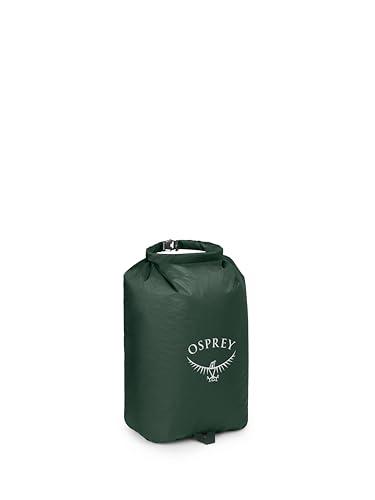
The verdict first. Under a hard live-price ceiling of $25, the Osprey Ultralight 12 L Waterproof Dry Sack is the best buy — a published 0.1 pounds for 12 liters, the lowest empty weight per liter in our catalog, in a shape Osprey publishes as rectangular so it stacks against a case wall instead of leaving corners. It is for the traveler packing a dry bag inside luggage. The budget pick is the Osprey Ultralight 6 L, which at a published 0.07 pounds is the lightest container of any kind in our catalog. If the bag needs to be carried rather than packed, the Earth Pak 20 L is the best cost per liter on the page and the only pick with a shoulder strap.
And here is the finding that makes this cap worth publishing, because it is a fact about the ceiling rather than about any one bag: the only thing $25 excludes from this category is the bundle — and the bundle is the one thing in it that is not worth buying.
The arithmetic that kills the three-piece set
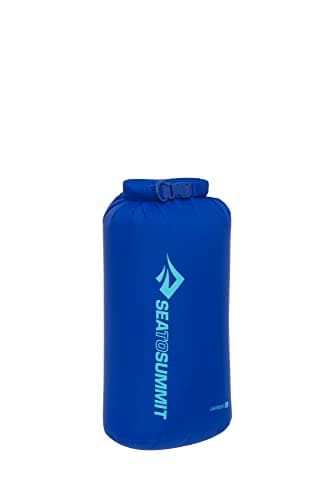
One product in our dry-bag catalog sits above the ceiling: the Sea to Summit Lightweight Dry Bag 3-Piece Set, published as 3 L, 5 L and 8 L — 16 published liters in total. Now put that next to what the cap leaves you:
- Buy the Osprey 6 L and the Osprey 12 L separately and you have 18 published liters — two more than the set — for a combined live price that is still comfortably below the set's single price. The figures are in the table above with the date they were checked.
- You also get two rectangular bags instead of three cylinders, which pack better in a square case, and a published IPX5 rating that the set does not publish at all.
- And you can weigh what you are carrying: Osprey publishes 0.07 lb and 0.1 lb. The three-piece set publishes no empty weight whatsoever.
Run it per liter and the ranking is unambiguous. By our arithmetic on published capacities and live prices, the Earth Pak 20 L comes in under a dollar per liter, the Osprey 12 L is the best of the ultralights, and the three-piece set is the worst value per liter in the entire category — which is the opposite of how bundles are supposed to work. Dry-bag sets are sold on the assumption that three sizes beat one; the published numbers say that in this catalog, two singles beat three bundled.
Which leaves one real decision, and it is not price
Everything under this cap is cheap. So the decision reverts to the question that actually matters in this category, and it is a fork rather than a ladder: is the bag going inside your luggage, or is the bag the luggage?
Inside your luggage — which is what most people are buying for — weight and shape dominate. The two Osprey sacks publish 0.07 lb and 0.1 lb; carrying both costs you under three ounces, and they are rectangular. That is the answer, and it is not close.
The bag is the luggage — a boat transfer, a beach day, a motorbike, a rafting trip — and abrasion resistance and a strap dominate. Only the Earth Pak bag has either, and it charges a published 0.85 lb for them, which is more than eight times the Osprey 12 L. Both halves of that are honest: it is far too heavy to pack clothes in inside a suitcase, and it is the only thing here you could sling over a shoulder in the rain.
The rating nobody under this cap claims
This is where cheap dry bags get misread, so it is worth being exact. Nothing on this page is published as submersible.
Osprey publishes a rating and states its own limit in the same breath: IPX5, waterproof non-submersible — sustained rain or a jet of water, not a trip overboard. Sea to Summit publishes no IP rating at all for the Lightweight range; it publishes construction instead, which is informative in a different way but is not a number you can compare. And the IPX8 figure in the Earth Pak box belongs to the phone case included with the bag, not to the bag itself.
The practical reading: a roll-top folded three or more times and clipped is extremely good at rain, spray, a wet towel and a leaking bottle — which covers essentially every reason a traveler buys one. If you genuinely need submersion, that is a welded-seam bag with a published depth, and nothing in this catalog is one at any price. The full construction comparison, including what we could not verify, is in best travel dry bags.
What a cheap dry bag still is not
A roll-top is not a packing cube and it should not try to be. A cube's value is a square footprint and a top-down view; a sack gives up both — it closes blind and you retrieve things by feel. The Osprey sacks are the partial exception because they publish a rectangular shape, which is exactly why they rank where they do.
So use dry bags for the three places water actually appears in a suitcase — the wet item, damp dirty laundry, gear that must survive weather — and cubes everywhere else. If what you want is a cube that resists water rather than a sack, best waterproof packing cubes is a genuinely different shortlist. And a dry bag does not compress anything: rolling the top expels air, which is not the sustained squeeze of a compression bag, and the two get confused constantly.
How we picked these, and what we could not check
The rule for this page is mechanical: a bag qualifies only if our live price feed showed it under $25 with a buyable offer on the day the page was written, and the as-of date of that check is printed under the comparison table.
What we could not check, stated plainly. We have not handled these bags and we have not put any of them in water. Every capacity, dimension, weight, denier, material and rating above is the manufacturer's own published figure, read off the listing on the date in Sources. Every cost-per-liter and weight-per-liter figure is our arithmetic on those published numbers and the live price, not a published specification. Two honest gaps: the Sea to Summit 8 L listing publishes two different empty weights — 0.15 lb in its feature text and a slightly higher figure in its spec table — so we quote the lower published number and tell you the listing disagrees with itself; and the three-piece set publishes no empty weight at all, so it is absent from the weight arithmetic rather than estimated into it. Earth Pak's abrasion-resistance claim is its listing's word. No submersion depth is claimed for any bag here because none is published. Our scores are judgments from published listings and documented research, which is what our methodology says in exactly those words.
Three questions, in the order that decides this under a cap.
1. Inside the luggage, or is it the luggage?
The fork, and nothing else matters until it is settled. Inside a case you are buying weight and shape, and the two Osprey sacks publish a tenth of a pound or less each — carrying both costs under three ounces. Out in the world you are buying abrasion resistance and a strap, which means PVC and a published 0.85 lb of empty bag. Buying the wrong side of this fork is the only real mistake available here.
2. One bag, or sizes?
If you want sizes, buy them as singles rather than as a set — that is the whole finding of this page. Two Osprey sacks give 18 published liters for less than the 16-liter three-piece set costs, in a better shape, with a published rating and a published weight the set does not provide. Bundles are usually the value play in this category and here they are the opposite.
3. How wet is wet?
Rain, spray, a damp towel and a leaking bottle: everything here handles that, and the one published rating on the page (IPX5) covers it. Dropped in a lake: nothing here claims it, and the only IPX8 figure in the group belongs to a phone case that comes in a box with a bag. If your honest answer is "it might go under", you want a welded-seam bag with a published submersion depth — a product this catalog does not contain.
What not to buy
Do not buy the three-piece set: it is above this cap, it holds less than two singles that sit under it, it costs more, and it publishes no weight. Do not buy a heavy PVC bag to pack clothes inside a suitcase — you pay the empty weight on every leg and the stiffness on every corner. Do not read "waterproof" as a single property: ask which rating is published, and note that most of this category publishes construction instead of a number. And do not expect a roll-top to compress anything; if space rather than water is the problem, that is a compression bag.