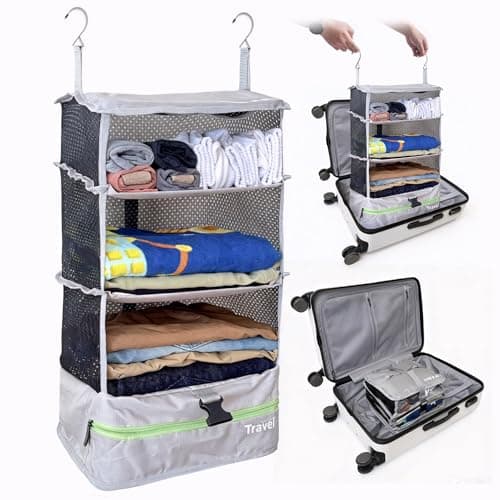
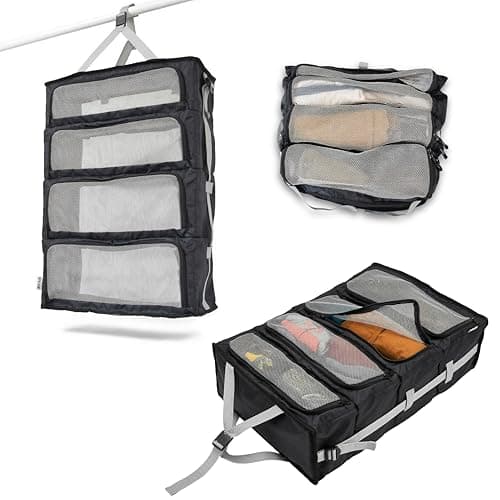
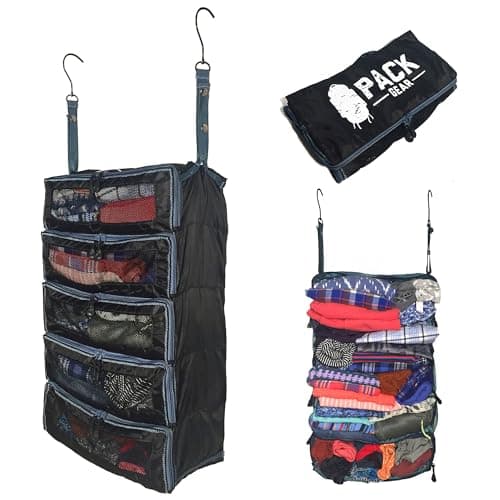
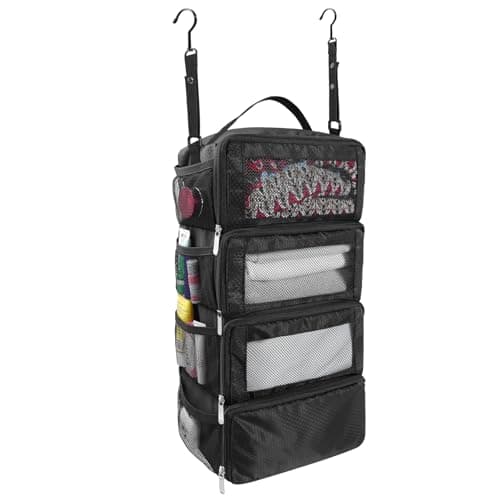
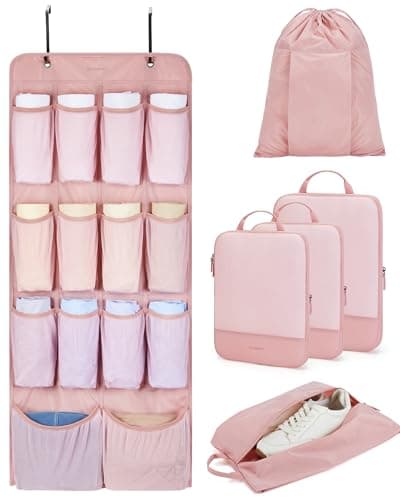
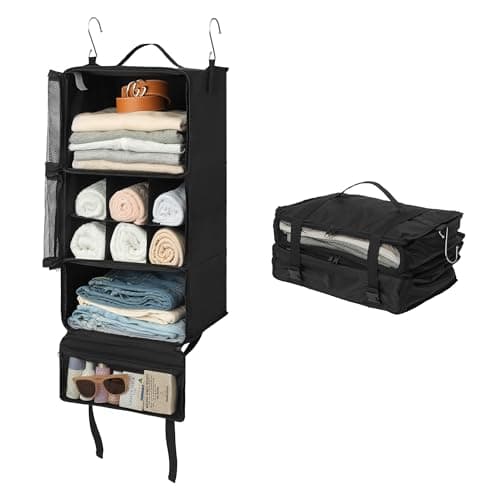
A hanging packing cube is the ordinary idea with one extra move: it goes into the suitcase flat and comes out as a small closet. Unzip it, hook it over the rail, and the clothes you folded at home are already on shelves — no unpacking, no living out of a case on the floor, no digging to the bottom on day four. For a hotel week or a cruise cabin that is a genuinely good trade. It is also a trade: these organizers cost you suitcase volume, they need something to hang from, and they do not create space no matter what the listing photo implies. Here is the honest version, ranked on what the manufacturers actually publish.
The three shapes sold under one name
"Hanging packing cubes," "hanging travel shelves" and "suitcase organizer" get used interchangeably on Amazon, but you are choosing between three different objects:
- Shelf columns. A stack of fabric shelves with hooks at the top that packs as one block and hangs as one piece. The Grand Fusion Stow-N-Go, the Olosar and the Pack Gear are all this shape — most closet-like in the room, least cube-like in the bag.
- Compressible hanging cubes. These pack like an oversized cube, cinched down with buckles and wraparound straps, then open on hooks into compartments at the other end. GRANNY SAYS and AMOGIE build this shape. It is the better compromise when the case is tight.
- Hybrid kits. Ordinary compression cubes bundled with a separate tri-fold hanging shelf, like the six-piece BAGSMART set. You get both tools, and you carry both.
The honest tradeoff: you are buying unpacking time, not space
A hanging organizer has walls, shelves, mesh panels and a hook assembly, and every one of those occupies room your clothes used to have. A regular packing cube costs you a couple of millimeters of fabric around each bundle; a shelf column costs you a whole vertical slice of the case. What you get back is not volume. It is the ten minutes at check-in to each hotel, and the not-rummaging for the rest of the week.
Some of these do compress. GRANNY SAYS states that its strap-and-buckle system saves up to 60 percent of suitcase space, and AMOGIE advertises built-in compression. Those are the manufacturers' claims, taken from their own listings, and we have not measured either — we do not run a testing lab, and our methodology says so plainly. What the published numbers do tell you is which organizers fold flat when empty and which keep their bulk.
If space rather than access is your real problem, this is the wrong category and we would rather say so: compression is the tool that shrinks a load, and compression packing cubes or travel compression bags do that for less money and less carried weight.
How we ranked them
Five criteria, in this order of weight. Capacity — the listed dimensions against the case you would realistically put it in. Hotel usability — what it hangs from, because a single fabric loop and a pair of steel hooks are not the same product. Packs flat — whether it collapses when empty or takes its full footprint home with it. Build — fabric, coating and stitching as described in the listing. Value — price against the footprint you actually get.
Every score is a judgment from documented specs and listing detail, not a measurement we took, and every dimension on this page traces to the product's own Amazon listing — each one is named in Sources at the bottom. Prices come live from Amazon and are date-stamped, so nothing here anchors you to a number that expired last month.
Who should skip these entirely
- Backpackers and ultralight packers. Half a pound to a pound and a half of empty organizer is a poor trade in a 40-liter pack, and hostels rarely hand you a closet rod. Ultralight cubes are the better answer.
- One and two-night trips. You will not unpack anyway, so you are carrying shelves you never hang. A small weekend set wins.
- Anyone whose case already shuts with effort. This category adds structure, and structure is volume. If you are at the zip today, a hanging organizer will make you leave something at home.
Hanging organizers also earn their place somewhere with no suitcase involved at all: a dorm closet, which is tall, narrow and shelf-free by design. Best packing cubes for college ranks them for that job alongside the move-in sets.
The buyer's guide: what to check before you click
Measure the inside of your case, not the outside
A 22-inch carry-on is an exterior figure that includes the wheels, the handle housing and the shell. The usable interior is smaller, and the handle tubes usually steal a strip down the middle of one side. Open your case, lay a tape measure inside it, and write down the height and width you actually have. Then compare: the Olosar Small is listed at 9.2 by 7 by 19 inches and slides into most cabin bags, while the AMOGIE at 17 inches and the Pack Gear Large at 22.5 inches are sized for bigger cases. Sizing failures are the most common reason these organizers get returned, and two minutes with a tape measure avoids the whole problem.
Decide what you will actually hang it from
Look at the hardware in the listing photos before anything else. A single fabric loop needs a hook that is already there. A pair of rigid hooks will go over a closet rod or a door top. A swivel or 360-degree hook, like the one on the Olosar, lets the unit turn flat against a door instead of twisting on itself. Rooms vary more than you expect — some cruise cabins and older hotels give you a shallow rail or fixed hangers rather than an open rod — so the organizer that can hang from a door top as well as a rail is the safer buy.
Count the compartments, then check which ones close
Four compartments with mesh windows sounds identical from listing to listing. What differs is whether any of them are enclosed. An open shelf is for clean, folded clothes; a zippered or covered section is where worn clothes go, and without one you end up laying a damp shirt on a clean stack. The GRANNY SAYS and the Olosar both describe an enclosed section at the bottom for exactly this. If yours does not have one, pack a travel laundry bag alongside it and keep the two apart.
Empty weight is not free
The listings here run from just over half a pound to about a pound and a half before you put a single shirt inside. In a checked bag nobody notices. In a weighed cabin bag — and plenty of carriers weigh them — that is a pair of shoes you now cannot bring. Weigh that tradeoff honestly, especially if you already travel with a full cube count.
It replaces some of your cubes, not all of them
A hanging organizer handles folded clothes well and small loose items badly. Underwear, socks, chargers and the odds and ends still want a small cube, which is why the sensible setup is one hanging unit plus one or two small cubes rather than a full swap. What to pack in each cube divides the load the same way, and how to pack a suitcase with packing cubes covers where the heavy block should sit once the organizer is in.
The short version
For most people the GRANNY SAYS XL is the buy: it packs like a cube and hangs like a shelf. Want the real drawer-unit experience? The Grand Fusion Stow-N-Go. Want it to stay square when full? The AMOGIE. Packing a checked bag for two weeks? The Pack Gear Large. Testing the format for the least money? The Olosar Small. Sailing, and starting from nothing? The six-piece BAGSMART kit. And if reading this has convinced you the whole category costs more volume than it saves you time, that is a perfectly good conclusion — the main packing cube ranking is where to go next.
Before you buy one of these
Hanging organizers are worth it on one trip shape and a waste on three others, and the cost side is real - they are the largest empty containers in this category. Are hanging packing cubes worth it states the trade plainly, names the four nights in one room break-even point, and sets the format against ordinary cubes side by side.